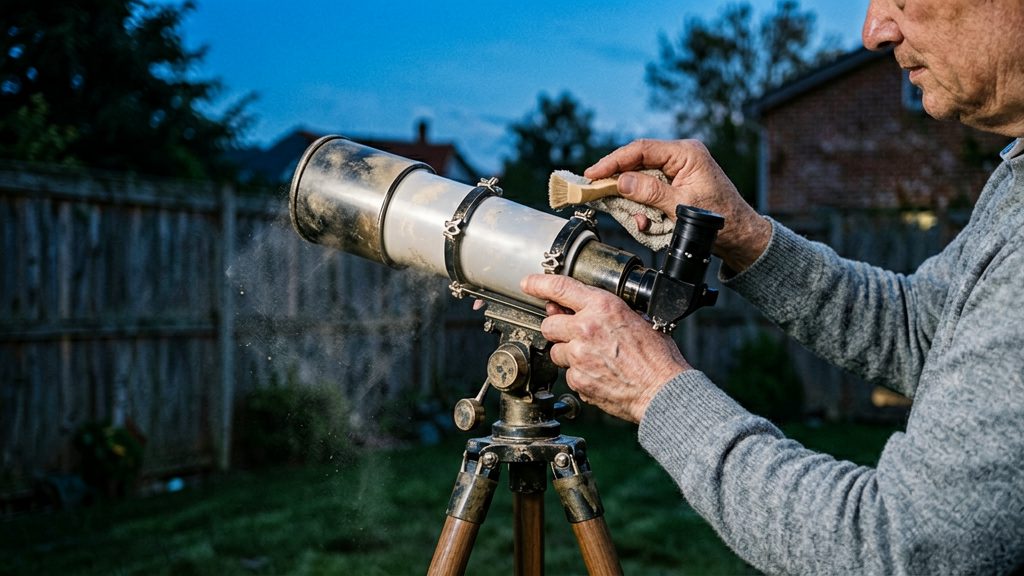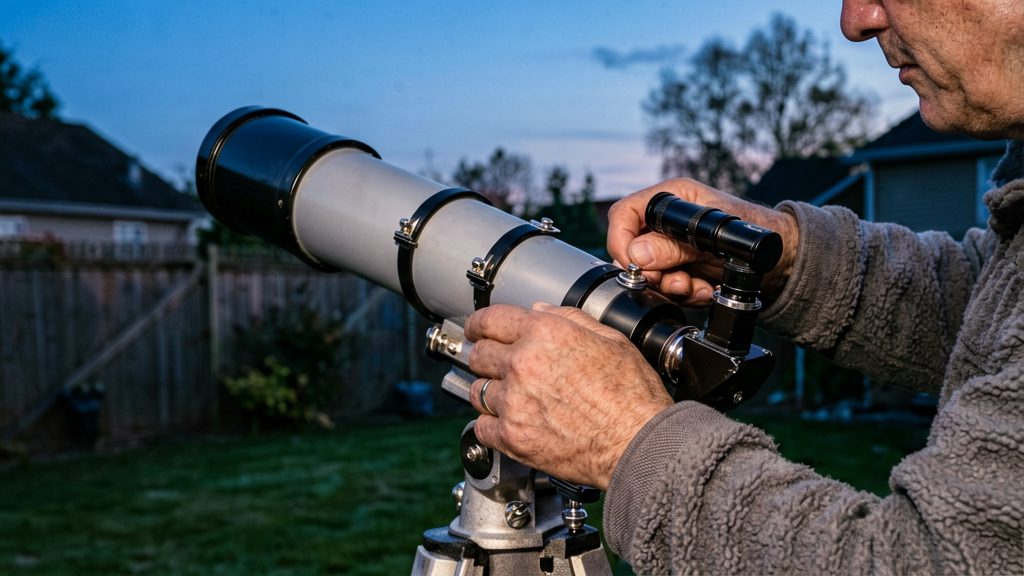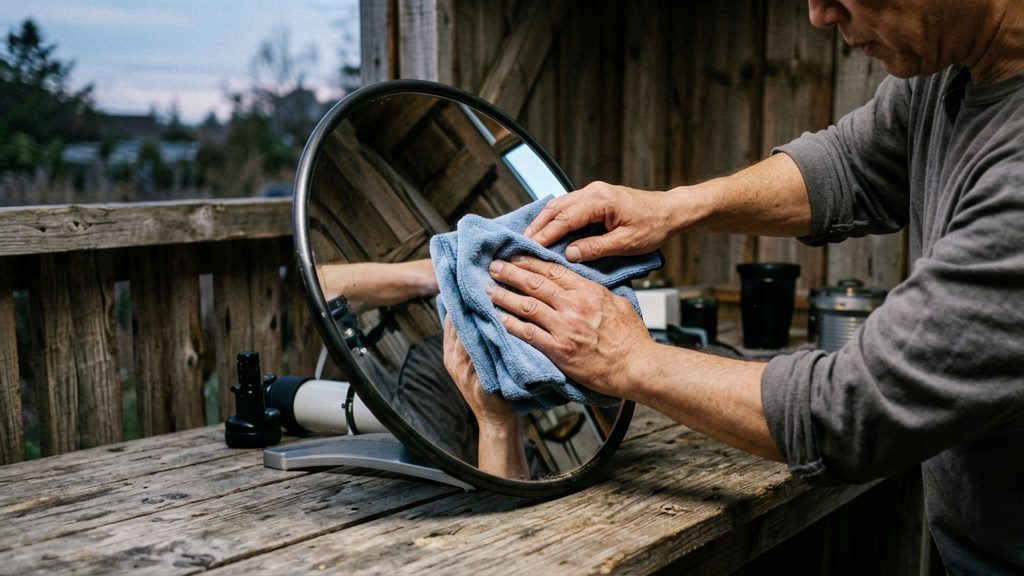
Most telescope mirrors need cleaning no more than once a year, and only when contamination is visible in ordinary room light. Celestron (2023) gives this limit for most optics, including the primary mirror of an enclosed Newtonian reflector, which is the baseline case here. Telescope School adds that most mirrors never need cleaning at all. Treat once a year as a ceiling for most optics, not a schedule. Open truss-tube Newtonians are more exposed and may need cleaning more often.
How often should you clean telescope mirrors?
The frequency ceiling is one cleaning per year at most. Celestron (2023) sets this as the upper limit for normal conditions, and Telescope School gives the same once-a-year maximum. A mirror that shows no contamination needs no cleaning in a given year.
The visibility trigger decides whether a cleaning happens at all. Inspect the mirror in ordinary room light before deciding. Telescopic Watch (c. 2025) lists the contaminants that justify cleaning:
| Condition seen in room light | Action |
|---|---|
| No visible contamination | No cleaning |
| Light layer of dust | Leave it alone |
| Pollen, dew, or mouse or insect droppings | Clean, within the once-a-year ceiling |
The enclosed Newtonian is the reference case. Its primary mirror sits inside a closed tube, so it collects contamination more slowly than an exposed mirror, and it follows the once-a-year ceiling and the visibility trigger above.
Why most mirrors need cleaning less than you think
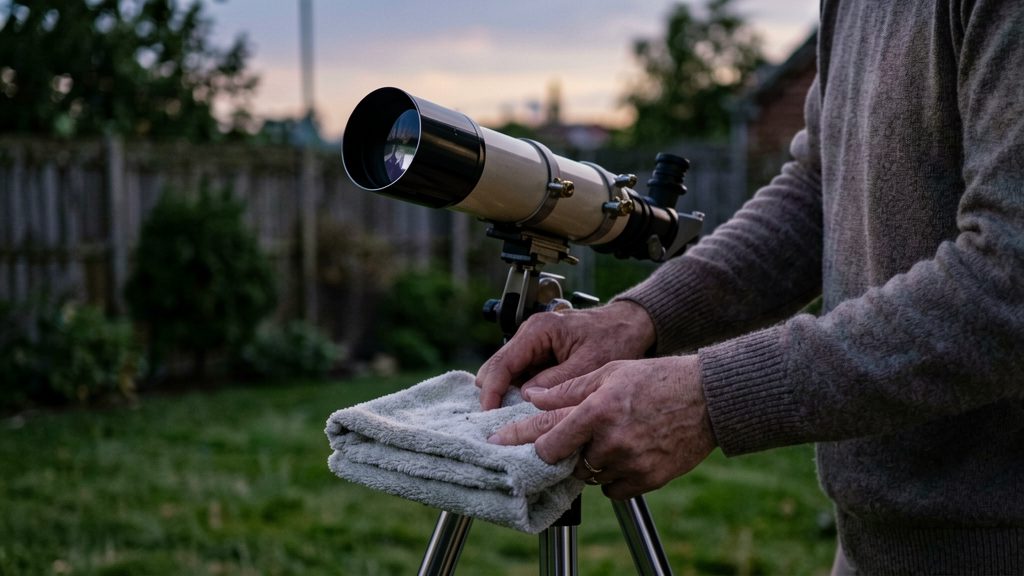
For most telescope owners, the cleaning itself is the bigger risk to a mirror. A mirror’s reflective coating is thin, and every wipe carries a chance of leaving marks that cannot be undone. Dust settles slowly and does little harm in the short term, so restraint is the safer default.
Celestron (2023) states that over-cleaning or aggressive wiping can cause micro-scratches that permanently degrade the coatings. The damage is cumulative: each unnecessary pass adds another chance of abrasion, and the wear does not reverse. The risk is highest with a wiping motion that presses down on the glass, which is why Celestron’s guidance stresses that no downward pressure should be applied.
Telescope School describes a related effect, sleeks: fine, permanent scratches left by cleaning. Sleeks are a different problem from dust. Dust sits on the surface and can always be cleaned later, while a sleek remains in the coating once made.
| Threat | Source | Reversible? |
|---|---|---|
| Dust on the mirror | Settles over time | Yes, can be cleaned later (Telescope School) |
| Micro-scratches | Aggressive or repeated wiping | No, permanent coating degradation (Celestron, 2023) |
| Sleeks | Cleaning contact | No, permanent fine scratches (Telescope School) |
| Ammonia-based glass cleaner | Household chemical | Can damage the aluminum coating (Telescope School) |
Chemicals add a second route to damage. Telescope School warns that ammonia-based household glass cleaners can damage the aluminum coating, so a product that looks harmless on a window should stay away from a primary mirror. Check the manufacturer’s instructions for any cleaning product before use.
Is dust on a telescope mirror a problem?
A thin layer of dust on a telescope mirror rarely harms what you see. Celestron (2023-07-25) states that specks of dust don’t noticeably affect image sharpness, and the same guidance says most optics, including the mirror in an enclosed Newtonian, should need cleaning no more than once a year, and only when visibly dirty. The practical question is therefore whether the contamination is cosmetic dust or functional contamination, because the two behave very differently.
Cosmetic dust
Cosmetic dust is loose particulate that sits on the surface without forming a film. Its main optical effect is light scatter: particles redirect a small share of incoming light away from the focused image. This can slightly reduce contrast, which is most noticeable on high-contrast targets such as the Moon or planets. For most observers, the loss is too small to detect at the eyepiece.
Telescope School notes that most mirrors never need cleaning. It also warns that dust grit can scratch the coating if you wipe a dry mirror, so light dust is often the less risky option to leave in place.
Functional contamination
Functional contamination changes how the mirror reflects light, or it damages the coating. Celestron (2023-07-25) lists films, fungus, and oil or grease as cases that call for professional cleaning rather than home cleaning. These are not dust problems, and they should not be handled the same way.
Biological and organic debris also falls into this category. Telescopic Watch (2025, approximate date) advises cleaning when pollen, dew, or mouse or bug waste lands on the mirror, because these residues can bond to the surface.
| Contamination | Typical source | Optical effect | Action per source |
|---|---|---|---|
| Light layer of dust | Ambient air | Minor scatter, slight contrast loss | Leave alone (Telescopic Watch) |
| Pollen or dew residue | Outdoor storage | Can bond to coating | Clean (Telescopic Watch) |
| Mouse or insect waste | Storage area | Can bond to coating | Clean (Telescopic Watch) |
| Film, fungus, oil, grease | Handling, humidity | Alters reflectivity | Professional cleaning (Celestron) |
Open-tube designs
Celestron (2023-07-25) says open truss-tube Newtonian mirrors are more exposed to airborne debris and need more frequent cleaning than enclosed designs. Check the mirror more often if your tube is open, but apply the same test: clean only when the residue is visible and affects the view or the coating.
When cleaning is justified
A mirror needs cleaning when visible contamination sits on its surface and shows up in ordinary room light. A light layer of dust is not a reason to clean. Celestron (2023) states that specks of dust don’t noticeably affect image sharpness. Some contaminants, such as film, oil, grease, or fungus, call for professional service rather than work in the field.
Signs that justify cleaning
Check the mirror under room light before you touch it. These are the contaminants the sources name:
- Pollen, dew, or droppings from mice or bugs. Telescopic Watch says to clean when these land on the mirror. Celestron takes a stricter line: clean only when the mirror is visibly dirty.
- Film. Celestron says films call for professional cleaning.
- Oil, grease, or fungal growth. Celestron says these call for professional cleaning.
In-field cleaning versus professional service
| Condition | Recommended action | Source |
|---|---|---|
| Light, loose dust | Leave it alone. Do not wipe a dry mirror, because grit can scratch the coating. | Telescope School; Celestron |
| Loose debris that a blower can lift | Remove it with a bulb blower or compressed gas before any wet step. | Celestron (2023) |
| Pollen, dew, or droppings | Clean in the field, using the method your mirror’s manufacturer recommends. | Telescopic Watch |
| Film, oil, grease, or fungus | Send the mirror to a professional. | Celestron (2023) |
| Corrector plate of a Schmidt-Cassegrain | Do not remove it. Leave service to the manufacturer or a qualified technician. | Celestron (2023) |
Each new wipe risks micro-scratches. Celestron (2023) warns that over-cleaning or aggressive wiping can permanently degrade the coatings, and Telescope School says cleaning can leave permanent fine scratches. Clean only when the contamination justifies the risk.
The sources do not set a threshold for when a debris cluster that a blower cannot remove should go to a professional. Check the manufacturer’s instructions for your mirror, or contact the service that serviced the instrument.
How do you clean a mirror safely?
Cleaning a telescope mirror safely depends on working in a fixed order: remove loose dust without touching the glass, then use a diluted alcohol solution with a light, non-abrasive wipe. Celestron’s sequence begins with a bulb blower or compressed gas, followed by a solution of 50-70% isopropyl alcohol diluted with distilled water. The steps below follow that sequence, and each one exists to prevent a specific type of damage.
Step 1: Remove loose dust first
Blow dust off with a bulb blower or compressed gas before any liquid touches the surface. Dust grit that is wiped across the coating acts like sandpaper, so the blower removes the particles that would otherwise cause scratches.
Step 2: Prepare the solution
Mix isopropyl alcohol with distilled water to reach a concentration between 50% and 70%. Celestron advises against alcohol above 70%. Use isopropyl alcohol rather than ammonia-based glass cleaners, which can damage the aluminum coating (Telescope School).
| Solution | Source | Status |
|---|---|---|
| 50-70% isopropyl alcohol in distilled water | Celestron (2023-07-25) | Recommended |
| Ammonia-based household glass cleaner | Telescope School | Avoid |
Step 3: Wipe with light, even pressure
Apply the solution to lint-free tissue or non-synthetic cotton, not directly to the mirror. Wipe in a single pass across the surface with no downward pressure. Use a fresh tissue for each pass and never reuse a contaminated cleaning item, since reused material can redeposit grit.
Step 4: Never wipe a dry mirror
Do not wipe a dry mirror. Dust grit can scratch the coating when it is dragged across dry glass (Telescope School). Blowing first and wiping only with a damp tissue avoids this.
Step 5: Re-collimate
A Newtonian needs re-collimating after its primary mirror is washed (Telescope School), so check collimation before your next session.
Note on conflicting methods
Celestron recommends isopropyl alcohol diluted with distilled water. Telescopic Watch, by contrast, suggests dish soap and water rinses or acetone. These methods conflict, and the Celestron sequence is the one described above. Check the manufacturer’s instructions for your specific mirror before choosing a method different from this one.
Open tube vs. closed tube: does it change the schedule?
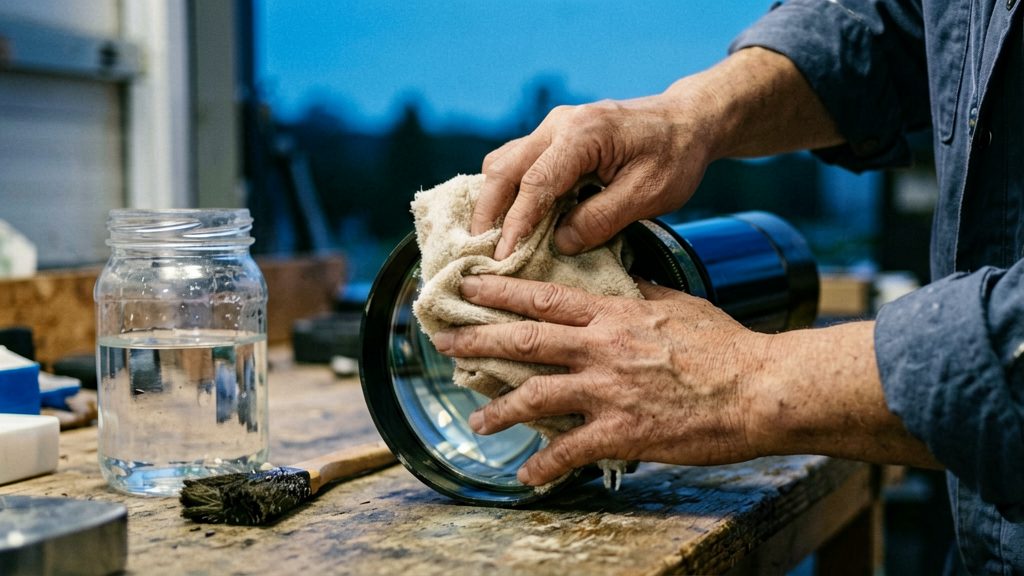
Yes. Tube design controls how much airborne debris reaches the primary mirror, so it changes how often you should check it. Celestron states that open truss-tube Newtonian mirrors are more exposed and need more frequent cleaning. The table compares the main designs.
| Design | Mirror exposure | Practical consequence |
|---|---|---|
| Open truss-tube Newtonian | Mirror has no enclosing tube and is exposed to open air (Celestron) | Needs more frequent cleaning (Celestron) |
| Enclosed-tube Newtonian | Tube shields the mirror from much of the airborne debris | Lower exposure than an open truss design |
| Schmidt-Cassegrain | Sealed corrector plate at the front of a closed tube | Corrector should not be removed (Celestron) |
Enclosed tubes reduce exposure but do not remove contamination entirely. Enclosed tubes still let some contamination in over time, so check the mirror in ordinary room light before deciding. Telescopic Watch lists pollen, dew, and mouse or bug waste as the contamination that justifies cleaning. Those triggers can still reach an enclosed mirror during a session.
For an open truss-tube telescope, the same triggers reach the mirror more easily between sessions, so checking after use matters more than following a fixed calendar. Telescopic Watch also advises leaving a light layer of dust alone, so the check is about whether contamination is actually present, not whether any dust has settled.
What about eyepieces and corrector plates?
Eyepieces and the corrector plate on a Schmidt-Cassegrain need different handling. The eyepiece lens is the part you touch most often, and it collects skin oil between sessions, so it needs regular attention. The corrector plate is the front lens of a Schmidt-Cassegrain telescope, and Celestron advises that it should not be removed for cleaning at all.
Cleaning eyepieces
Eyepieces collect skin oil and may need attention every several sessions, according to Telescope School (undated). Inspect the lens in ordinary room light before cleaning, and clean only when oil or smears are visible.
When you clean an eyepiece:
- Use only pure isopropyl alcohol or methanol.
- Apply the solvent to the cloth, not to the glass, so no liquid runs into the eyepiece barrel.
- Wipe lightly, without downward pressure.
- Use a fresh, lint-free cloth or tissue, and never reuse one that has touched contaminated optics.
Schmidt-Cassegrain corrector plates
Celestron states that a Schmidt-Cassegrain corrector plate should not be removed (Celestron, 2023-07-25). Celestron says the plate should not be removed. Leave any work that needs removal to the manufacturer or a qualified technician.
If the corrector plate looks dirty, follow the general guidance from Celestron: start with a bulb blower or compressed gas, and only then consider a wipe. Celestron’s wiping solution is 50-70% isopropyl alcohol diluted with distilled water, and the same source warns against alcohol above 70%. Oil, film or fungus on optics calls for professional cleaning, per Celestron (2023-07-25).
When to recoat instead of clean
Cleaning removes material sitting on top of a mirror. It cannot repair the reflective aluminum layer itself. When that coating is physically damaged, the remedy is recoating by a qualified optics specialist, not further cleaning.
| Damage | What it looks like | Action |
|---|---|---|
| Peeling or flaking | Patches of reflective layer lift off the glass, leaving bare or dull areas | Recoat. Cleaning cannot rebuild lost coating |
| Oxidized aluminum | The surface looks grey, cloudy or milky rather than bright | Compare under ordinary room light. If the dullness stays after standard cleaning, arrange recoating |
| Pitting | Small pits or dark spots within the reflective surface | Recoat. The damage is in the coating, so wiping will not remove it |
| Widespread erosion | Reflectivity loss across much of the surface, with the image visibly dimmer than before | Recoat or replace the mirror, depending on the specialist’s assessment |
Check before deciding. Inspect the mirror in room light, at a low angle. If marks come off with the cleaning procedure described elsewhere, the problem was surface contamination, not coating damage. Marks that remain after proper cleaning point to the coating.
Recoating through a specialist. Recoating replaces the reflective layer, and it should be done by a qualified optics specialist. Before work starts, confirm the coating type with the specialist. According to Telescopic Watch (2025), standard aluminium coatings can last decades or longer with good storage, while silver coatings need recoating about yearly. The article’s date is approximate, so treat these intervals as a guide and confirm them with the specialist or the mirror maker.