Telescope Optics Cleaning: When and How to Clean Lenses and Mirrors
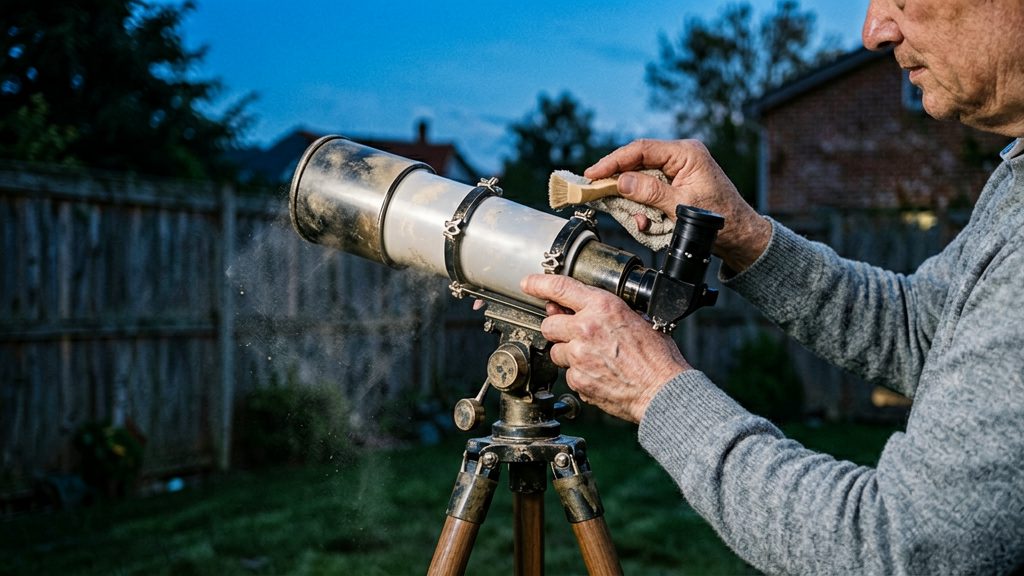
Most telescope optics need cleaning less often than owners expect. According to Explore Scientific (2026), optics should be cleaned only when they are dirty or have sticky residue, because every touch risks scratching the glass. Deciding whether to clean comes first, before any tool or liquid is chosen. The question is not whether dust is present but whether the glass has a film or residue that dust alone cannot explain.
Do you really need to clean your telescope lens?
Dusty versus dirty
Dust and dirt are treated differently. Dust on a lens is usually a nuisance rather than a fault in the view, and Explore Scientific (2026) states that a little dust barely affects it. Optics are therefore not cleaned on a schedule. They are cleaned when the glass is visibly dirty or carries a film that stays after it has been looked at in normal light.
Sticky residue as the real trigger
Sticky residue is the condition that justifies cleaning. Residue is a sticky film, such as a fingerprint, that dust removal alone does not clear. Explore Scientific (2026) names it as the trigger, and, together with visibly dirty glass, it is the condition in which the sources recommend wet cleaning.
Scratch risk from every touch
Each contact with the glass carries scratch risk, even when done carefully. Explore Scientific (2026) makes this the main argument against cleaning by habit.
| Condition | Decision |
|---|---|
| Loose dust on the glass | Leave it alone (Explore Scientific, 2026) |
| Dirty glass or sticky residue | Clean it (Explore Scientific, 2026) |
What supplies do you need?
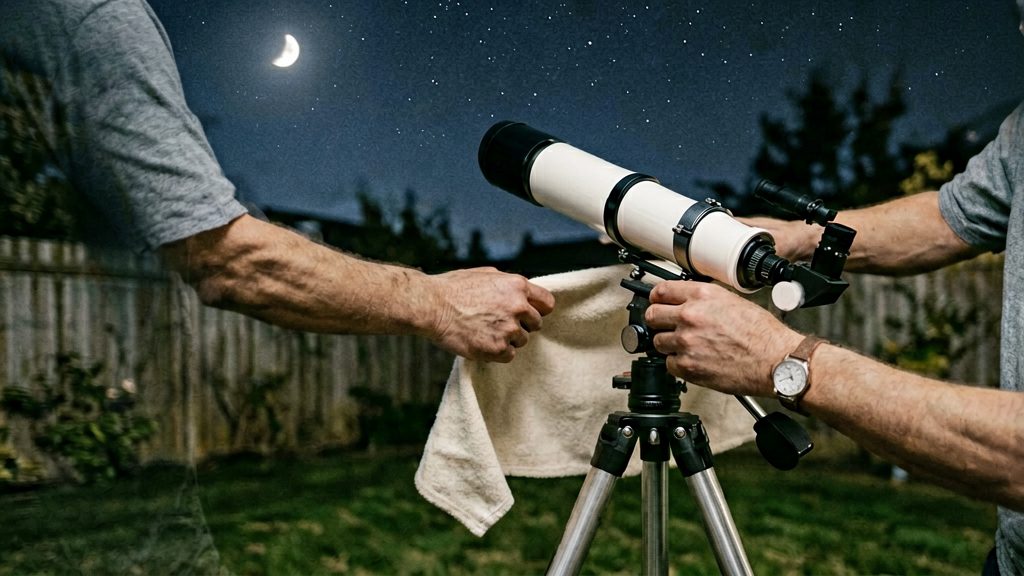
A safe cleaning kit for optical glass needs a few inexpensive items: distilled water, 94% or higher isopropyl alcohol, a drop of phosphate-free dish detergent, soft tissues, cotton swabs, gloves, and eye protection. Explore Scientific (2026) recommends mixing water and alcohol in a 3:1 ratio, with one drop of detergent per half liter of mixture. Keep the solution in a clearly labelled, sealed container, away from heat and open flames.
Core cleaning kit
- Distilled water: leaves no mineral deposits on the glass.
- Isopropyl alcohol, 94% or higher: the solvent for the mixture. Explore Scientific (2026) specifies this strength.
- Phosphate-free dish detergent: a small amount helps lift oily residue.
- Soft tissues or lens tissue.
- Cotton swabs (Q-tips): for small optics such as eyepieces and Barlow lenses, according to Telescopic Watch (2026).
- Microfibre cloth: Sky at Night (2015) uses it for a gentle final polish on a refractor, but Telescopic Watch (2026) avoids microfibre on large surfaces, so check your manufacturer’s guidance first.
Solution proportions
| Component | Ratio | Amount per 0.5 L batch |
|---|---|---|
| Distilled water | 3 parts | 375 ml |
| Isopropyl alcohol (94% or higher) | 1 part | 125 ml |
| Phosphate-free dish detergent | 1 drop per 0.5 L | 1 drop |
The batch amounts are the 3:1 ratio applied to a half-liter total, not separate figures from the sources.
Safety equipment
Isopropyl alcohol is flammable and toxic. Explore Scientific (2026) recommends:
- Gloves to protect your skin during handling.
- Eye protection in case of splashes.
- Good ventilation, meaning a room with open windows or fresh airflow, away from flames, heaters, and pilot lights.
How do you remove dust first?
Remove loose dust with dry tools before any liquid touches the glass. Do this only when dust is heavy enough to matter, since a little dust barely affects the view. Start with the gentlest method and move up only if needed. The sequence below runs from least to most contact.
Start with a squeeze bulb blower
A rocket-style squeeze bulb blower is the first tool to use. Telescopic Watch (2026) recommends it as the first step. For a refractor, hold the telescope lens-down and blow off dust with the bulb, as BBC Sky at Night Magazine (2015-09-11) describes.
Use filtered canned air carefully
Explore Scientific (2026) suggests filtered canned air in short bursts, held upright, but Telescopic Watch (2026) advises against canned compressed air because it can leave residue and its force can shatter thin optics. The sources disagree, so prefer the bulb blower, avoid canned air on thin optics such as Schmidt corrector plates, and check the manufacturer’s manual before using a can.
Puff with an ear syringe or brush stubborn dust
A pharmacy ear syringe gives a controlled puff of air. Explore Scientific (2026) suggests it as an alternative to canned air. For dust that the blower and syringe do not lift, Explore Scientific (2026) recommends a photographic-grade camel-hair brush.
| Tool | Method | Source |
|---|---|---|
| Rocket-style squeeze bulb blower | First step, lens-down for a refractor | Telescopic Watch (2026); BBC Sky at Night Magazine (2015-09-11) |
| Filtered canned air | Short bursts, held upright | Explore Scientific (2026) |
| Pharmacy ear syringe | Short air puffs across the surface | Explore Scientific (2026) |
| Photographic-grade camel-hair brush | Very light strokes for stubborn dust | Explore Scientific (2026) |
How to clean fingerprints and residue
Work through solvents in a fixed order, from the mildest to the strongest. Explore Scientific (2026) starts with distilled water, moves to isopropyl alcohol, and uses its mixture only if streaks remain after those two passes. At every step the liquid goes on the tissue, never directly on the optic. Stopping at the first step that clears the glass limits how much liquid reaches the optic.
| Order | Solvent | When to use it |
|---|---|---|
| 1 | Distilled water | First pass on every cleaning |
| 2 | Isopropyl alcohol (94% or higher) | Next, if water leaves residue or streaks |
| 3 | Mixture | Only if streaks remain after steps 1 and 2 |
Apply the solvent to the tissue, never to the optic. Telescopic Watch advises putting the liquid on the wipe and cleaning one small area at a time. Sky at Night (2015) describes adding two drops of isopropyl alcohol to a fresh tissue for a refractor.
Wipe with light strokes and no pressure. The sources disagree on motion: Explore Scientific (2026) specifies straight lines, Telescopic Watch describes small circles, and BBC Sky at Night Magazine (2015-09-11) wipes from the centre outward. Check your manufacturer’s manual and use a fresh section of tissue for every stroke so that you never drag residue back across the glass. Use a fresh section of tissue for every stroke so that you never drag residue back across the glass.
What should you never do to telescope optics?
The three actions to avoid are acetone on anything except bare glass, canned air near thin corrector plates (the sources disagree on canned air in general), and over-wetting a multi-element lens. Each one can damage the instrument, and each damages a different part: coatings and plastics, thin optical plates, or the cement that holds lens elements together.
Acetone on paint, plastic and labels
Explore Scientific (2026) warns that acetone can damage paint, plastic and labels, so it should stay on the glass only. The same source ranks it last in its cleaning sequence, after distilled water, alcohol and its mixture. Acetone is also flammable and toxic, so use gloves, eye protection and ventilation.
Canned air near thin corrector plates
Telescopic Watch advises against canned compressed air, stating that it can leave residue and that its force can shatter thin optics such as Schmidt corrector plates. Explore Scientific takes a different position, allowing short bursts of filtered canned air held upright. The sources disagree, so the stricter Telescopic Watch warning is the safer reference for a Schmidt-Cassegrain corrector.
Over-wetting multi-element optics
Explore Scientific (2026) advises against over-wetting multi-element optics, because liquid can seep between the elements. BBC Sky at Night Magazine (2015-09-11) adds that alcohol must never be applied directly to the lens or allowed to reach its edges, since excess liquid can seep into the lens cell and dissolve the cement holding the lens together.
| Action | Damage named in sources | Source |
|---|---|---|
| Acetone on non-glass surfaces | Paint, plastic and labels | Explore Scientific (2026) |
| Canned compressed air on thin optics | Shattering of Schmidt corrector plates; residue | Telescopic Watch |
| Liquid reaching the lens edges or elements | Seepage between elements; dissolved lens-cell cement | Explore Scientific (2026); BBC Sky at Night Magazine (2015-09-11) |
Eyepieces, correctors and mirrors: special cases
Eyepieces, Schmidt corrector plates and mirror coatings need more caution than a standard objective lens. Eyepieces are often cleaned more than necessary, and a corrector or mirror can be damaged by the wrong tool or solvent. For all three, check the manufacturer’s instructions before touching the glass.
Eyepiece lens surfaces and internal dust
- Do not unscrew the eyepiece barrel or remove its lenses unless the inside surface is contaminated. Opening the barrel exposes the internal lens surfaces to new dust. Telescopic Watch gives this rule.
Corrector plates
- Telescopic Watch advises caution for Schmidt-Cassegrain corrector plates, which are thin and can be damaged by forceful dust removal.
- If the corrector must be removed, mark the position of each shim and the plate’s rotational orientation before unscrewing anything. Without these marks, reassembly can misalign the plate.
Mirror coatings
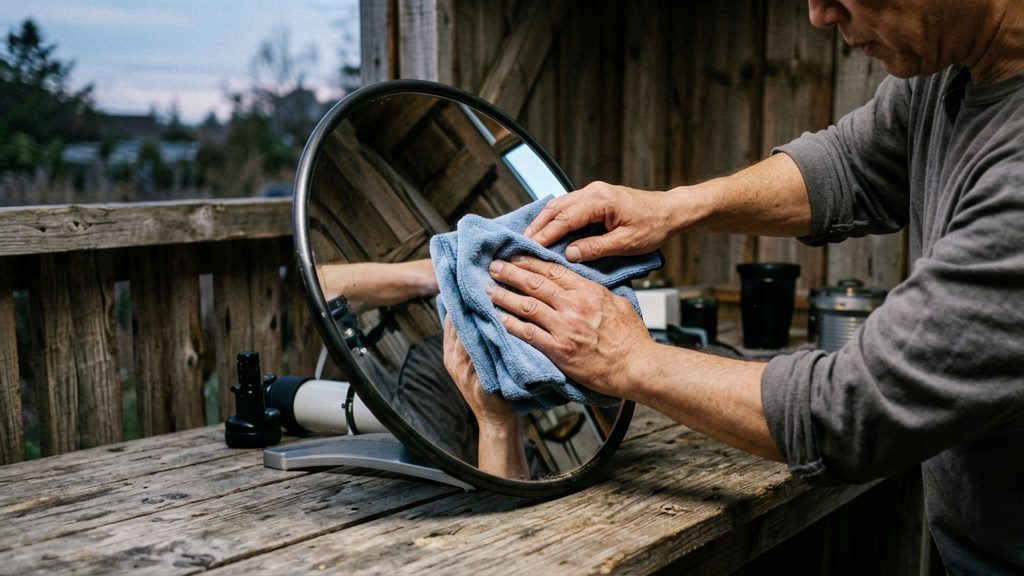
- Mirror coatings are the most sensitive surface in this group, and no single cleaning method applies to all of them. Follow the maker’s guidance for each product.
- If the manual is unclear or missing, contact the manufacturer before using any liquid on a mirror.
| Optic | Main caution | Source |
|---|---|---|
| Eyepiece lens | Clean only if dirty; do not open the barrel unless the inside is contaminated | Telescopic Watch |
| Schmidt corrector plate | Check the manufacturer’s instructions first; mark shim positions and orientation before removal | Telescopic Watch |
| Coated mirror | Follow the manufacturer’s manual before using any liquid | Manufacturer’s manual |
How to keep optics clean longer
The habits below reduce the dust and skin oil that force cleaning in the first place.
Cap every opening
Dust enters a telescope through open tube ends, focusers and eyepiece barrels. Put the dust cap on each eyepiece when it is out of the focuser, and cover the open end of the tube when the telescope is not in use. Keep caps on whenever an optic is off the instrument.
Each opening you leave closed is one less route for dust to reach the inner surfaces.
Store away from humidity
Keep the telescope, eyepieces and filters in a closed case in a dry room. Avoid damp garages, basements and spaces next to windows where condensation forms. Humidity and temperature swings encourage moisture to settle on glass, so a stable indoor location suits optics better than a shed or car.
Hold by the housing
Handle eyepieces, filters and loose lenses by their metal or plastic housing, never by the glass. Keep fingers off any exposed glass surface, including the front element of an eyepiece.