The Orion Nebula (M42) sits below Orion’s Belt, in the sword of Orion. To find it, look south as night falls and scan for a fuzzy glow below the belt, not a star. Its exact height above the horizon depends on your latitude and the date.
Where is the Orion Nebula in the sky?
Looking south as night falls
According to StarDate (McDonald Observatory, University of Texas), the best starting point is to look south as night falls. The nebula appears as a fuzzy, star-like smudge below Orion’s Belt, which makes it the first thing to check once the sky darkens.
Using a nearby star as a directional check
According to Sky & Telescope, Iota Orionis (magnitude 2.8) lies a little south of the nebula, so M42 sits just north of it. Once you have located this star, look slightly north of it to confirm the nebula’s position.
Timing and altitude for your latitude
The nebula’s visibility and altitude change with your latitude and the date, so use a tool that calculates them for your location:
- Set your planetarium app or star chart to your exact location.
- Enter the observing date and set the time to nightfall.
- Read the altitude of the nebula, or step the time forward to see when it rises higher.
Find Orion’s Belt first
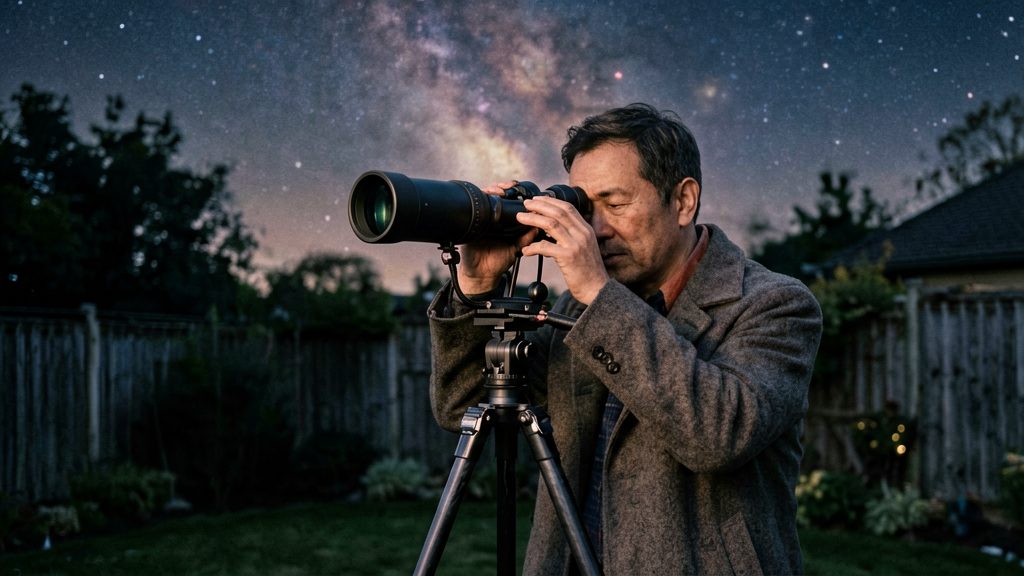
Orion’s Belt, a short, nearly straight row of three bright stars, is the most reliable starting point for finding the Orion Nebula in binoculars. It sits in the middle of a larger, rectangular outline of Orion, so once you match the belt to that outline, you know you are looking at the right part of the sky.
The three belt stars
| Star | Position in the row (facing south, Northern Hemisphere) |
|---|---|
| Mintaka | Western end, on the right-hand side |
| Alnilam | Middle star |
| Alnitak | Eastern end, on the left-hand side |
The three stars sit at roughly equal spacing along a nearly straight line. Treat the row as a ruler: if the stars look bunched or bent, you are probably looking at a different pattern.
Outline and outer anchors
Orion’s main stars form a rough rectangle around the belt:
- Betelgeuse marks the upper-left corner (Northern Hemisphere, facing south). It has a distinctly reddish-orange colour.
- Rigel marks the lower-right corner and appears bluish-white.
- Bellatrix marks the upper-right corner.
- Saiph marks the lower-left corner.
Betelgeuse and Rigel are the outer anchors. A line drawn between them crosses the belt near its centre, which confirms you have the correct rectangle before you move your binoculars.
Follow the sword to M42
Once you have the three belt stars, the Orion Nebula (M42) sits in the sword hanging below them. It is the middle “star” of the sword, and in binoculars it appears as a soft, fuzzy glow rather than a point of light. Follow the sword down from the belt until the glow appears between the sword’s brighter stars.
Use Iota Orionis as a southern reference
Iota Orionis (magnitude 2.8) lies a little south of the nebula and works as a confirmation check. Once you are in the sword, sweep slowly north from Iota, and the glow should come into view just above it.
| Reference | Position relative to M42 | Role in the star-hop |
|---|---|---|
| Iota Orionis (mag 2.8) | A little south | Starting point; move north from it |
| Theta1 and Theta2 Orionis | Within the glow | Confirm you are on the nebula |
Locate the nebula around Theta1 and Theta2
Theta1 and Theta2 Orionis are the stars at the heart of the nebula. In any binoculars, M42 is easy to spot as a soft glow surrounding these two stars. If you see the glow centred on a pair of stars rather than on one isolated point, you have reached the target.
Use a tripod or a braced stance, since a steady view makes the faint shape easier to judge.
Recognise the glow among field stars
The key test is texture. Stars stay pinpoint at higher magnification, while M42 remains a soft, uneven patch of light that spreads around the central stars.
What binoculars do you need?
For M42, the Orion Nebula, a 10x50 pair is a sound starting point, and it is the size Astronomy magazine used to describe the nebula. Astronomy magazine describes the nebula in 10x50 binoculars on a tripod as irregular and curved around the two Theta Orionis stars. High Point Scientific gives 10x50 or larger as general guidance for binocular targets. It does not give M42-specific directions, so treat it as a general baseline. The nebula is a large, soft glow, so the choice depends on how much light the objective gathers and how wide a field the eyepiece shows.
Aperture, magnification and field of view
- Aperture is the objective lens diameter in millimetres. In “10x50,” the 50 is the aperture. A larger objective gathers more light, which helps the faint outer parts of the nebula stand out from the sky background.
- Magnification is the first number. Lower magnification shows a wider field and a steadier image. Higher magnification makes the image larger but narrower and more sensitive to hand shake.
- Field of view matters most for M42. The nebula sits near the Theta stars in Orion’s sword, and you need a field wide enough to hold those stars and the glow around them at the same time.
Choosing between 8x42, 10x50 and 15x70
| Format | Magnification | Objective (mm) | Practical note for M42 |
|---|---|---|---|
| 8x42 | 8x | 42 | Lower magnification gives the widest view of the nebula and the Theta stars together, and the image is the steadiest when held by hand. |
| 10x50 | 10x | 50 | The format named in the sources as the general recommendation. On a tripod, it shows the nebula’s irregular, curved shape and the dark lane from the north. |
| 15x70 | 15x | 70 | Larger aperture collects more light but needs a steadier support. Hand-held use shows more movement, so a tripod is the practical choice. |
Start with 10x50 if you want one pair for general use. Choose 8x42 if you plan to hold the binoculars by hand more often, and 15x70 only if you have a tripod and want more light.
Mounting on a tripod for steadiness
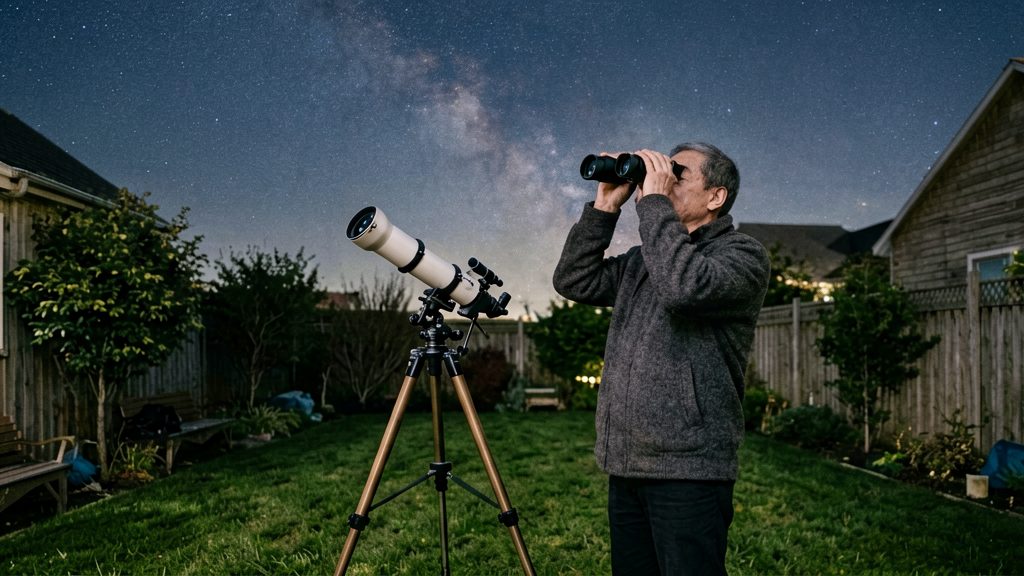
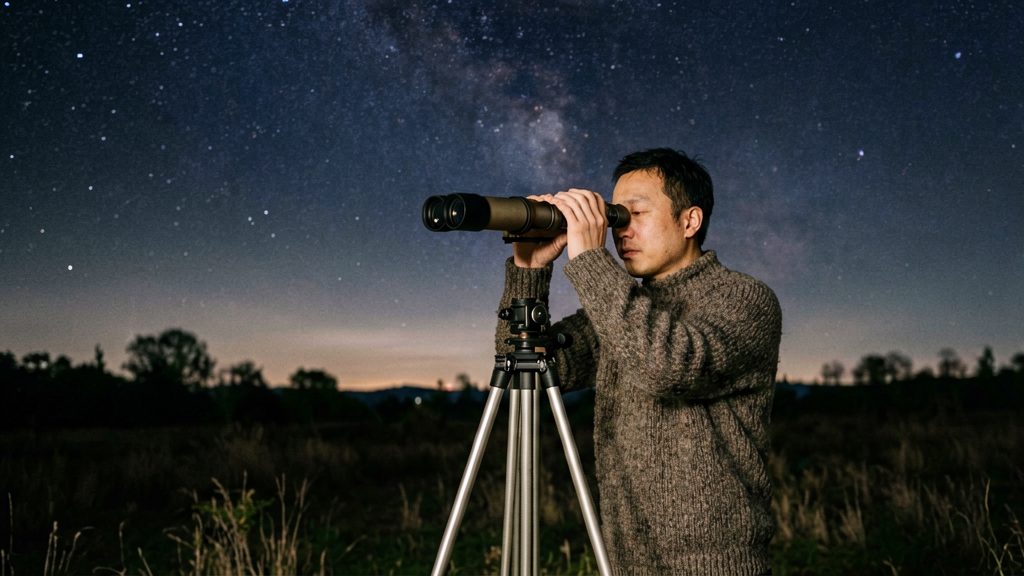
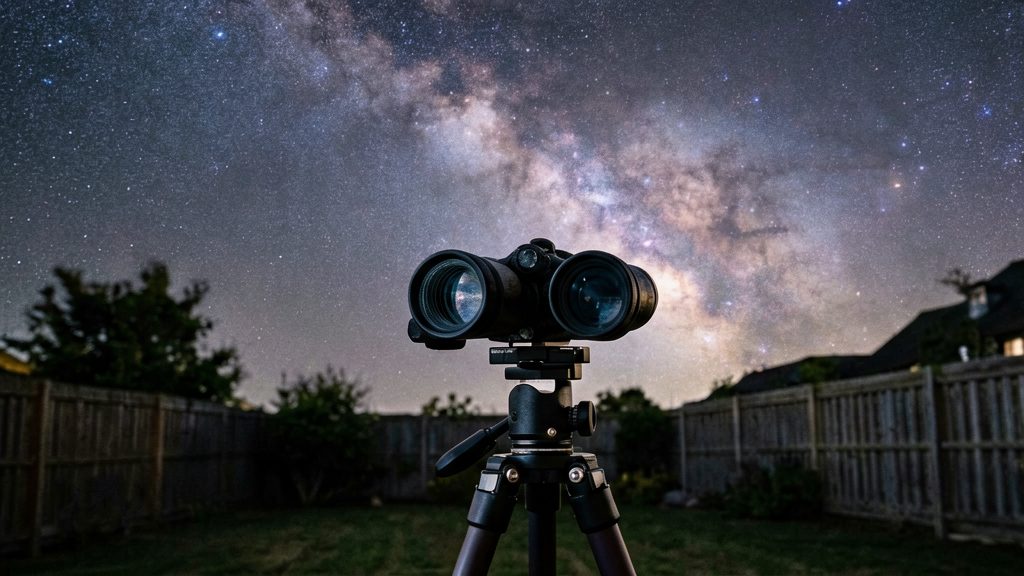
A tripod removes the hand movement that blurs fine detail. Use a tripod adapter designed for your binoculars, and confirm the adapter fits your model in the manufacturer’s manual. Set the tripod height so you can look through the eyepieces without bending or raising your arms. Once the nebula is centred, avoid touching the tripod while you observe.
What will you see through binoculars?
In 10x50 binoculars, M42 appears as a soft glow centred on the stars Theta1 and Theta2 Orionis. It does not look like a round, evenly lit disc. Viewed on a tripod, the nebula shows an irregular, curved glow around those two stars, so the edges look shaped rather than uniformly fuzzy.
Shape of the glow
The brightest part of the haze surrounds Theta1 and Theta2. From there, the brightness falls off unevenly, so the outline bends and curves instead of forming a symmetrical halo. Because the faint outer edges are the hardest part to see, a steady mount helps you judge where the glow ends.
The Fish’s Mouth
A dark dust lane, known as the Fish’s Mouth, pokes into the glow from the north. It appears as a dark notch against the surrounding gas, which makes it a useful reference point once you have found the nebula. Check the northern side of the bright glow to locate it.
Field context
Several other objects share the same binocular field:
| Object | Position relative to M42 | What the source reports |
|---|---|---|
| M43 | Just north of M42 | Lies adjacent to the nebula |
| NGC 1981 | In the same region | Easily visible in 7x binoculars |
| Iota Orionis (magnitude 2.8) | A little south of the nebula | Marks the southern side of the nebula’s position |
Brightness under light pollution
Compare what you see from your home site with a darker location if one is available to you. The difference will show most clearly in the faint, outer edges of the glow and in the subtlety of the dust lane.
Can you see the Trapezium in binoculars?
The Trapezium is the four-star group at the core of the Orion Nebula, and Theta1 Orionis is the star system that makes up that group. In binoculars you can see Theta1 as an odd, non-stellar point at higher magnifications. Astronomy magazine reports that 25x100 binoculars resolve it into four stars, but this threshold is not confirmed across sources. StarDate says binoculars can show the Trapezium. Other sources state that ordinary binoculars can show the Trapezium, so the exact requirement remains unresolved.
| Magnification | What to expect on Theta1 |
|---|---|
| 10x | Theta1 and Theta2 sit inside the soft glow of M42, which looks irregular around them (Astronomy magazine) |
| 15x and above | Theta1 looks odd and not like a single star (Astronomy magazine) |
| 25x100 (reported) | Theta1 is reported to resolve into the four-star Trapezium (Astronomy magazine) |
Finding Theta1 before you switch magnification
Start at low power so the nebula is easy to find. M42 sits in the sword below Orion’s Belt, and its middle “star” is the nebula itself. Centre the glow, locate the pair Theta1 and Theta2 within it, and then increase magnification. Theta2 serves as a reference: if you can see both stars in the glow, you are on the correct target.
Checking for the four-star pattern
At higher power, focus carefully on Theta1 and look for a change from a single point to an uneven or elongated shape. The four components are close together, so you are looking for a compact group rather than separate stars spread across the field. Work during moments when the image is steadiest, because the separation is faint and small image movements can blur it.
Tips for a better view
Viewing habits affect how much of the Orion Nebula (M42) you can see through binoculars as much as the optics do. Site choice, dark adaptation and averted vision all improve contrast on the nebula’s soft glow without changing equipment.
Site selection and light pollution
According to Sky & Telescope, M42 is bright enough to be seen from light-polluted sites, so a suburban backyard is a workable starting point. A darker site still helps, because the background sky is dimmer and the glow stands out more clearly against it.
- Position yourself so that street lamps, porch lights and windows are not in your direct line of sight.
- Stand in the shadow of a building or a tree line to block nearby lights from entering your eyes.
Dark adaptation
Your eyes need time in the dark before they become sensitive to faint light. Avoid looking at bright phone screens or white torches during the session, because each exposure can reduce your night vision.
Averted vision
Averted vision uses the more light-sensitive outer part of the retina. Instead of looking straight at the nebula, shift your gaze to a point a little to one side of it, and let the faint glow appear at the edge of your view. Around the Theta Orionis stars, the nebula’s curved outline often becomes easier to make out this way. Try a few gaze positions until the glow appears steadiest.
Nearby targets: M43 and NGC 1981
Once you have found the Orion Nebula, two nearby objects make a useful wide-field pair. M43 lies just north of M42, so it sits in the same part of the sky and can be reached by a small move from the nebula. NGC 1981, an open cluster, is easily visible in 7x binoculars, according to Astronomy magazine. NGC 1981 is easily visible in 7x binoculars, so low-power binoculars suit this area.
| Target | What to look for | Binocular note |
|---|---|---|
| M42 (Orion Nebula) | Soft glow in the sword, around Theta1 and Theta2 Orionis | Visible in any binoculars, according to Astronomy magazine |
| M43 | Just north of M42 | Reached by a short move north from the nebula |
| NGC 1981 | Open cluster | Easily visible at 7x, according to Astronomy magazine |
To find M43 and M42 in the same view, centre the nebula first, then slowly pan north. Keep the nebula near the middle of the field so that M43 stays within the view as you move.
Frequently asked questions
What should I check if I cannot see the glow?
Confirm that you are on the three-star belt first, then count the sword stars hanging below it. If the belt looks bent or bunched, you are probably looking at a different part of the sky. Also check your focus, because a slightly blurred image makes the soft glow hard to tell apart from the background.
Why do photographs of M42 look so much brighter and more colourful?
Photographs combine many long exposures, which collect far more light than your eyes gather through binoculars. The visual view is a faint, soft glow, and its shape is the main detail you can judge at the eyepiece.
Can I look for M42 when Orion is low on the horizon?
You can, but the glow will be harder to see. Light from a low object passes through more of the atmosphere, which dims and blurs it, so wait until Orion climbs higher for the clearest view.