Moon filter vs polarizing filter: the short answer
For most first-time observers, the choice depends on whether you want one fixed dimming level or the ability to adjust brightness. A fixed neutral-density filter, such as Celestron’s 94105, passes 13% of light and dims the Moon without a colour tint, which suits a simple, steady setup. A variable polarizing filter, such as Celestron’s 94107, lets you adjust transmission across a range, so it suits observers who switch between full and crescent Moons. The rule below points you to the right option for your situation.
Quick decision rule for first-time buyers
- Telescope under 127 mm and you accept a green tint: Celestron’s basic Moon Filter (94119-A) is a 25% green filter meant for economical Moon viewing in telescopes under 127 mm.
- You want steady, neutral dimming: choose a fixed neutral-density filter. According to Celestron’s product listing, the 94105 blocks 87% of light and dims the Moon evenly.
- You want to adjust brightness or reduce glare: choose a variable polarizing filter. Polarizers reduce glare and darken the sky, and the Celestron 94107 offers adjustable transmission.
Summary of the two filter families
| Feature | Fixed neutral-density | Variable polarizing |
|---|---|---|
| Transmission | Fixed; a 0.9 ND passes 13% | Adjustable; 1% to 40% in Celestron and Starizona listings |
| Colour effect | No colour tint (Celestron 94105) | Colour unchanged per Celestron 94107; Starizona notes a possible slight blue tint at very low transmission for a typical polarizer set |
| Adjustment | None | Two elements rotate against each other |
| Glare reduction | Not stated in the reference data | Reduces glare and darkens the sky |
The polarizer range varies by source. Celestron and Starizona list 1% to 40%, while Astronomy magazine describes roughly 3% to 50% for an adjustable two-filter system. Check the specification for the model you are buying.
Which option wins for budget and variable brightness
For variable brightness, the polarizing filter wins because its transmission can be adjusted. A fixed filter gives one dimming level, so it cannot match a bright gibbous Moon and a thin crescent equally well.
For budget, the reference data does not include prices, so no filter can be named as cheaper. Compare current retail prices for the exact models before buying.
What does a fixed Moon (ND) filter do?
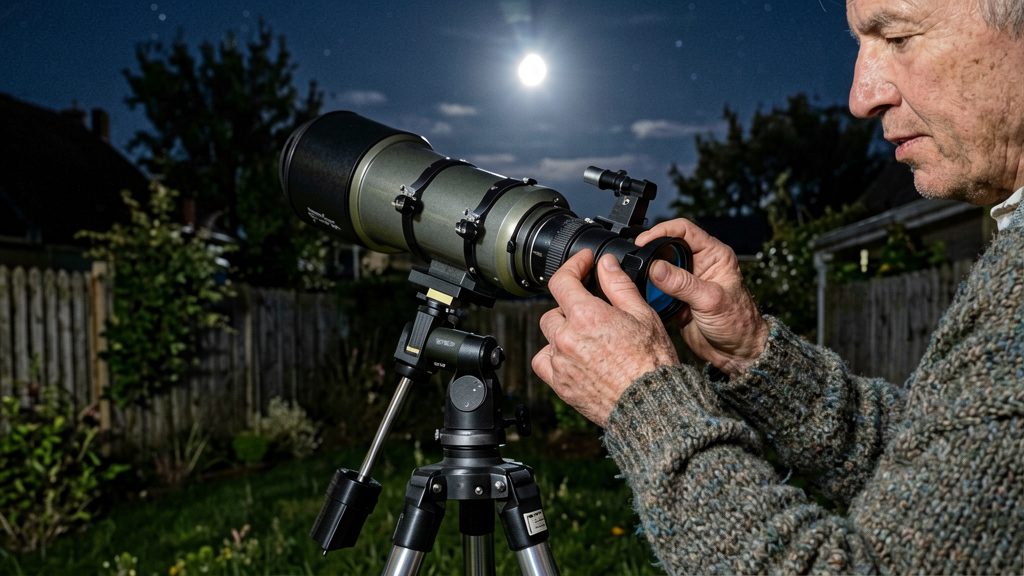
A fixed neutral-density (ND) Moon filter reduces the amount of light reaching the eyepiece across the whole image, so the Moon gets dimmer without a change in colour. The neutral density principle is the core of the design: the glass absorbs light evenly across the visible spectrum rather than favouring one colour. Celestron’s Neutral Density Moon Filter (94105) passes 13% of light and blocks 87%, which is the transmission level that a typical No. 96 density 0.90 filter also gives.
How the dimming works
- Transmission: The 94105 lets 13% of the incoming light through, so the Moon appears roughly one-eighth as bright as it does unfiltered.
- Even dimming: Because the reduction is uniform, the bright limb, the mare and the highlands all darken by the same proportion. Celestron describes the 94105 as dimming the Moon evenly.
- No colour tint: Celestron states that the filter dims the Moon without a colour cast, so the Moon keeps its natural tone in the eyepiece.
Where it helps
The Moon can be painfully bright in telescopes larger than about 3 inches (76 mm) when it is more than half full, according to Astronomy magazine. That is the situation where a fixed ND filter’s dimming is most useful.
How does a variable polarizing filter work?
A variable polarizing filter controls Moon brightness by rotating one polarizing element against a second one. Changing their relative angle changes how much light passes through, so you set the brightness by turning the filter rather than choosing a fixed density in advance. According to Celestron, its Variable Polarizing Filter (94107) has adjustable transmission of 1% to 40%, and the color of the image stays unchanged across that range.
Setting the brightness
- Thread the filter onto the bottom of the eyepiece and point the telescope at the Moon.
- Turn the outer ring slowly while watching the glare.
- Stop when the surface detail is clearest and the glare is comfortable. This is the transmission range you need for that night’s Moon phase and telescope.
The usable range depends on the model, so check the manufacturer’s stated figures:
| Source | Stated range | Note |
|---|---|---|
| Celestron 94107 | 1% to 40% | Color unchanged |
| Starizona, typical polarizer set | 1% to 40% | Can block more light than a 0.9 ND filter |
| Astronomy magazine (Robert A. Garfinkle), adjustable two-filter system | Roughly 3% to 50% | Range varies by model |
Reducing glare and darkening the sky
Glare is the main reason to use a polarizer. Polarizing filters reduce glare and darken the sky, according to Astronomy magazine.
The sky background also darkens. Sky light is most polarized at 90° from the Sun, so when you observe the quarter Moon in daylight, the polarizer can reduce the blue sky behind it. Rotating the filter changes how strongly the sky is dimmed, not only the Moon.
Which filter suits which Moon phase and telescope size?
The Moon’s brightness and your telescope’s aperture decide which filter you need. According to Astronomy magazine (Robert A. Garfinkle), the Moon can be painfully bright in telescopes larger than about 3 inches (76 mm) when it is more than half full. Filters help most from First to Third Quarter, according to Astronomy magazine. Match the transmission to the phase and aperture, and check that the filter’s stated aperture range covers your telescope.
Matching transmission to aperture and phase
| Situation | Option | Transmission |
|---|---|---|
| Moon more than half full, telescope above about 3 inches (76 mm) | Celestron Neutral Density Moon Filter (94105) | 13%, no colour tint |
| Same situation, with adjustable brightness | Celestron Variable Polarizing Filter (94107) | 1% to 40%, colour unchanged |
| Telescope under 127 mm, economical viewing | Celestron basic Moon Filter (94119-A) | 25%, green tint |
For a larger instrument, Celestron’s 94105 or 94107 are the options discussed here.
Quarter phases
Between First and Third Quarter, use a filter when the Moon is bright enough to cause discomfort in your telescope. Polarizers can help with the quarter Moon in daylight, because sky light is most polarized 90° from the Sun.
Polarizer range varies by model
The adjustable polarizer range is not the same across sources. Celestron lists 1% to 40% for the 94107, while Astronomy magazine cites roughly 3% to 50% for an adjustable two-filter system. Read the transmission range printed on your own filter before choosing it for a specific phase.
Do you need a filter to observe the Moon?
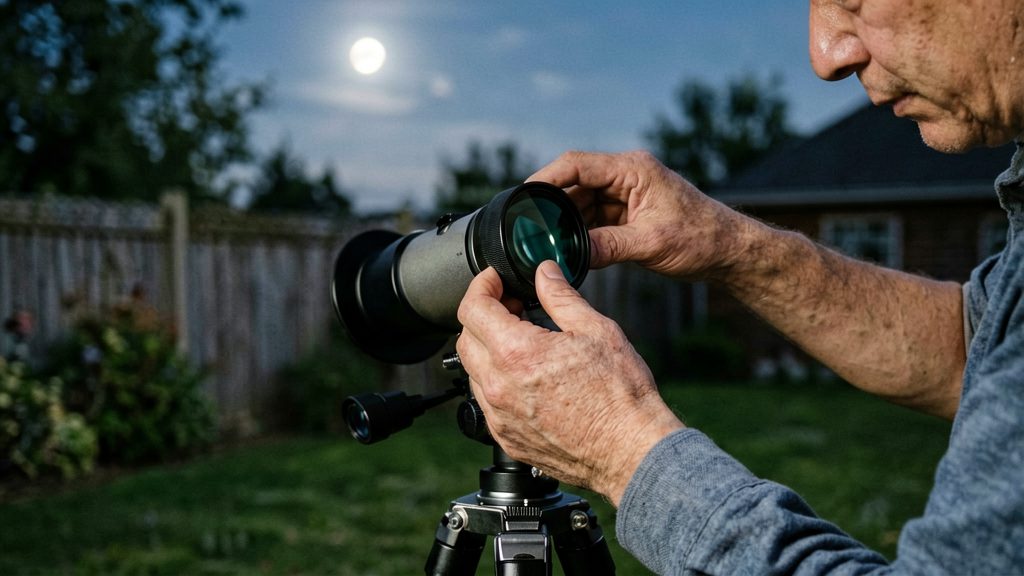
A filter is optional, and whether you need one depends on your telescope’s aperture, the Moon’s phase and how comfortable the view is for you. In very small telescopes and binoculars, the unfiltered Moon is often comfortable to look at. The Moon can be painfully bright in telescopes larger than about 3 inches (76 mm) when it is more than half full. A filter becomes useful when glare rather than lack of detail is the problem.
Signs that glare calls for a filter
Use these checks to decide whether to add a filter:
- Squinting, watering eyes, or a headache after a few minutes at the eyepiece
- Bright areas washing out crater rims and fine detail near the lit edge
- Difficulty holding focus because the image feels too bright to judge
Aperture is the main factor. A larger telescope gathers more light, so the bright Moon becomes uncomfortable sooner than in a small instrument.
Filter-free options
| Situation | Practical approach |
|---|---|
| Telescope of about 3 inches (76 mm) or smaller, or binoculars | Observe unfiltered first; glare is often tolerable |
| Larger telescope, Moon more than half full | Consider a filter; a lower-power eyepiece gives a wider view but a brighter image |
| Still too bright after changing eyepieces | Add a filter |
A lower-power eyepiece shows a wider view of the whole disc, which is easier to take in than a magnified fragment. It does not dim the Moon, though: a larger exit pupil sends more light to the eye, so a filter is still the way to cut glare.
Can color filters improve lunar detail?
Some color filters do improve lunar detail, but the result depends on the filter’s hue. Yellow filters improve contrast and cut glare, orange sharpens shadow edges, and a green such as No. 58 helps show thin shadows. The No. 47 violet passes about 3% of light and is too dark for crescent phases. Each color also tints the view, so a filter that helps one kind of feature can make the overall image look noticeably different from the unfiltered Moon.
| Filter (Wratten number) | Documented effect on the Moon |
|---|---|
| No. 12 yellow | Improves contrast and cuts glare |
| No. 15 yellow | Improves contrast and cuts glare |
| No. 21 orange | Sharpens shadow edges |
| No. 58 green | Helps show thin shadows |
| No. 47 violet | Passes about 3% of light, too dark for crescents |
Yellow filters are the most general choice, because they combine added contrast with reduced glare. Orange and green filters are more specialised: use them when you want to examine shadow edges or faint shadows rather than general surface brightness.
Celestron Basic Moon Filter (94119-A)
Celestron’s basic Moon Filter (94119-A) is a green filter that uses #58 green glass and transmits 25% of light. According to Celestron (the manufacturer’s product description), it is intended for economical Moon viewing in telescopes under 127 mm aperture and adds a green tint to the image. It is a fixed color filter, so any benefit comes from the green glass (No. 58 helps show thin shadows) rather than from adjustable density.
Filter sizes, stacking and safety
Eyepiece filters are sold in three thread sizes, each matched to the diameter of the eyepiece barrel: 0.965-inch, 1.25-inch and 2-inch. The 1.25-inch size is the most common. Measure your eyepiece barrel or check its specification before buying, because a filter of the wrong size will not fit.
Stacking limits
Stacking means screwing one filter onto another. Some Moon filters are threaded on one side only, which prevents stacking. Celestron’s basic Moon Filter (94119-A) is one example. It is threaded on one side, so it cannot be combined with a second filter. Check the threading on both faces of each filter before buying a second one to combine with it.
Refocusing after a change
Inserting or removing a polarizing filter usually requires refocusing, so check focus after each change.
Sun safety
Photographic neutral-density (ND) filters must never be used to look at the Sun. A typical ND Moon filter, such as the No. 96 with a density of 0.90 and 13% transmission, dims the Moon for comfortable viewing. That dimming does not make it safe for solar observation.