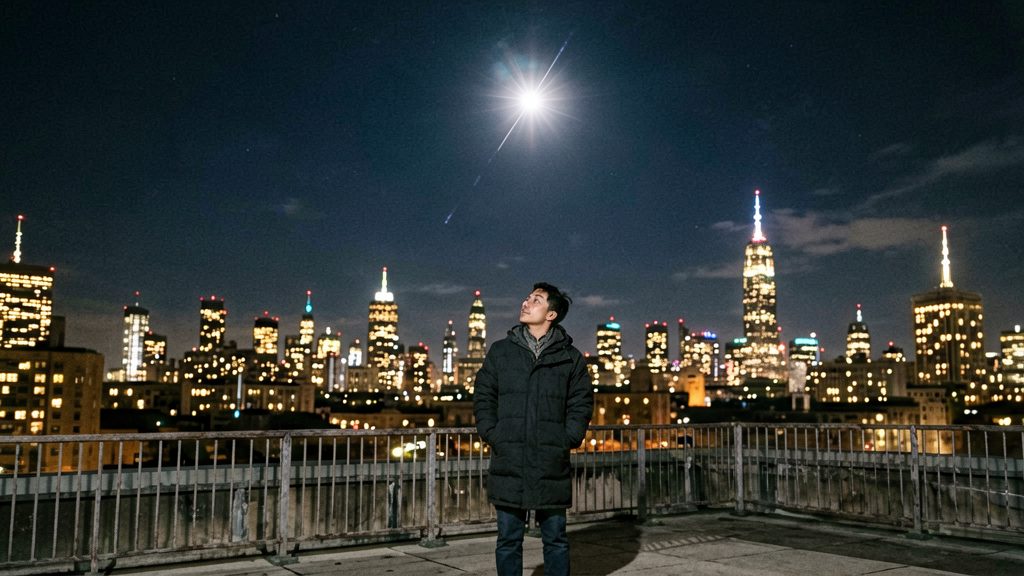
Yes. The Canadian Space Agency (2026) states that the International Space Station needs no equipment to be seen and looks like a “big white dot” to the naked eye, so you can spot it from Toronto without binoculars or a telescope. It is usually the brightest object in the night sky after the Moon, which is why it remains visible from urban areas despite light pollution. Its steady, one-directional motion, combined with its brightness, is what separates it from the stars around it.
Can you see the ISS from Toronto with the naked eye?
ISS brightness compared with the Moon and stars
The ISS is usually the brightest object in the night sky after the Moon. Using that ranking from the Canadian Space Agency (2026):
| Object | Brightness relative to the ISS |
|---|---|
| Moon | Brighter than the ISS |
| ISS | Usually the brightest object after the Moon |
| Stars | Fainter than the ISS |
The CSA says the ISS is usually the brightest object after the Moon, so a pass near a bright Moon can be harder to pick out.
Why it looks like a steady white dot
The CSA describes the ISS as a “big white dot” to the naked eye. The CSA describes the ISS as a “big white dot” that moves quickly and steadily in one direction, which sets it apart from stars.
Effect of urban light pollution
Light from streets and buildings brightens the sky background, which makes faint objects harder to see. The ISS is bright enough to stay visible despite this, according to the CSA (2026), which is why Toronto’s city lights do not prevent a sighting. Light pollution still reduces the contrast between the station and the sky, so the object may look less striking than it would from a dark site.
How do you find ISS pass times for Toronto?
To see the International Space Station pass over Toronto, you need its predicted pass times and a clear view of the sky. The Canadian Space Agency (2026) points to NASA’s Spot the Station for pass times, ESA’s Where is the ISS? for the live position, and its own live views from the ISS.
Using NASA’s Spot the Station
Spot the Station, run by NASA, lists the passes over your area for the next two weeks. Enter your location and note the listed passes and their start times.
Using ESA’s Where is the ISS?
ESA’s Where is the ISS? page shows the station’s live position on a map. Use it to confirm that the station is currently in your part of the sky, which helps when a predicted pass is close to its start time.
Reading a pass listing
Pass listings generally give a start time, a direction and a peak height, but check what your chosen tool shows. Before going outside:
- Note the start time and the direction of rise, then face that direction a few minutes early.
- Check the peak height: a higher peak keeps the station above the horizon for longer and gives a better view.
- Note the end time so you know when to stop watching.
Best time of night to spot the ISS
The ISS is visible because it reflects sunlight, so the best timing depends on the Sun as much as on the clock. A pass is easiest to see when the sky around you is dark but the station is still lit by the Sun. Passes are generally seen in the hours after sunset or before sunrise, when the sky is dark but the station is still lit by the Sun. The CSA only says ‘night sky’, so check the exact times in a pass listing. A darker sky still makes the pass easier to track.
Evening passes
- Be outside a few minutes before the listed start time, even if the sky still has some twilight glow, and follow the listing rather than waiting for full darkness.
- Check the pass start time against local sunset for your date. A pass that begins while the sky is still bright is harder to pick out.
-
- Watch the whole listed pass, since the station can fade suddenly if it enters Earth’s shadow.
Morning passes
- The logic is reversed: the sky must still be dark, and the station must still be sunlit.
- A pass that ends as the sky brightens may be harder to follow toward its end.
- Compare the pass end time with local sunrise to judge whether the sky will still be dark enough.
Seasonal shifts
Hours of darkness change through the year, so the pass times that work in one season may fall in daylight or twilight in another. Do not reuse a timing from a previous month. Look up passes for the specific date before you go out.
How to tell the ISS from a plane or a star
The International Space Station is one of the easiest objects to confuse with an aircraft at first, but a few visual cues separate it reliably. Once you know what to watch for in its motion and light, you can rule out planes and satellites in a few seconds.
Steady, single-direction motion
The ISS crosses the sky in a smooth, continuous arc in one direction. The Canadian Space Agency (2026) states that it moves quickly and steadily in one direction, unlike aircraft, which can change course. Track the object for its full path: if it bends, turns back, or changes heading mid-sky, it is almost certainly an aircraft.
No blinking navigation lights
Aircraft carry red, green and white navigation lights, and many also show flashing strobes or beacons. The ISS appears as a steady white dot rather than a blinking light, so a flashing or coloured light more likely points to an aircraft.
Stars stay fixed while the ISS crosses
Stars and planets hold their positions relative to each other as the night progresses. The ISS moves against that background, so a useful check is to pick two or three nearby stars and confirm they stay in place while the object passes through the field. If the object drifts past a fixed pattern of stars, it is a moving body in low orbit rather than a star.
Do you need binoculars or a telescope?
No. According to the Canadian Space Agency (2026), the ISS needs no equipment to be seen. Optical aids are optional and are mainly a challenge for experienced observers.
Field of view versus apparent speed
A pass is a short, continuous crossing rather than a slow drift, and the station leaves a view quickly once it enters one.
- Naked eye: the widest field of view. You can follow the station across the sky without moving your head much, and you don’t need to find it in an eyepiece first.
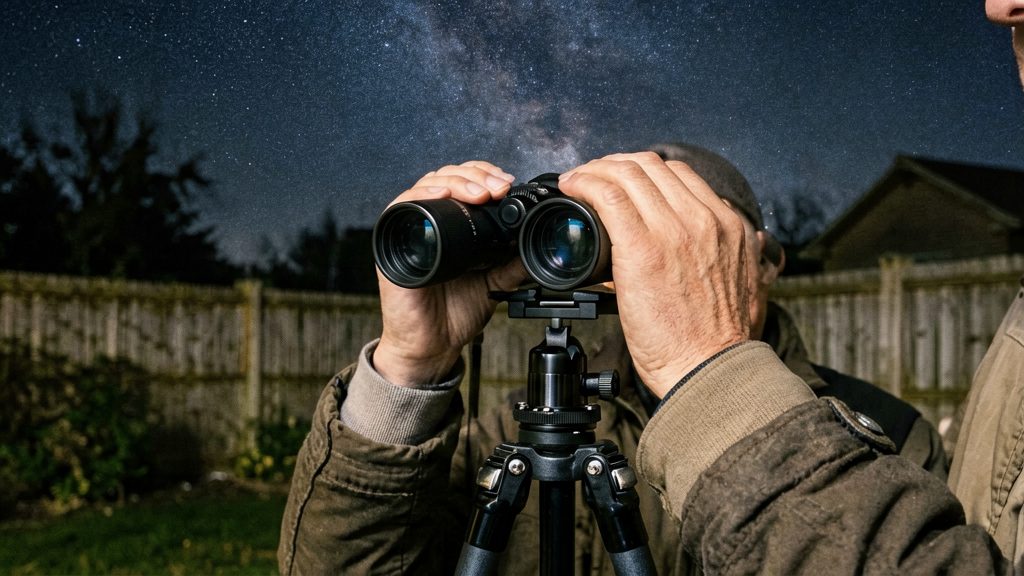
- Binoculars: a narrower field than the eye. You must sweep to keep the station centred, which takes practice, but the image is brighter and steadier, but you must keep sweeping to follow the station.
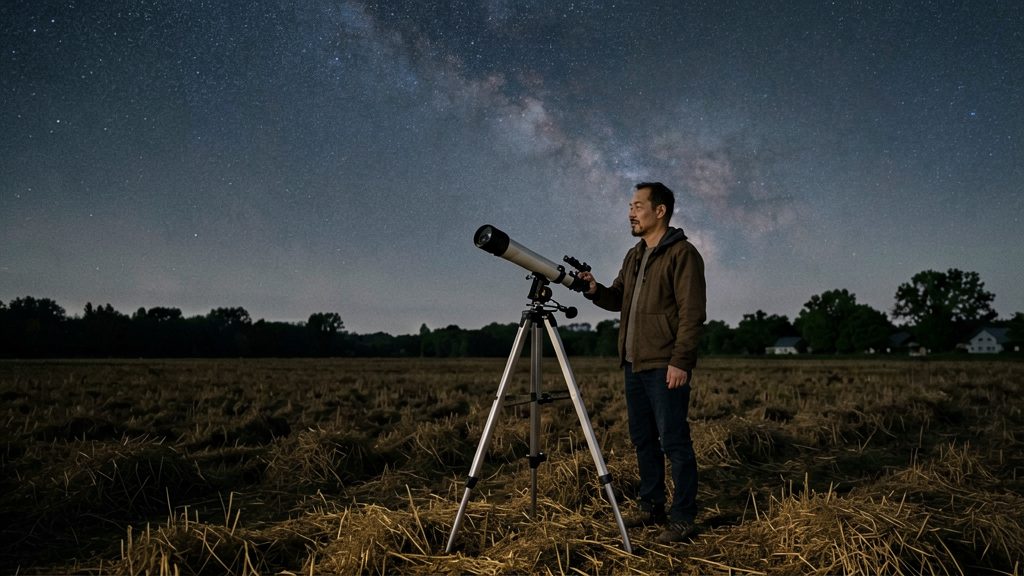
- Telescope: the narrowest field. Once magnification increases, the station can cross the view in a very short time, so it is easy to lose.
Why naked-eye tracking often suffices
The station is bright enough that the naked eye can follow it easily, so it stands out even from urban areas. At about 400 km above Earth, the station appears as a small moving point to the eye. You are following a moving point, and your eyes do that well.
Telescope magnification and tracking difficulty
A telescope used for a pass needs one of two approaches:
- Low power and manual tracking: use the lowest-power eyepiece, centre the station before it enters the view, and nudge the tube to follow it.
- Motorised or tracking mount: a mount that follows the sky keeps the object in the field more easily, though it still needs accurate alignment.
Where to watch in the Toronto area
For a pass that climbs high in the sky, you need a site where you can see the whole arc, from one horizon to the other, without trees, rooftops or towers blocking the view. Because the ISS crosses the sky in one steady direction, a spot with a wide, open view in both directions works better than a narrow gap between buildings. You only need a site where its path is not interrupted.
Unobstructed horizon for high passes
- Choose ground with a clear view of the sky down to the horizon in several directions, not only overhead.
- Avoid courtyards and narrow streets, where buildings hide the lower part of the path and cut short the visible arc.
- Check the site in daylight first, noting tall trees, billboards and apartment towers.
Lakefront and open parkland
- Shoreline and large open parks give a wider sky than most residential streets, so they suit passes that travel across much of the sky.
- Pick spots away from direct streetlights where possible. Turning off your phone screen and avoiding flashlights helps your eyes adjust to the dark.
Safe access and parking at night
- Use only parking areas that are open and signed for the time you plan to be there, and follow posted restrictions.
- Choose a well-lit lot or a spot close to the path you walk on, and go with at least one other person.
- Tell someone where you are and when you expect to leave.
Photographing the ISS with a phone or camera
Photographing the station is mainly a matter of holding a steady camera and choosing an exposure that either freezes that dot or records its path across the sky. Its motion is predictable, which makes it easier to plan a shot.
Phone: manual exposure and tripod stability
Most phone cameras handle a night scene automatically, but automatic modes often brighten the sky and blur the dot. Use the phone’s manual exposure control (often labelled Pro or Manual mode) if it has one, and lower the exposure until the sky is dark and the dot is still clearly visible.
For tripod stability, mount the phone on a tripod or rest it on a firm, flat surface. Use a timer or a Bluetooth remote so that pressing the shutter does not shake the phone. Keep the phone in one position; with a long enough exposure a fixed frame records the station as a streak, while hand movement adds blur.
Camera: exposure settings for a moving dot
A camera gives you direct control over the two settings that decide the result:
- Shutter speed: A short exposure freezes the station as a point of light. A longer exposure turns it into a trail, which shows the direction of travel because the ISS moves steadily in one direction.
- Aperture and ISO: Start with a wide aperture and a moderate ISO, then adjust the shutter speed until the sky is dark and the dot is bright without being overexposed.
Focus manually on a distant star or bright object, since autofocus may hunt in the dark. Take a short sequence of frames at slightly different settings and compare them on screen, because you cannot review the exposure in the field as easily as during daylight shooting.
Framing the ISS with the Moon or stars
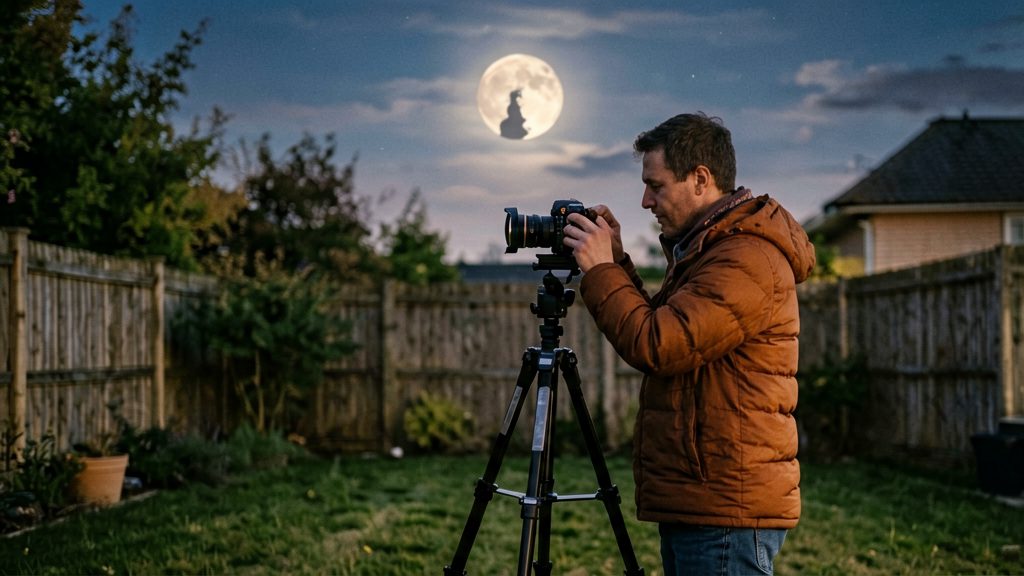
The Moon is a natural reference for framing. A wide shot that includes the Moon places the station in a recognisable context, though the Moon will be much brighter than the station, so you may need to set exposure for the dot and accept a brighter Moon.
Stars help you judge the path. Include a recognisable star pattern in the frame, then compare the trail or dot position across consecutive frames. This shows the direction of travel without any extra equipment.