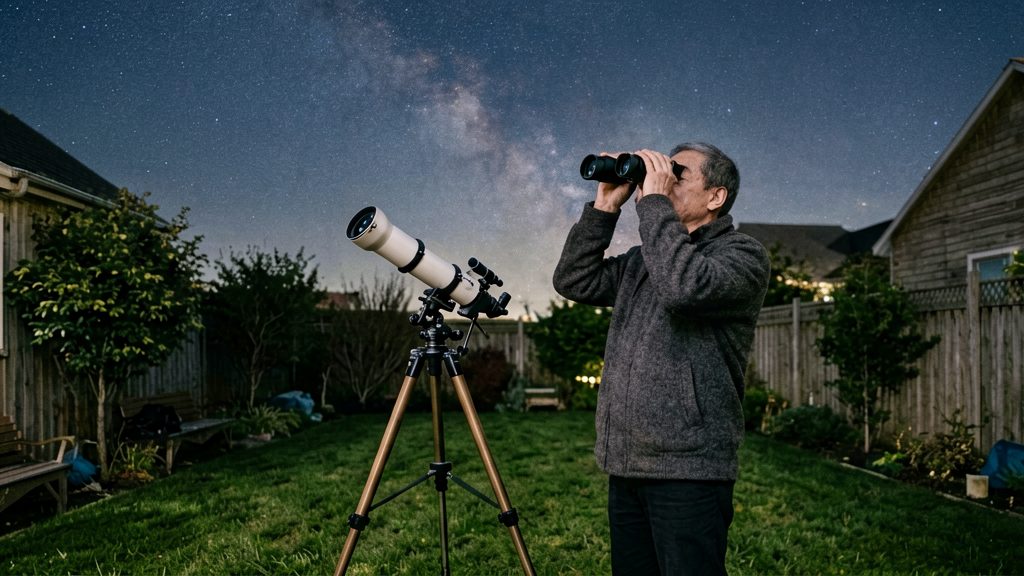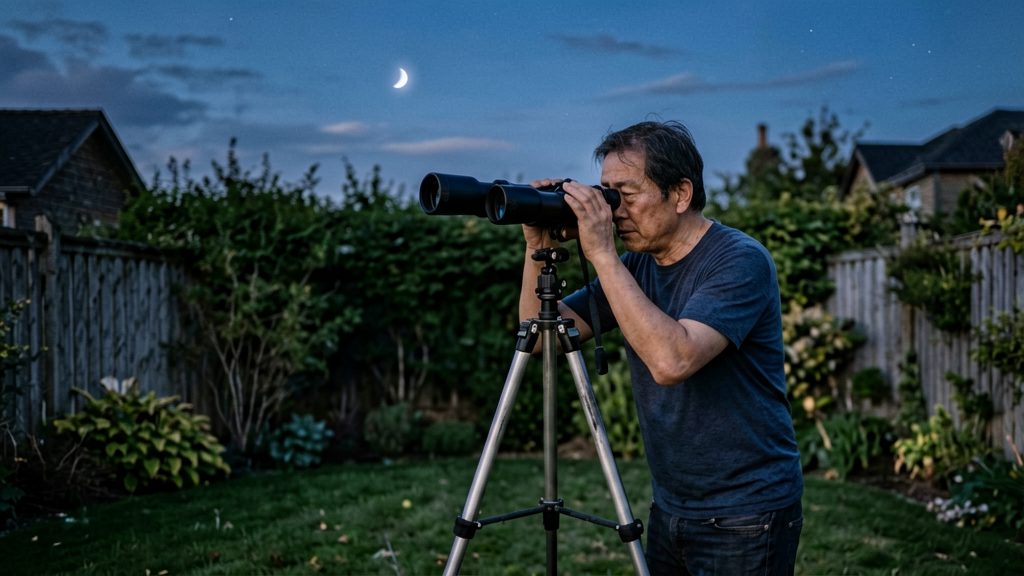
For most backyard observers, the 7x50 is the practical starting point because it is much easier to hold steady without support. The 10x50 is the better choice if your skies are light-polluted and you can keep the binoculars still on a monopod or tripod, since its smaller exit pupil gives a darker sky background that helps contrast. Both sizes are described as strong all-around astronomy binoculars, so the right pick depends mainly on your sky and how you hold them.
7x50 vs 10x50: the quick answer
The table compares the two sizes as sold in the common 50 mm format. Exact figures vary by model, so check the label or the manufacturer’s specifications for the model you are considering.
| Specification | 7x50 | 10x50 |
|---|---|---|
| Magnification | 7x | 10x |
| Objective diameter | 50 mm | 50 mm |
| Exit pupil | About 7.1 mm | 5 mm |
| Resolution of close pairs in open clusters | About 20–21 arcseconds (Telescopic Watch, 2026) | About 15 arcseconds (Telescopic Watch, 2026) |
Magnification trades against brightness: the 10x enlarges the view more but spreads the same light over a smaller exit pupil, which makes the sky background darker.
Overall verdict
- 7x50 suits hand-held, general use and most observers who do not have a mount.
- 10x50 suits observers with light-polluted or moonlit skies who can support the binoculars on a monopod or tripod.
Sky-specific caveats
- Telescopic Watch (2026) says the 7x50’s brightness advantage on extended objects is cancelled out by light pollution, so the 10x50’s darker background can matter more from a light-polluted backyard.
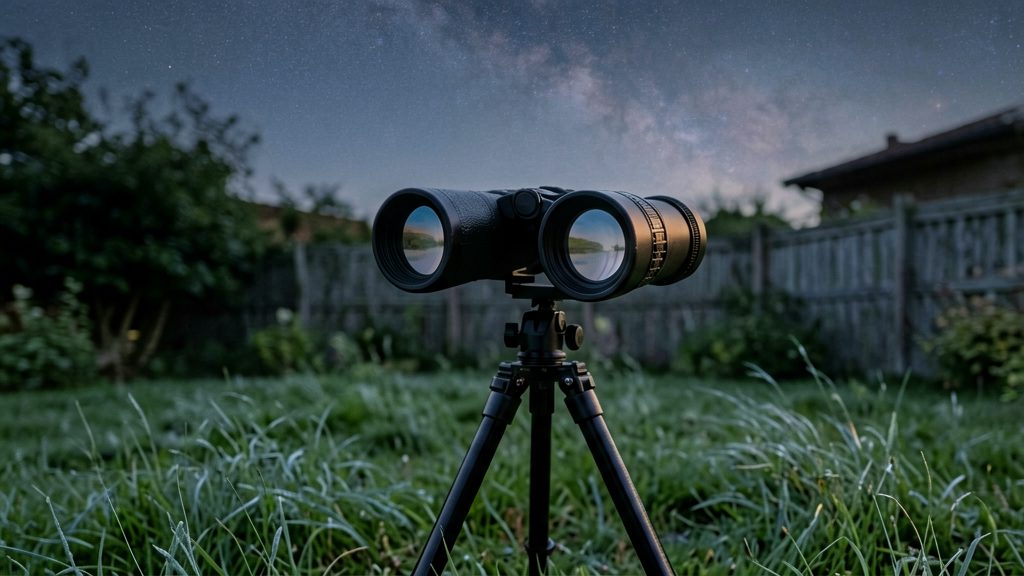
- A 10x50 may need a monopod or tripod for long sessions, so factor in the cost and carrying weight of a support.
What does exit pupil mean for stargazing?
The exit pupil is the diameter of the light beam leaving the eyepiece, in millimeters. It sets how much of the objective’s light reaches your eye at once. For binoculars, the formula is aperture divided by magnification: 50 mm ÷ 7 = 7.1 mm for a 7x50, and 50 mm ÷ 10 = 5 mm for a 10x50. A larger exit pupil delivers more light to the eye, but only up to the point where the eye can use it.
| Model | Exit pupil | Position against the ~7 mm dark-adapted ceiling |
|---|---|---|
| 7x50 | 7.1 mm | At the ceiling |
| 10x50 | 5 mm | Below the ceiling |
Why bigger is not always brighter
According to Starizona (2026), the dark-adapted pupil tops out near 7 mm. An exit pupil wider than that cannot fill your eye, so the extra light is lost. The 7x50’s 7.1 mm exit pupil already sits at that limit, so it delivers close to the most light a dark-adapted eye can take in. Going to a larger aperture or lower magnification would add nothing for most observers.
The 10x50’s 5 mm exit pupil sits inside the limit, so the eye can use all of its light. Its extended-object view is dimmer than the 7x50’s only when the observer’s pupil opens wide enough to take in the 7x50’s larger beam.
Vignetting when the pupil does not fully open
Telescopic Watch (2026) reports that a 7 mm exit pupil can vignette if the observer’s eyes do not dilate that far. Vignetting is darkening toward the edge of the field, because the eye’s own iris cuts off the outer part of the light cone before it reaches the retina. If the field edges look dim or cropped at 7x, your pupil is probably not fully open, and the 10x50’s smaller exit pupil will give an evener view.
Which has the wider field of view?
The 7x50 generally has the wider true field of view. Starizona (2026) states that the 7x50 has a wider field than the 10x50, and that binoculars typically offer 5 to 7 degrees of true field of view. Telescopic Watch (2026) cautions that field width varies by model and that the 7x50 is not always wider than the 10x50, so compare the figure printed for the exact pair you are considering.
How the field width affects scanning and star-hopping
A wider field shows more sky in each sweep, which makes scanning faster when you explore a region such as a dense part of the Milky Way. For star-hopping, a wider field keeps more reference stars in view at once, so you can move from a bright guide star to a faint target with fewer re-centering moves. A narrower 10x50 field rewards more precise pointing, because the target and its reference stars occupy a smaller area of the view.
Framing large objects: the Pleiades and Andromeda
The Pleiades (M45) and the Andromeda Galaxy (M31) are extended targets that cover a large area of sky. The wider field of a 7x50 gives more room around these objects, so the whole group or the galaxy’s faint outer glow can sit inside the view with space to spare. With a 10x50, the same objects are more likely to extend past the edges, and you need to pan to see their full shape.
Before choosing, check each target’s apparent size in a star-chart or planetarium app and compare it with the true field of your binoculars.
Can you hand-hold 10x50 binoculars steadily?
Most observers can hand-hold a 7x50 with a reasonably steady view, but few can hold a 10x50 without visible shake. Starizona (2026) reports that a 7x50 appears to shake less and is much easier to hold, and that few people can hold even 10x steady. Because hand movement is magnified along with the image, the wobble that is barely noticeable at 7x becomes obvious at 10x.
How magnification amplifies tremor
Each movement of the hands moves the field of view by a larger amount at higher power, so faint stars and fuzzy targets drift out of the eyepiece more often. Starizona (2026) also notes that the difference between 7x and 10x for stargazing is minimal, so the practical gap is how steadily you can hold each one.
| Factor | 7x50 | 10x50 |
|---|---|---|
| Movement seen in the eyepiece | appears to shake less | hand movement magnified |
| Typical hand-held steadiness | much easier to hold | few people hold it steady |
Who can hold 10x50 steady
Steadiness depends on the individual, so the practical test is to hold each model on a star or bright object for a few seconds before buying. If the image keeps drifting off target, a 10x50 will be frustrating without support. Observers with a tremor or limited arm strength should treat a 7x50 as the more realistic choice for hand-held viewing.
Elbow and chest support positions
Bracing reduces movement more than gripping harder does. Use these positions:
- Seated: rest both elbows on your knees, or on a table, and press the forearms against your chest.
- Standing: lock elbows against your ribs and lean your back or shoulder against a wall, fence post or car roof.
- Before viewing: breathe out and pause briefly, so the chest is still when you look.
Which is better under light-polluted skies?
Under city glow or bright moonlight, the 10x50 is the better choice for extended objects such as galaxies and nebulae. Its 5 mm exit pupil gives a darker sky background, which improves contrast against the glow. The 7x50 has a larger exit pupil of about 7.1 mm, but according to Telescopic Watch, its brightness advantage on extended objects is cancelled out by light pollution. That is why Telescopic Watch recommends 10x50s over 7x50s when dark skies are not available.
Comparison under glow and moonlight
| Factor | 7x50 | 10x50 |
|---|---|---|
| Sky background under glow | Lighter, per Telescopic Watch’s comparison | Darker, which helps contrast |
| Brightness advantage on extended objects | Cancelled out by light pollution (Telescopic Watch) | Not offset by a brightness gain |
| Telescopic Watch advice for light-polluted sites | Not recommended by default | Recommended by default |
Practical test at your site
Compare the two pairs on the same extended object from your own location. Pick a target that is easy to find, observe it at the same time and position, and note whether the object stands out more clearly from the background in each pair. Repeat the test on a night with moonlight, since the sky background changes with the Moon’s phase and height.
Do you need a tripod?
For a 7x50, hand-holding is usually enough. Tripods are mainly needed above 10x. A 10x50 sits at that boundary: Starizona says few people can hold even 10x steady, and Telescopic Watch notes that it may need a monopod or tripod for long sessions.
| Binocular | Support guidance | Source |
|---|---|---|
| 10x50 | May need a monopod or tripod for long sessions | Telescopic Watch |
| Above 10x | Tripods mainly needed | Starizona |
When a monopod is enough
Telescopic Watch says a 10x50 may need a monopod or tripod; a monopod is generally the lighter option. A monopod takes part of the binocular’s weight off your arms and steadies the view, but it does not lock the binoculars in place the way a tripod does. For long sessions, that is usually the trade-off to weigh: less setup and portability against a steadier, hands-free view.
Neck and back fatigue
Long sessions at the eyepiece load the neck and back, and a heavier binocular adds to that. Go-Astronomy recommends a tripod for these binoculars, which removes the need to hold them at all. If you observe without a support, a reclining chair or a seat that lets you look up without tilting your head reduces strain. Shorter sessions with frequent breaks also limit fatigue.
Which should beginners buy?
Sky conditions, the observer’s age, and how steady they can hold the binoculars decide most first purchases. Go-Astronomy calls both the 7x50 and the 10x50 the best all-around astronomy binoculars. The rules below follow from the pupil figures and the observing conditions.
Matching the model to your situation
| Situation | Suggested pick | Basis given by the sources |
|---|---|---|
| Dark-sky site, steady hands, younger adult | 7x50 | Exit pupil of about 7.1 mm already reaches the dark-adapted pupil of about 7 mm, so a younger observer under dark skies gets the most light from the 7x50, and the 10x50’s smaller 5 mm exit pupil adds no brightness (Starizona) |
| Light-polluted sky | 10x50 | Telescopic Watch’s default recommendation when dark skies are unavailable |
| Observer over 40 | Either; choose by steadiness | Pupils around 5 mm see similar brightness in both (Starizona); Go-Astronomy says the maximum dilated night pupil is likely closer to 5 mm |
| Splitting close pairs in open clusters | 10x50 | Resolution of about 15 arcseconds versus 20 to 21 for the 7x (Telescopic Watch) |
Buyer age and pupil size
The exit pupil is the bright disc of light the binocular sends to your eye. Its effect depends on how far your pupil opens in the dark. A 7x50’s exit pupil of about 7.1 mm is at or above the roughly 7 mm a dark-adapted pupil can use, and above the roughly 5 mm that people over 40 likely reach, while a 10x50’s 5 mm matches the pupils of older observers. A buyer over 40 gains little from the 7x50’s extra light, so the choice rests on the other factors in the table.
Choosing a binocular for a child
Telescopic Watch names buying for a child as one of the exceptions to its 10x50 recommendation, which points to the 7x50 for young observers. The 7x50’s wider field of view also makes it easier to find targets, although Telescopic Watch notes that field width varies by model and the 7x50 is not always the wider option. Check the stated field of view and exit pupil on each model’s spec sheet before buying, rather than assuming either size is wider.
What to look for in a pair
Before buying, check the build and optical features that decide whether a pair can be mounted, focused for your eyes, and identified accurately. Most of these details appear on the product page, the printed label, or the manufacturer’s manual, so confirm them before ordering rather than after delivery.
Threaded tripod socket and adapter placement
A threaded tripod socket lets you attach the binoculars to a tripod or monopod. Go-Astronomy (2026) recommends a model with a threaded hole at the front for mounting. Not every pair has one, so check for it specifically.
- Confirm that the socket is on the front of the body, not on a side or the top.
- Check whether the socket is centred on the bridge so the binoculars balance on the mount.
- Check whether an adapter is included. If you buy one separately, confirm that its thread matches the socket listed in the manufacturer’s documentation.
Focus and diopter adjustment
Most pairs have a central focus wheel and a diopter ring on one eyepiece to correct for differences between your two eyes. Set them in this order:
- Cover the objective lens of the eyepiece that has the diopter ring.
- Focus on a distant object with the central wheel, using the eye without the ring.
- Cover the other objective lens and turn the diopter ring until the same object is sharp.
- Check both eyes together and adjust the focus wheel slightly if needed.
Confirm that the focus wheel turns smoothly and that the diopter ring has a locking or detent mechanism, if the manufacturer lists one.
Coatings and prism type
Coating and prism terms are often printed on the label or in the spec table, but the wording varies by brand. Read them against the manufacturer’s documentation.
| Feature | What to confirm | Where to check |
|---|---|---|
| Prism type | The type named in the spec sheet (for example, Porro or roof) | Product page, manual, or label |
| Lens coatings | Whether the spec states multi-coated or fully multi-coated optics | Product page or label |
| Coating on the prisms | Whether the spec describes the prism coatings separately from the lens coatings | Manufacturer’s documentation |
| Tripod socket | Presence, position, and thread size | Product photos and manual |