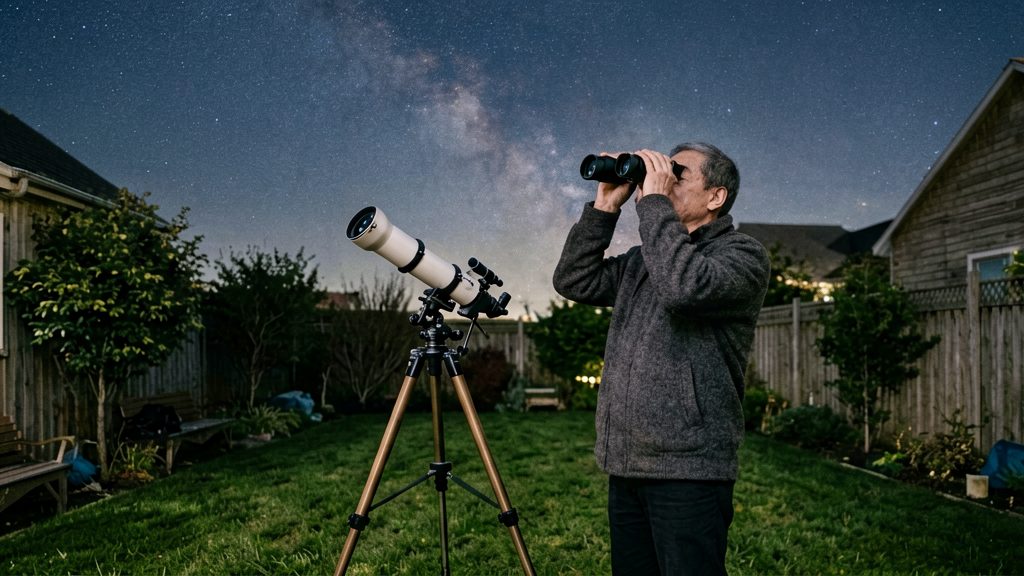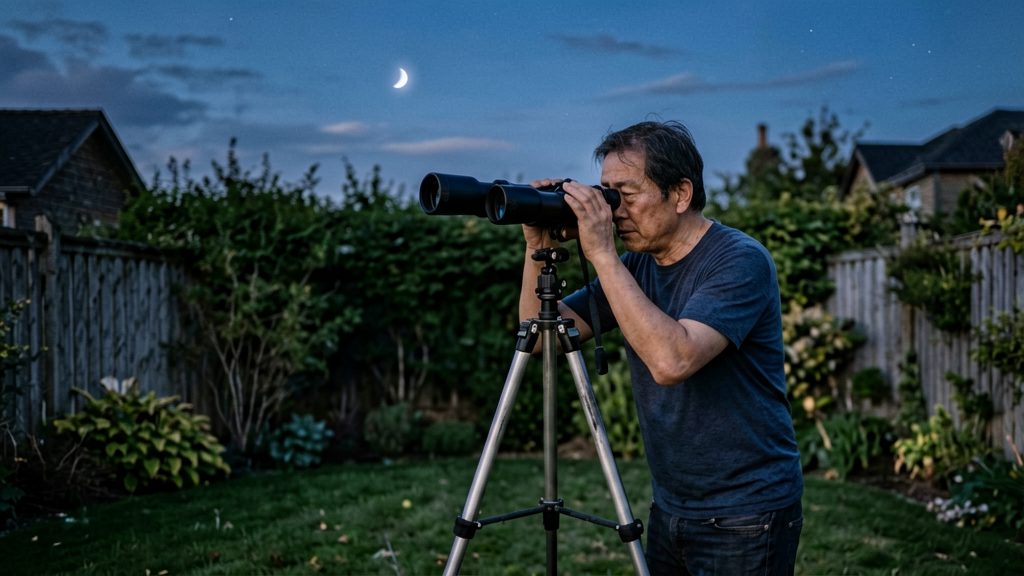
No, standard 10x50 binoculars do not show Saturn’s rings. At that size, Saturn appears as a tiny, slightly oval object rather than a sharp star-like point, and the rings cannot be picked out. The rings are real and bright, but the planet’s image is too small for binocular optics to separate the ring from the globe. Its ring structure requires more optical power.
Can you see Saturn’s rings with binoculars?
Through 10x50 binoculars, the answer is no. High Point Scientific’s Astronomy Hub (2023) and Telescopic Watch (2025) both report that Saturn looks slightly oval but stays tiny, with no visible rings.
Why the rings stay out of reach
- Magnification sets the limit. At 10x, Saturn’s disc and rings are still too small to tell apart. The sources put the point where rings begin to separate at about 20 to 30x.
- Image scale is the second limit. At 10x, the planet’s disc is small, and the narrow gap between ring and globe falls below what the eye can separate.
- Brightness is not the issue. Saturn is easy to spot, but the rings are fine structure, so a visible planet does not mean visible rings.
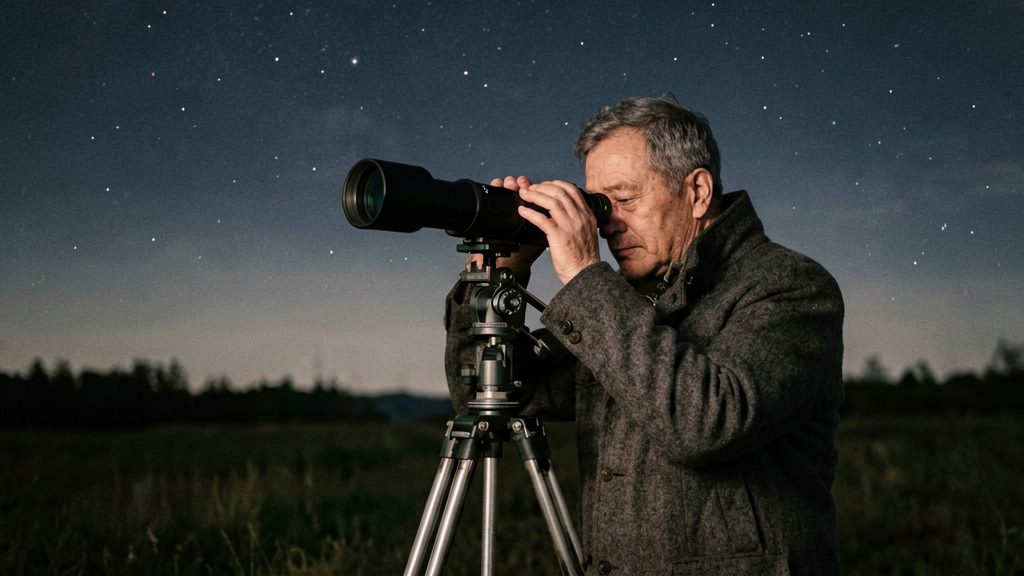
What Saturn looks like in 10x50 binoculars
To check the shape yourself:
- Center the planet in the field. Edge views are more distorted, so keep Saturn near the middle of the eyepiece.
- Compare it with nearby stars. Stars appear as points of light. Saturn should look slightly less pointlike, which is the faint oval shape the sources describe.
- Choose a steady, clear night. Saturn is bright, so dark skies matter less than steady air and a sharp focus.
How much magnification do you need for the rings?
Saturn’s rings begin to separate from the planet’s disc at roughly 20 to 30x magnification, according to Telescopic Watch (2025). That range is an approximation: the exact threshold depends on the instrument, the sky conditions and the observer’s eyesight. Once the rings are visible, two rings are usually clear at about 30x, as High Point Scientific (Astronomy Hub, 2023-08-15) reports for a small 70mm refractor or reflector.
Sources disagree on the exact starting point. Some secondary search snippets put the minimum at 25x or more, while one birdwatching forum post suggests 18 to 20x. That forum figure is not reliable evidence, so treat 20 to 30x as the working range rather than a hard limit.
Practical steps to test the threshold:
- Focus carefully, since a slightly soft image hides the faint ring edges.
- Start with an eyepiece that gives about 20x and step up toward 30x, checking whether the planet looks elongated or flanked by ring structure.
- Judge at the same magnification each time, because a change of eyepiece alters both magnification and brightness.
Do ring tilt and timing matter?
Yes. Saturn’s rings are tilted relative to Earth, and that tilt changes over the planet’s roughly 29.5-year orbit. The ring opening, the apparent angle between the ring plane and your line of sight, controls how much of the ring system is visible. A wide opening shows more ring area, while a narrow one makes the rings look thin and harder to separate from the planet. According to Telescopic Watch (2025), the rings were edge-on at the March 2025 ring plane crossing, and the opening is expected to peak around 2032.
| Period | Ring opening | What to expect |
|---|---|---|
| March 2025 | Edge-on at the ring plane crossing | Rings nearly invisible; Saturn looks like a plain oval |
| 2026 | Narrow, opening gradually after the crossing | Rings likely harder to resolve than at peak |
| Around 2032 | Peak opening | Best period to view the Cassini Division |
Because the tilt changes slowly, the ring angle stays roughly similar across a single observing season. Before a session, check the current ring angle in a planetarium app or a published ephemeris, so you know whether the rings should look wide or thin that year.
Can big tripod-mounted binoculars show the rings?
Large tripod-mounted binoculars collect more light than a standard 10x50 pair, which is the main reason they are considered for Saturn. The reference data gives no verified aperture for these instruments, so whether a given model shows the rings depends on that model. For comparison, a 10x50 binocular shows Saturn as a slightly oval point with no visible rings, while a small 70mm refractor or reflector shows the rings clearly.
Published data on large binoculars is thin. Manufacturers of models such as Oberwerk’s tripod-mounted binoculars market them for planetary viewing and state that the rings can be seen. This claim is unconfirmed by independent testing in the available data, so treat it as a claim to verify rather than a known result.
Three factors determine what a large binocular can show:
- Light gathering: A larger objective collects more light than a 10x50, so Saturn appears brighter and its outline is easier to pick out against the sky.
- Steadiness on a tripod: A tripod removes hand tremor at high power, so the image stays still long enough to judge whether the planet is a disc with extensions or a plain round point.
- Image quality at high magnification: Higher power narrows the field of view and dims the image, and optical quality and atmospheric steadiness (seeing) limit how much fine detail you can resolve. The Cassini Division, a finer feature, needs close to 100x according to Astronomy Hub (High Point Scientific, 2023). Expect fine detail to be the first limit reached, even when the rings themselves are visible.
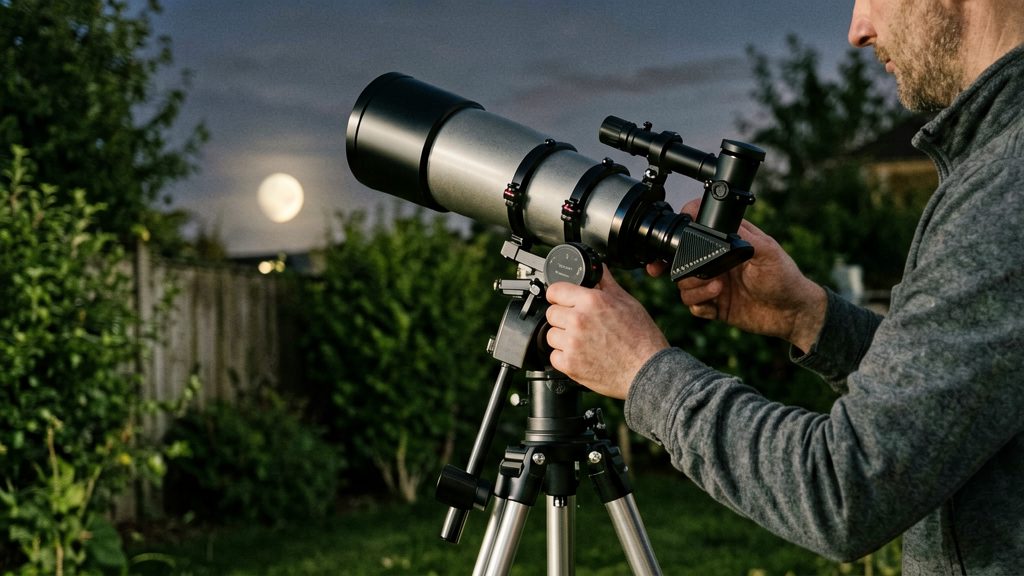
Best telescope for Saturn’s rings
A small 70mm refractor or reflector is enough to show Saturn’s rings clearly (Astronomy Hub, via High Point Scientific, 2023). Larger apertures resolve finer detail and give a more detailed view of the same rings. The table compares four telescopes by type and aperture, using the size in each model name.
| Model | Type | Aperture | Ring view |
|---|---|---|---|
| Celestron PowerSeeker 70EQ | Refractor, equatorial mount | 70mm | Rings shown clearly |
| Sky-Watcher Heritage-100P | Compact tabletop Newtonian reflector | 100mm | Larger aperture than the 70mm class |
| Orion SkyQuest XT10 Classic | Newtonian reflector on a Dobsonian base | 10-inch (254mm) | Largest aperture in this group |
| 10-inch Dobsonian | Large Newtonian reflector, Dobsonian mount | 10-inch (254mm) | Same aperture class as the XT10; the rings are the easiest to resolve here |
Refractors like the PowerSeeker 70EQ are the simplest option for a first look at the rings, because they need little setup and no collimation. Reflectors such as the Heritage-100P and the XT10 offer larger apertures, though they need occasional collimation.
A 70mm aperture is enough to show the rings clearly, and a larger aperture gives a more detailed view.
What else can you see near Saturn?
Beyond the rings, a few targets near Saturn are within reach of different equipment. The most accessible is Titan, Saturn’s moon, which experienced observers can sometimes pick out in binoculars under excellent conditions. The Cassini Division and the Encke Gap are finer features within the ring system and depend on magnification and aperture rather than on binoculars.
| Target | What it takes | Source |
|---|---|---|
| Titan | Binoculars, for experienced observers under excellent conditions | High Point Scientific (Astronomy Hub, 2023) |
| Cassini Division | Visible in almost any good telescope, but needs close to 100x magnification | High Point Scientific (Astronomy Hub, 2023) |
| Encke Gap | At least a 10-inch (254 mm) telescope | High Point Scientific (Astronomy Hub, 2023) |
For Titan, scan the area beside the planet for a faint star-like point.
For the Cassini Division, a higher magnification is needed once the rings are already resolved. Increase power gradually with a good eyepiece and watch for a dark line within the outer rings.
Tips for a sharper view
At 10x, Saturn’s image is tiny, so small movements and air turbulence can erase the faint oval shape. Steady handling and a high position in the sky help you judge the faint oval shape, but they cannot make the rings visible at 10x.
- Wait for steadier air. Atmospheric turbulence causes shimmer, which makes the planet’s disc dance and blurs fine detail. Watch for a few minutes and use the moments when the image settles, which often happen between gusts of wind. Observing from a spot that is open to the air, away from rooftops and buildings, also helps.
- Brace your elbows. Rest your elbows firmly against your torso, or on a fence, car roof or table, and keep the binoculars pressed to your eyes. This elbow bracing turns your upper body into a single stable support. Breathe out gently before you look, and avoid holding your breath while focusing.
- Observe Saturn high in the sky. Its altitude determines how much atmosphere the light passes through. A planet near the horizon is seen through a thicker layer of turbulent air, which adds blur and colour fringing. Check the planet’s height with a planetarium app and plan your session for when it is as high as possible from your site.