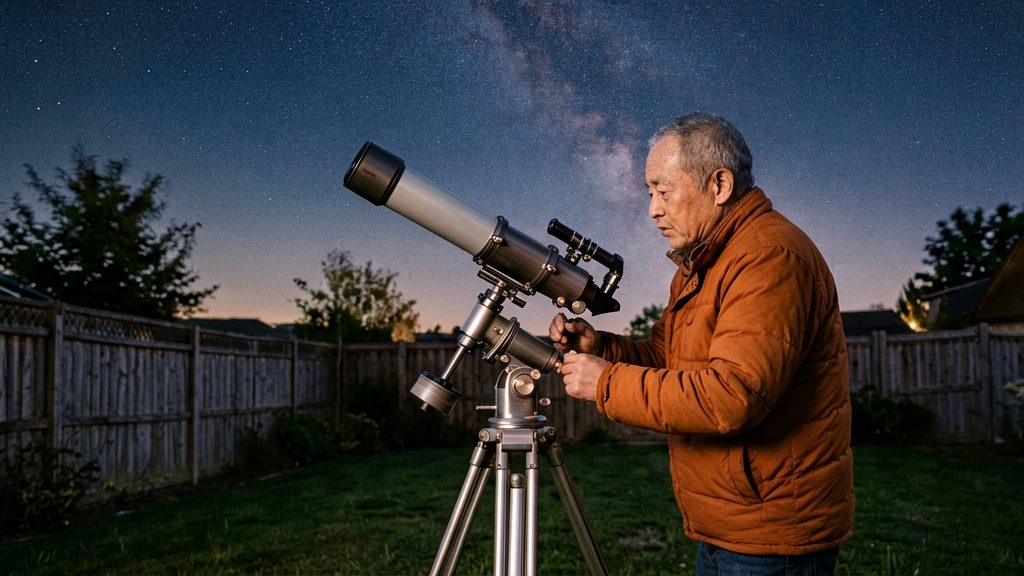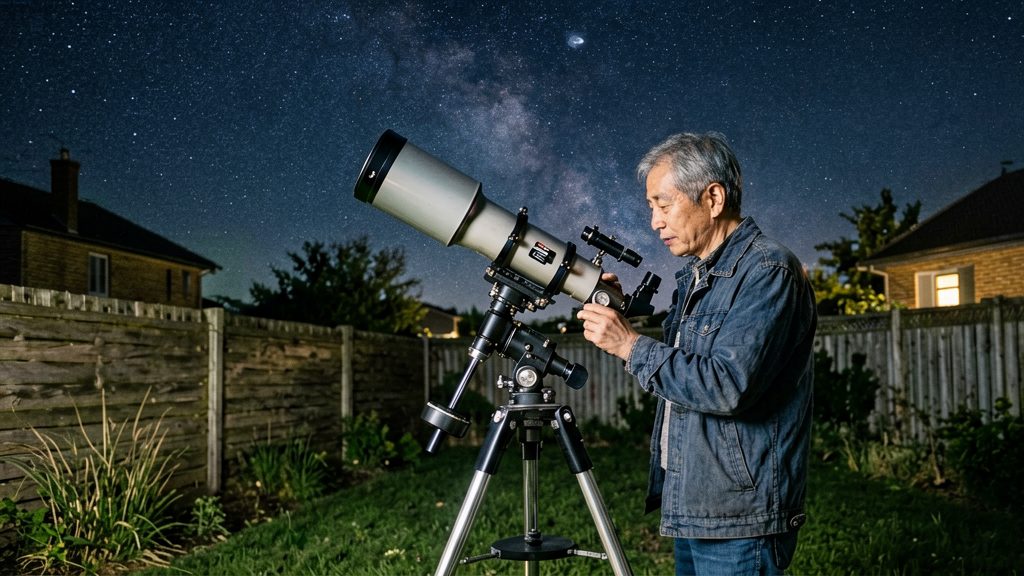
An alt-az mount moves the telescope up and down and left and right, using two axes referenced to the local horizon. An equatorial mount has one axis aimed at the north celestial pole, parallel to Earth’s rotation, so a single slow motion can follow the sky’s daily turn. This difference determines whether an object stays centred in the eyepiece without manual correction.
Alt-az vs equatorial: what’s the difference?
Axes of motion
- Altitude and azimuth: the alt-az mount’s altitude axis raises and lowers the tube over the horizon, and its azimuth axis turns it around the vertical. Following a star requires both axes to move together, at changing rates.
- Right ascension and declination: the equatorial mount’s declination axis sets how far the tube points north or south of the celestial equator. Its right ascension axis, the polar axis, turns the tube to follow the sky.
| Feature | Alt-az mount | Equatorial mount |
|---|---|---|
| Axes | Altitude and azimuth | Right ascension (polar) and declination |
| Reference | Local horizon and vertical | Celestial equator and north celestial pole |
| Motion to follow a star | Both axes combined | Mainly the polar axis |
Polar axis alignment with the north celestial pole
An equatorial mount’s polar axis must be aligned with the north celestial pole, according to Celestron (2018). Tracking accuracy depends on this alignment, so it is done before observing begins. An alt-az mount references the horizon instead and has no polar alignment step.
Daily sky motion and the rotation of the sky
As Earth turns, stars appear to rise in the east and set in the west, and the whole sky rotates around the celestial pole. Without tracking, objects quickly drift out of the eyepiece, according to Celestron (2018). An equatorial mount follows this motion with its polar axis alone. An alt-az mount needs both axes to move in a coordinated way.
Telescopic Watch notes that the advantages of an equatorial mount are mainly for astrophotography.
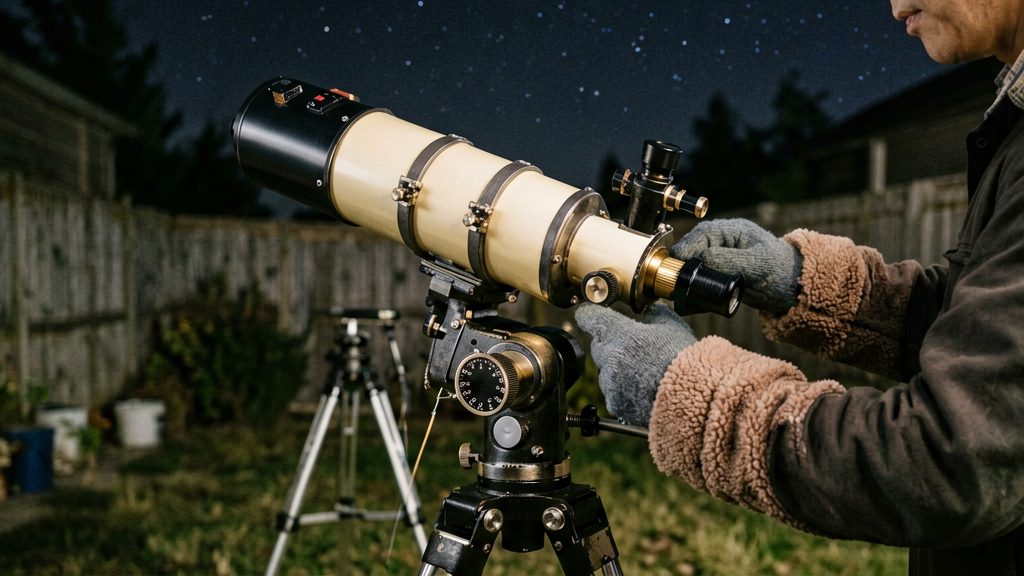
Which mount is better for viewing planets?
For visual planet observing, an alt-az mount is the common recommendation, especially for a first telescope. Telescopic Watch (c. 2023) recommends alt-az for a first visual telescope, and High Point Scientific describes alt-az mounts as typically used for planetary observing. An equatorial mount also works visually, but no verified data shows that it gives noticeably better planetary views than a GoTo alt-az.
The main difference is how the object stays in the eyepiece. An equatorial mount follows the sky’s daily motion with its polar axis, which keeps the object centred with little adjustment. A GoTo alt-az mount also tracks automatically, so this stability is available on both designs. The equatorial gain is therefore one of ease of use, not proof of sharper planetary detail.
| Factor | Alt-az mount | Equatorial mount |
|---|---|---|
| Typical use per High Point Scientific | Common for planetary observing | Works for visual use |
| Setup | Level base, no polar alignment | Polar axis must point at the north celestial pole (Celestron, 2018) |
| Main stated advantage | Simplicity for visual beginners | Mainly astrophotography, according to Telescopic Watch (c. 2023) |
Do you need tracking at high magnification?
Tracking becomes more noticeable at high power, because a narrower field of view leaves less time before the object drifts out of it.
Automatic tracking on an alt-az mount requires a computerized pointing system, known as GoTo. According to Telescopic Watch (c. 2023), an alt-az mount can only track automatically if it has GoTo.
| Setup | How the object stays in the eyepiece | Source |
|---|---|---|
| Alt-az, no GoTo | Manual nudging with slow-motion controls; the object drifts out quickly | Celestron (2018-07-02) |
| Alt-az with GoTo | Automatic tracking | Telescopic Watch (c. 2023) |
| Equatorial | Polar axis follows the daily motion | Celestron (2018-07-02) |
What is field rotation, and does it matter for planets?
Field rotation is the apparent turning of the image around the target as the telescope follows it across the sky. An alt-az mount moves on a vertical (azimuth) and a horizontal (altitude) axis, so as the sky turns, the orientation of the object in the eyepiece or camera frame changes. Visually this is hard to notice. In a photograph it appears as a curved trail of stars around the target, or as a rotated planet between frames.
According to High Point Scientific (2021), a retailer, field rotation becomes visible on alt-az mounts after about 20–30 seconds of exposure, so shorter planetary frames are less likely to be affected. The exact point at which it appears depends on your setup, so check your mount’s manual.
When it matters
| Setup | Exposure length | Field rotation |
|---|---|---|
| Alt-az, short planetary exposures | About 5–15 seconds per frame | Short frames can be stacked instead, as High Point Scientific (2021) notes for alt-az users |
| Alt-az, long exposure | Beyond about 20–30 seconds | Visible (High Point Scientific, 2021) |
| Equatorial mount or wedge | Any length within tracking limits | Corrected (High Point Scientific, 2021) |
Planetary imaging typically uses short exposures, which keeps most planetary frames below the range where the effect appears.
Correcting it with an equatorial wedge
An equatorial wedge tilts the mount’s polar axis toward the north celestial pole, so the telescope rotates around the same axis as the sky. High Point Scientific (2021) states that an equatorial mount or wedge corrects field rotation.
Practical limits
- Keep individual planetary exposures well below the 20–30 second range, as the 5–15 second frames used for stacking are.
- The 20–30 second figure comes from a single retailer, High Point Scientific (2021). Confirm the behaviour of your own mount and camera before relying on it.
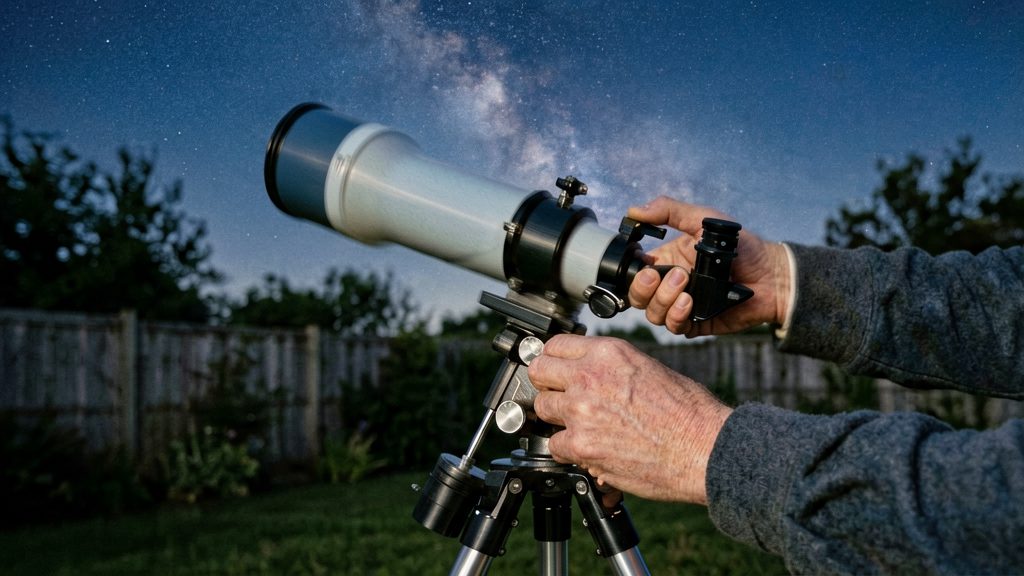
Can a phone or planetary camera work on alt-az?
Yes. Short-exposure planetary cameras on alt-az mounts can capture the planets and the Moon, according to High Point Scientific (2021).
Short-exposure planetary cameras
A dedicated planetary camera is a small video-type camera that records a fast sequence of frames through the telescope, which software then selects and combines. This approach suits the Moon and planets, which are bright enough to record in brief exposures. High Point Scientific (2021) notes that alt-az users can stack many 5–15 second exposures in place of one long exposure, which is the basis of alt-az planetary work.
Stacking on alt-az
The practical workflow is:
- Centre the planet or Moon in the eyepiece, then swap in the camera’s adapter.
- Record a short video or burst of frames.
- Use stacking software to select the sharpest frames and combine them.
- Process the result to improve contrast and detail.
Stacking works because software keeps the sharpest frames, and combining them reduces noise and the effect of atmospheric blurring.
Phone imaging versus dedicated planetary cameras
Phone imaging uses the phone’s own camera held at an eyepiece, often with a clip-on or adapter. The following is general guidance on typical differences:
| Aspect | Phone | Dedicated planetary camera |
|---|---|---|
| Exposure control | Limited, set by the phone’s software | Adjustable for gain and exposure |
| Recording | Usually standard video or photos | Designed for fast frame sequences |
| Stacking | Requires third-party apps or manual selection | Supported by the camera’s usual software workflow |
| Mounting | Depends on the adapter fitted to the eyepiece | Typically fitted to a standard telescope connection |
Check the phone adapter or camera manufacturer’s instructions for compatible eyepiece sizes and recording settings, as these vary by product.
When is an equatorial mount worth it?
An equatorial mount justifies its cost mainly when long-exposure deep-sky photography is the goal. Celestron describes alt-az mounts as unsuited to deep-sky photography (Celestron, 2018). For faint targets that need exposures of several minutes, tracking is the core reason to buy one.
Visual observing is a weaker case: Telescopic Watch (c. 2023) says the advantages of an equatorial mount are mainly for astrophotography, although tracking does keep an object centred with less adjustment.
| Scenario | Alt-az mount | Equatorial mount |
|---|---|---|
| Long-exposure deep-sky photography | Not suited (Celestron, 2018) | Follows the daily motion once the polar axis is aligned (Celestron, 2018) |
| Planetary imaging | Typically used, with short exposures (High Point Scientific, 2021) | Also works (High Point Scientific, 2021) |
Equatorial mounts also work for visual use and planetary imaging, according to High Point Scientific (2021), a retailer. This makes them usable for several activities, but it is a secondary reason to buy one, not the main one.
The cost and setup trade-off is real. An equatorial mount requires polar alignment before each session, which an alt-az mount does not. Prices, accessories and alignment methods vary by model and region, so check the manufacturer’s manual and current listings before buying.
What to check when buying a computerized alt-az for planets
For planets, a computerized (GoTo) alt-az telescope is a practical first choice, since it keeps a tracked target in view automatically. High Point Scientific (2021) describes alt-az mounts as typically used for planetary observing.
Before buying, check these points on the manufacturer’s product page:
| Check | What to verify |
|---|---|
| Computerized pointing (GoTo) | Listed as part of the model. |
| Aperture | The aperture printed on the spec page. Compare it across models in the same series. |
| Eyepieces | Which eyepieces come in the box and their focal lengths. |
| Included accessories | Compare the box contents list with the listing to confirm what you actually receive. |