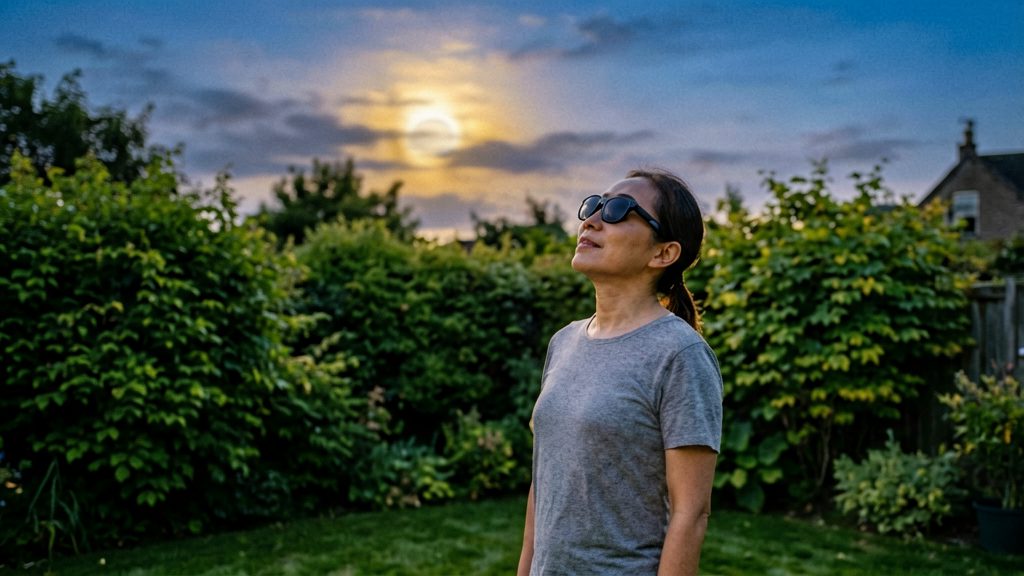
Looking directly at the Sun during an eclipse can damage the retina, the light-sensitive layer at the back of the eye, and the damage can go unnoticed at the time. The Sun stays bright even when most of its disc is hidden, and your eyes give no reliable warning. Squinting, short glances and regular sunglasses do not reduce that light to a safe level. For naked-eye viewing, only certified eclipse glasses or indirect viewing methods avoid the risk.
Why the eye feels no pain during solar damage
Discomfort is not a safety signal. Looking at the retina-damaging Sun can leave you feeling fine at the time, so a comfortable glance tells you nothing about whether the exposure was harmless. High Point Scientific (2025-03-12) makes the same point about optical aids: telescopes and binoculars without solar filters concentrate heat as well as light, and damage may not be felt until after the eclipse. Pain and visible discomfort are therefore not usable checks.
Why a partial eclipse still delivers dangerous light
Partial phases are the stage people underestimate. Before totality, the Moon covers only part of the Sun, so the remaining bright crescent still sends intense light to your eyes. Dimmer daylight can make the Sun feel easier to look at, which encourages longer stares.
Why squinting and brief glances do not protect
Squinting narrows the eye opening but does not reduce the sunlight reaching the retina to a safe level. A brief glance is still exposure. Substitutes that people often reach for fail for the same reason. The Planetary Society (2023-09-07) lists these as unsafe:
- Regular sunglasses
- Stacked sunglasses
- Camera filters
- Smoked glass
- Film and similar items
How do you know your eclipse glasses are safe?
A certified eclipse viewer is a pair of glasses that carries the ISO 12312-2 label and comes from a vendor on the AAS approved vendor list. NASA does not approve any particular brand. It says safe viewers should comply with ISO 12312-2 (NASA, 2024-11-04). Confirming both the standard and the vendor is the practical way to check a pair before an eclipse.
Reading the ISO 12312-2 label
- Eclipse glasses should carry the ISO 12312-2 label.
- The label is sometimes written as ISO 12312-2:2015. The year after the colon identifies the edition of the standard (The Planetary Society, 2023-09-07).
- If the packaging or glasses show no ISO 12312-2 reference, treat the pair as unverified and do not use it.
Confirming the vendor on the AAS list
The most reliable way to buy glasses is from a vendor approved by the American Astronomical Society. The AAS publishes its list at eclipse.aas.org (The Planetary Society, 2023-09-07).
- Open eclipse.aas.org and find the current vendor list before you buy.
- Match the seller or manufacturer name on the list against the store you are buying from, not only the product name.
- Check the current list on the day you order.
Why a printed label alone does not prove safety
Some vendors print the ISO 12312-2 label on glasses that were never tested, so the label by itself does not show that the glasses are safe (The Planetary Society, 2023-09-07). A “NASA-approved” claim does not guarantee safety either (High Point Scientific, 2025-03-12). Combine the label check with the vendor check above, and do not rely on either one alone.
How to check eclipse glasses before use
Inspect every pair before each use, not only the first time you open the packet. NASA (2024-11-04) advises checking glasses before each use and discarding any that are torn, scratched or damaged. The Planetary Society (2023-09-07) lists the specific faults that rule a pair out: scratched, torn or punctured lenses, and lenses separating from the frame.
Do the check in a bright indoor spot so that marks and holes show clearly. Hold each lens up to a light and go through the points below.
| Check | Fault to look for | Result |
|---|---|---|
| Lens surface | Scratches on either lens | Do not use the pair |
| Lens material | Tears or punctures, including pinholes | Do not use the pair |
| Lens-to-frame join | Lens separating from the frame | Do not use the pair |
| Whole pair | Any new damage, for example after the glasses have been dropped or stored in a pocket | Re-inspect before use |
Once a fault appears, take the pair out of service rather than repairing it with tape, glue or a patch. Replace it with a new pair before the eclipse. NASA’s guidance is to discard damaged glasses, so there is no approved repair route to follow.
How to watch the eclipse step by step
Timing the first look before first contact
First contact is the moment the Moon’s edge first touches the Sun’s disk. Look up the local time of first contact in an eclipse calendar or astronomy app before the day, and allow time to set up at your viewing spot.
Before first contact, the Sun looks normal, which makes it easy to forget the risk.
Keeping glasses on through every partial phase
During the partial phase, the Moon covers part of the Sun and the visible crescent gets thinner or thicker. Keep the glasses on continuously from first contact to last contact. Do not lower them to check the Sun with bare eyes between phases.
- Supervise children and check that their glasses are worn correctly and stay on (NASA, 2024-11-04).
- Give each person in a group their own pair. High Point Scientific (2025-03-12), a retailer, recommends this as practical advice.
Looking away before putting glasses on or off
Eye damage can happen in the moment you move the glasses, so the rule is to turn away first. Put the glasses on before you look up, and take them off only after you have turned your face away from the Sun.
| Stage | Action | Glasses |
|---|---|---|
| Before first contact | Inspect lenses, set up, look away | Off, in hand |
| After last contact | Look away, then remove | Off, once you have turned away |
When can you take eclipse glasses off?
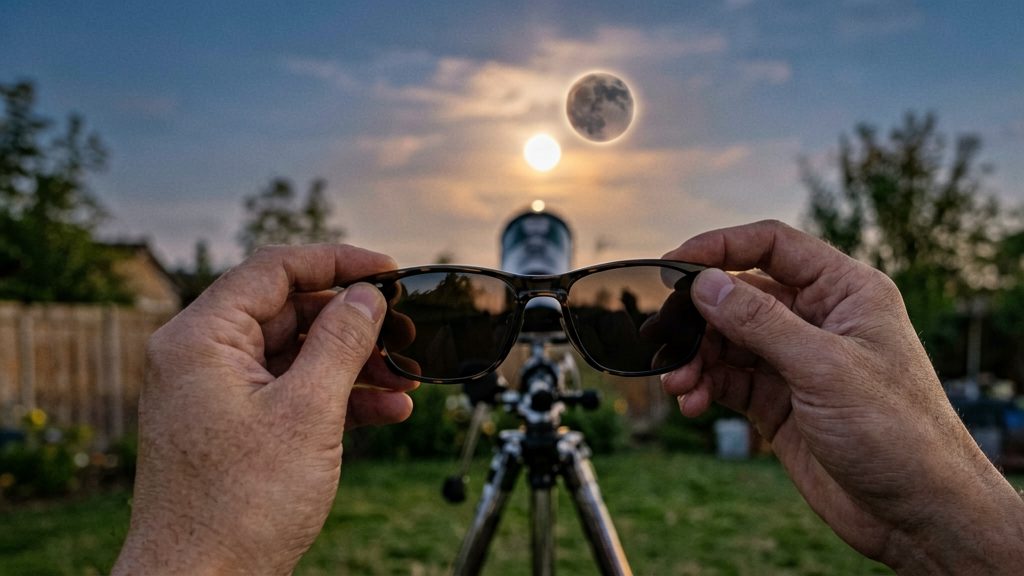
Eclipse glasses come off only during totality, the phase of a total solar eclipse when the Moon fully covers the Sun, and only for observers inside the path of totality. According to NASA (2024-11-04), glasses may be removed only when no part of the Sun can be seen through them.
| Eclipse situation | Eclipse glasses |
|---|---|
| Total eclipse, outside the path of totality | Stay on |
| Total eclipse, before and after totality | Stay on |
| Total eclipse, during totality inside the path | May be removed only when no part of the Sun is visible |
| Partial or annular eclipse, any phase | Stay on throughout |
Confirming that no part of the Sun is visible
Removing glasses is safe only when the Sun is fully covered. Before taking them off, confirm that the bright crescent is gone and that the light has changed to the dim, eerie glow of totality. If any sliver of the Sun is still visible through the lenses, keep them on. The Planetary Society (2023-09-07) states that only during totality, when the Moon fully covers the Sun, is it safe to look without eye protection.
Putting glasses back on
The glasses must go back on as soon as bright sunlight returns, which marks the end of totality. NASA (2024-11-04) gives this as the rule for when to re-apply them.
Can you use eclipse glasses with cameras or telescopes?
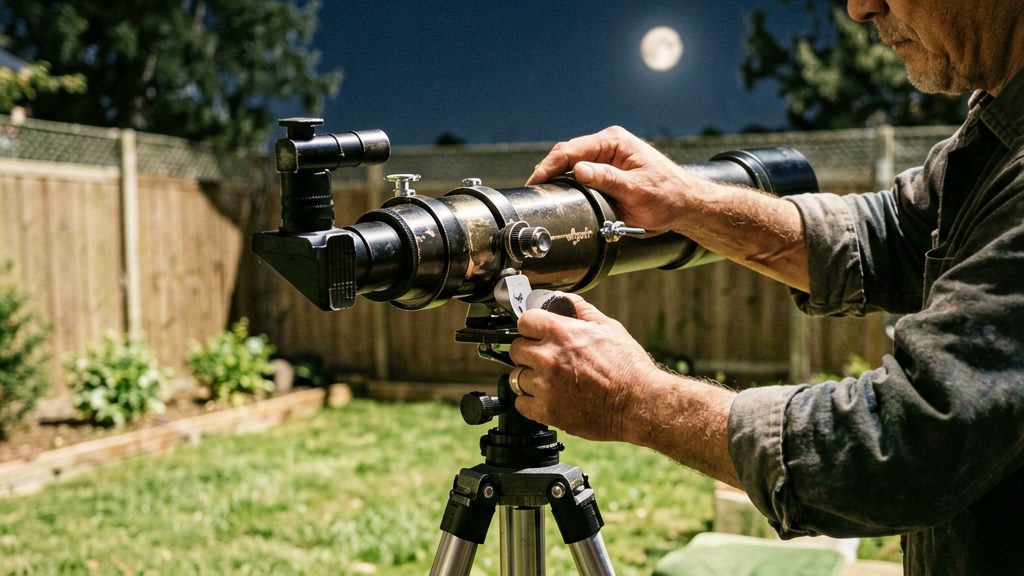
No. Eclipse glasses and handheld viewers are designed for direct viewing by the eye and cannot be used on cameras, binoculars or telescopes. NASA (2024-11-04) advises that optics need a proper solar filter on the front of the instrument. The difference comes down to how the light reaches the eye or sensor. Glasses reduce the light that reaches your eyes. Optics gather a much larger beam of sunlight and focus it into a small spot, so the concentrated energy can damage the glasses, the eyepiece, the camera sensor or your eyes.
Concentrated sunlight is the main hazard. Telescopes and binoculars without solar filters are more dangerous than unaided viewing because they concentrate heat as well as light.
| Setup | Status | What to do |
|---|---|---|
| Eclipse glasses or handheld viewer on a camera, binoculars or telescope | Not safe | Do not use. Glasses are not designed for optics (NASA, 2024-11-04). |
| Ordinary camera filters, smoked glass or similar substitutes on a lens | Not safe | Do not use. |
| Unfiltered telescope or binoculars | More dangerous than naked-eye viewing | Never point them at the Sun. |
| Full-aperture solar filter on the front of the objective | Required setup for optics | Fit the filter over the entire front opening before the Sun is in view. |
Full-aperture filters on the objective
A solar filter must cover the whole front opening of the telescope or binoculars, so that no unfiltered sunlight enters the tube. A filter placed at the eyepiece or behind the objective lets the full concentrated beam into the instrument first, so it does not provide protection. Check that the filter label states it is designed for solar observation, and follow the manufacturer’s fitting instructions.
Mounting on a phone or camera lens
Confirm the filter is rated for solar use, and secure it so it cannot slip during the eclipse. Follow the manufacturer’s instructions for the specific filter and lens, and do not improvise a mount with tape or a loose sheet of film.
Safe ways to watch without glasses
Indirect viewing lets you follow a partial eclipse without looking at the Sun. The two methods covered here are a pinhole projector made from cardboard and paper, and indirect projection onto a flat white surface. Both show the Sun as a crescent-shaped shadow. Neither replaces eclipse glasses for direct viewing of the Sun during the partial phases.
Pinhole projector from cardboard and paper
Pinhole projectors and colanders are safe indirect ways to see the crescent-shaped shadows (The Planetary Society, 2023-09-07). To make one:
- Cut a square of stiff cardboard and punch one small, clean hole near the centre.
- Stand with your back to the Sun so light passes through the hole.
- Hold a sheet of white paper on the ground or a table, below and behind the card.
- Adjust the distance between card and paper until a sharp image of the Sun appears. During a partial eclipse it shows as a crescent.
A colander works the same way. Each of its holes casts a small crescent, so the pattern shows many images at once.
Indirect projection onto a white surface
Sunlight passing through any small gap forms the same crescent-shaped spots during a partial eclipse. Gaps between tree leaves are a common example. To use this method:
- Choose a flat white surface, such as a wall, a sheet of paper or a piece of white cardboard, in open sunlight.
- Stand with your back to the Sun and face the surface.
- Look at the shapes on the surface, never at the Sun.
Why welder’s glass is not a recommended substitute
Welder’s glass is sometimes suggested as an alternative to eclipse glasses. Sources disagree on welder’s glass, and the primary NASA and AAS guidance could not be verified for this article, so it is not recommended here. Use certified eclipse glasses or the indirect methods above instead.