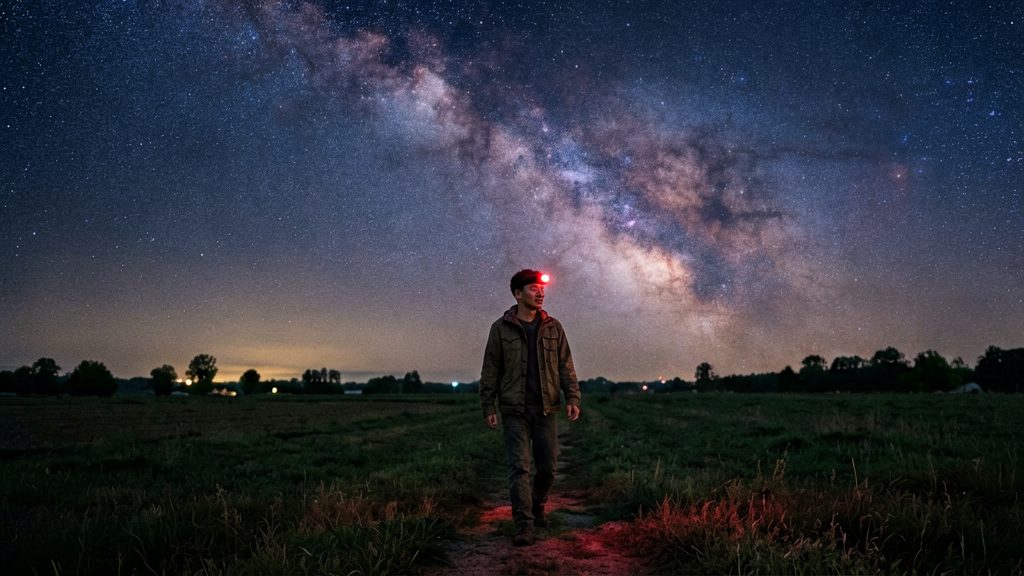
Why dark skies matter for stargazing
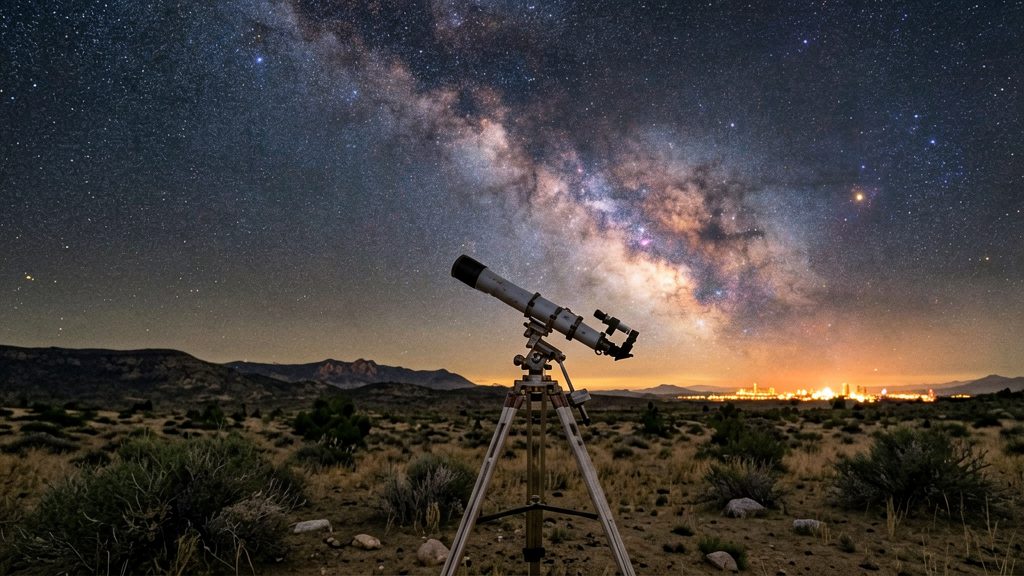
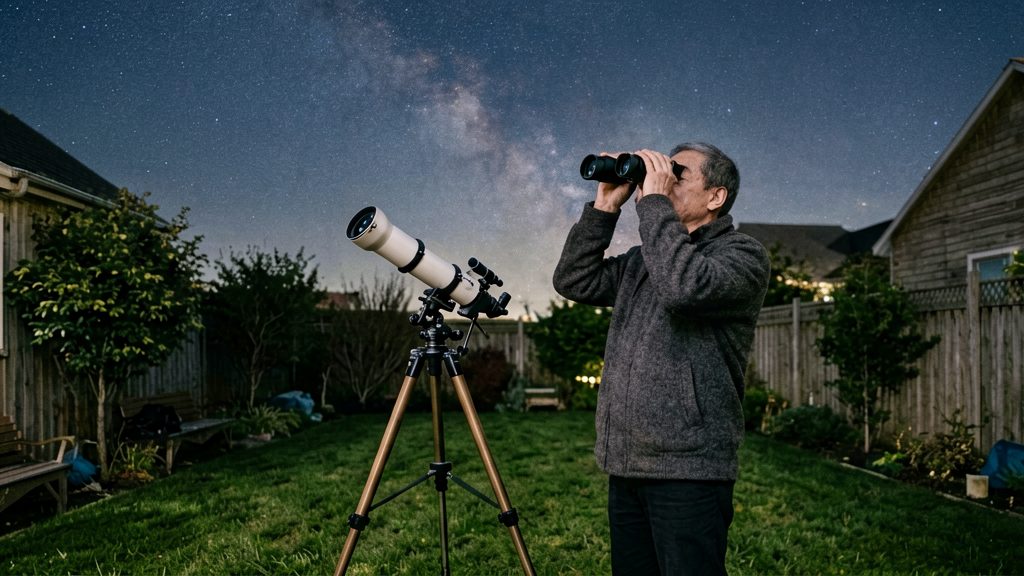
Artificial light scatters in the atmosphere and creates skyglow, a diffuse background that sits behind every object you try to see. Faint stars are the first casualty. Stars that are easy to spot from a rural site can vanish entirely from a suburban backyard, even though the telescope or eye has not changed.
| Sky condition | What you notice | Effect on deep-sky objects |
|---|---|---|
| Dark site | Faint stars visible, Milky Way structure clear | High contrast; galaxies and nebulae stand out from the background |
| Light-polluted site | Only the brightest stars visible, Milky Way faint or absent | Background glow flattens contrast; faint galaxies and nebulae are hard to detect |
Contrast is the key concept. A deep-sky object is only visible when its light stands out from the sky behind it. Skyglow raises that background, so even a large telescope shows less detail in a faint nebula than the same instrument would under a dark sky.
To judge a site yourself, let your eyes adapt for about 20 to 30 minutes, then check whether the Milky Way is visible to the naked eye and how many stars you can count in a familiar constellation. Compare the result with the same check at another site, ideally on the same clear, moonless night. If the Milky Way is faint or absent and only bright stars show, light pollution is a likely cause, but moonlight, haze or thin cloud can produce the same result, so repeat the check before you decide.
How do I find dark sky sites near me?
Start with a radius search around your home, then check each candidate against the IDA finder before you commit to a drive. Sky at Night Magazine recommends the International Dark-Sky Association’s finder for locating certified Dark Sky Places in the USA (BBC Sky at Night Magazine, 2026).
- Draw a radius search. Use any mapping app to mark your home address and draw circles at several distances, such as the distance you would be willing to drive on a weeknight and a longer distance for a weekend trip.
- Cross-check candidates on the IDA finder. Enter your region and compare the certified sites inside each circle. Note the designation type listed for each site, since the categories differ in what they protect.
- Add non-certified options. The NPS “Explore Night Skies” page describes where and how to observe in parks, and its “Night Sky Interactive Maps” show the sites where NPS collects night sky data (National Park Service, 2026).
- Ask locally. Contact a nearby amateur astronomy society and search online for observatories or star parties near you (BBC Sky at Night Magazine, 2026).
- Build a drive-time shortlist. Estimate the drive from home to each candidate at the time you would actually leave, then keep the few closest sites that have usable access. Discard any site whose access hours or road conditions you cannot confirm.
| Resource | What it gives you | Source |
|---|---|---|
| IDA finder | Certified Dark Sky Places by region | BBC Sky at Night Magazine (2026) |
| NPS Explore Night Skies | Where and how to observe night skies in parks | National Park Service (2026) |
| NPS Night Sky Interactive Maps | Locations of NPS night sky data collection sites | National Park Service (2026) |
| Local astronomy society | Local observing nights and recommended sites | BBC Sky at Night Magazine (2026) |
When a dark site is too far, public observatories offer a substitute; see the last section for examples.
What do the DarkSky designations mean?
The International Dark-Sky Association (DarkSky International) certifies places where the night sky is protected. Each certified place carries a designation that names its category. Published summaries list the categories as Park, Sanctuary, Reserve, Community and Urban Night Sky Place. Confirm each category’s exact criteria at darksky.org/places before you plan a visit.
Use the designation as a quick guide to what kind of site you will reach:
- Designation names come from search-result summaries of the finder, not from an opened page, so check each category’s definition on darksky.org/places before assuming what a site offers.
These descriptions are general orientation only. Read the category and the place’s own entry on the finder for the specifics. Before you go, ask the managing organisation for its current lighting policy and check whether outdoor lights are shielded or switched off at set hours.
Published counts of certified US places range from roughly 60 to nearly 140. Sky at Night Magazine gives nearly 140, but the date of that figure is unverified, so check the live count on the finder.
Using light pollution maps and apps
Light pollution maps and stargazing apps let you rank candidate sites by expected sky darkness before you drive anywhere. Many tools show artificial sky brightness as colour-coded layers, and some report a Bortle class for each point; the exact definitions vary by tool, so read each legend. Read the legend first, then compare several locations on the same map. A single layer is an estimate, so confirm your shortlist against at least one other source.
| Map element | What it tells you | Main limit |
|---|---|---|
| Bortle class (where shown) | A rating of how dark the sky is expected to look from that point, with a darker class meaning a darker sky | Class boundaries and definitions differ between tools, so check the legend’s own definitions |
| Artificial sky brightness layer | Modelled brightness of the sky from artificial light, usually shown as a colour gradient | Often built from satellite-derived data at limited resolution, so it can miss local glare from a single streetlight or a nearby building |
| App darkness estimate | A quick read of expected darkness at a chosen point, often combined with the map layer | Reflects the underlying model only; it does not account for haze, humidity, or horizon obstructions |
Reading Bortle classes
- Use the Bortle class as a relative ranking, not an exact measure of what you will see.
- Compare classes only within the same tool, since two apps may use different data or colour thresholds.
- Open the legend in each app to confirm which classes correspond to which colours.
Working with sky brightness layers
- Zoom in before drawing conclusions. A rural town centre can look dark at regional zoom but be bright at street level.
- Check the surrounding area, not just the pin. A site next to a bright city edge can be affected by light domes that extend across a wide area.
- Treat the layer as a prediction. Local conditions, such as new construction or temporary lighting, may not appear in the data.
Estimating darkness with astronomy apps
- Enter the candidate location and enable the light pollution or sky brightness layer.
- Note the reported class or brightness value, along with the date the data was last updated if the app shows it.
- Compare two or three candidates on the same zoom level.
Are national and state parks good dark sky options?
National parks are among the strongest places to look for dark skies in the United States. The National Park Service says national parks are home to some of the last remaining harbors of starlit skies. Not every park or state park offers the same darkness, however, so the practical approach is to check each site’s own night-sky information before planning a trip.
The NPS night skies pages are the first place to look. The Explore Night Skies page explains where and how to observe the night sky within parks, and it is the most direct route to park-specific guidance. From there, the Night Sky Interactive Maps show the locations where the NPS collects night sky data. Because these maps mark data collection sites, they help you judge which parks have been measured and how their conditions compare, rather than offering a single rating for every park.
Darkness varies widely from one park to another, and even within a single park. Factors that change the sky include:
- Distance from nearby towns and highways
- Outdoor lighting at park entrances, campgrounds, and visitor centers
- Elevation and local terrain, which can block the horizon
- Park location relative to large metropolitan areas
For state parks, the search is less centralized, and certified Dark Sky Places include some parks and reserves. Certified status signals a commitment to dark skies, but it does not guarantee that every spot within the boundary is equally dark, so confirm conditions for the specific area you plan to use.
Can local astronomy clubs and star parties help?
Local amateur astronomy societies are one of the most direct routes to a dark site, because their members already know which fields, parks and rural roads are dark and which have become unusable. According to BBC Sky at Night Magazine (2026), the practical first step is to contact a local amateur astronomy society and to look online for nearby observatories or star parties. A club can tell you where its members observe, what conditions to expect there and whether the site is open to the public.
Contacting a local society for site advice
Most clubs list a contact form, an email address or a meeting schedule on their website. When you write to them, give your general location, the telescope or binoculars you use and whether you want to observe visually or photograph the sky. Experienced members can then point you to sites they already use and explain the access rules, such as gate hours or whether a permit is needed.
- Ask which sites are used regularly, not only which ones are recommended in general guides.
- Ask whether access depends on a landowner, a park schedule or a club membership.
- Ask whether the club holds meetings where you can see its instruments and meet observers before attending a session.
Finding star parties through club calendars and listings
Star parties are scheduled observing events, usually held at a dark site away from city lights. The BBC Sky at Night Magazine (2026) recommends searching online for nearby star parties, and club websites are the most reliable place to check them. Calendars typically show the date, the site, the start time and whether the event is open to non-members. Check the calendar again close to the date, because weather or site closures can change the plan. For details on how public observatory sessions are priced, see the separate guidance on paid public sessions.
Club-hosted observing sites and member-led sessions
Some clubs own or lease an observing site reserved for members and their guests. Others arrange sessions at a location they do not control, such as a park area or private land, and bring members together for a shared night. Member-led sessions are often less formal than public events: experienced observers set up their own telescopes, point out objects and share equipment checks, which makes them useful for beginners learning to find targets.
What to check before you drive out
Confirm access, weather and moon conditions before leaving home. Dark-sky sites in the United States are managed by many different agencies, parks and private owners, and a site that is dark on paper can be closed, locked or unusable on the night you plan to go. The National Park Service night skies pages are the first place to check park-specific guidance.
Access, gate hours and parking
- Gate hours: Look up the posted opening and closing times on the park, forest or reserve website. Many sites lock vehicle gates overnight, which can leave you unable to leave until morning.
- Closures: Check for seasonal, road or trail closures and temporary restrictions. Call the managing office if the website is unclear.
- Parking rules: Confirm where vehicles may park after dark, whether roadside parking is allowed and whether lights, tents or overnight stays are restricted.
Weather, cloud cover and transparency
Check a forecast that reports cloud cover by hour, not only a general “clear” icon. Look at the dew point and wind as well, because humidity can fog optics and wind affects comfort during long sessions. Transparency, the clarity of the air that determines how faint stars appear, is not always included in standard forecasts, so compare cloud forecasts with the observing forecasts published by astronomy clubs or astronomy apps for your area.
Moon phase and contrast
The Moon is the largest single source of sky brightness you can control by scheduling. A bright Moon in the sky lowers the contrast of faint nebulae, galaxies and the Milky Way, so plan deep-sky sessions for nights when the Moon is down or in a thin phase. Bright Moon nights are better suited to lunar and planetary observing.
| Check | What to verify | Why it matters |
|---|---|---|
| Gate hours | Posted opening and closing times | Avoids being locked in |
| Closures | Road, trail or seasonal notices | Prevents wasted trips |
| Parking | Permitted zones and overnight rules | Avoids fines and tow risks |
| Cloud cover | Hourly forecast | Confirms the sky will be open |
| Moon phase | Moonrise and moonset times | Sets the contrast you can expect |
Public observatories if you can’t travel far
When a dark site is out of reach, a public observatory or museum telescope night is the practical alternative. Three examples follow: McDonald Observatory in Texas, which holds star parties at $15; Lowell Observatory in Arizona, listed at $22; and Griffith Observatory in Los Angeles, which offers free telescopes and monthly star parties. These are prices as listed by BBC Sky at Night Magazine (2026) and may have changed, so confirm them before you travel.
What to look for in a public session
- Star parties: scheduled evenings where staff or volunteers set up telescopes for visitors, usually aimed at the Moon, planets and bright deep-sky objects.
- Free telescope nights: sessions where the telescopes are provided at no charge, as at Griffith Observatory.
- Ticketed observing: paid sessions, such as the $15 and $22 examples above, often include a short talk before observing.
Listed examples
| Venue | Location | Offer | Listed price |
|---|---|---|---|
| McDonald Observatory | Texas | Star parties | $15 |
| Lowell Observatory | Arizona | Observing sessions | $22 |
| Griffith Observatory | Los Angeles | Free telescopes and monthly star parties | Free |
Prices and schedules change, so check each venue’s website or phone line before planning.