As of 10 November 2026, Jupiter’s closest approach for 2026 has already happened. The perigee fell on January 9, 2026, according to EarthSky (2026), so no later date in this calendar year counts as this year’s closest approach. The next one is on February 10, 2027 at 15:31 UTC. Anyone planning to observe Jupiter near its nearest point should look ahead to early February 2027.
When is Jupiter closest to Earth this year?
The 2026 closest approach has passed
The closest approach of 2026 was on January 9, 2026 (EarthSky, 2026). Because that date is in the past, the calendar year alone decides which event counts. Searching for “this year” in November returns the January date, not an upcoming one.
The next closest approach
| Year | Closest approach date | Status on 10 November 2026 |
|---|---|---|
| 2026 | January 9, 2026 | Already passed |
| 2027 | February 10, 2027 at 15:31 UTC | Upcoming, next closest approach |
The two events are roughly 13 months apart.
Why the calendar year shapes the answer
A closest approach is a single moment, not a season. Each calendar year contains at most the one date that falls within it, so a 2026 search can only point back to January. Checking the year first prevents a common mix-up with the nearby opposition date.
Closest approach vs. opposition: what’s the difference?
Perigee and opposition are two separate events. Perigee is the moment Jupiter is closest to Earth. Opposition is the moment Earth sits between the Sun and Jupiter, so Jupiter lies on the opposite side of the sky from the Sun. In 2026, EarthSky (2026) gives January 9 for the closest approach and January 10 for opposition, one day apart.
Perigee: a distance event
Perigee depends only on the gap between the two planets. Both orbits are elliptical, so the gap is not the same from one apparition to the next. The closest point is the smallest value of that gap in a given cycle.
Opposition: an alignment event
Opposition depends on angle, not distance. Seen from Earth, the Sun and Jupiter are 180 degrees apart in the sky. Earth, moving faster in its shorter orbit, overtakes Jupiter, and the alignment happens at that moment.
Why the two dates differ
The two events are defined by different conditions, so they rarely fall on the same day:
| Event | What it measures | Defining condition | 2026 date |
|---|---|---|---|
| Perigee (closest approach) | Earth–Jupiter distance | Smallest gap between the two planets | January 9 (EarthSky, 2026) |
| Opposition | Angle between the Sun and Jupiter as seen from Earth | Sun, Earth and Jupiter in a straight line, with Earth in the middle | January 10 (EarthSky, 2026; Fox Weather) |
The orbits are not perfect circles and are not in the same plane, so the minimum distance does not have to coincide with the exact alignment. Fiske Planetarium at the University of Colorado Boulder (2025-12-12) gives January 9 for opposition, which probably reflects a US or local time reading rather than a different event.
How close does Jupiter actually get?
Jupiter’s closest approach to Earth in 2027 is the one with a confirmed distance. According to EarthSky (2026), Jupiter is about 405 million miles (652 million km) away at that closest approach, roughly 36 light-minutes. That figure is the reference point for the next close pass.
To check it yourself, look up Jupiter’s geocentric distance for the date in an ephemeris such as NASA’s JPL Horizons, which lists distance by date and time.
| Event | Date | Distance or brightness |
|---|---|---|
| Closest approach, 2026 | January 9, 2026 | Distance not confirmed; check an ephemeris |
| Closest approach, 2027 | February 10, 2027, 15:31 UTC | About 652 million km (405 million miles) |
| Brightness at January 2026 opposition | January 2026 | Magnitude -2.7 (University of Colorado Boulder, Fiske Planetarium, 2025-12-12) |
Brightness follows distance, but it is not the only factor. Magnitude runs backwards: the more negative the value, the brighter the object. At the January 2026 opposition, Jupiter reached magnitude -2.7 in Gemini, which is the reference brightness for that apparition. Jupiter’s apparent brightness at a given time depends on how far it is from Earth at that moment, so a close approach will look brighter than a distant one.
Best time of night to see Jupiter
Around opposition, Jupiter rises near sunset, reaches its highest point in the sky around midnight, and sets near sunrise, so it is observable for most of the night. For the 2026 opposition, Fox Weather advises looking east after full dark, around 8 p.m. The Fiske Planetarium at the University of Colorado Boulder (2025) reports that at the January 2026 opposition Jupiter rose around sunset and set around sunrise, which made it visible all night.
Rising and setting around opposition
Opposition is the point when Jupiter lies opposite the Sun as seen from Earth, so the planet rises as the Sun sets and sets as the Sun rises. EarthSky (2026) and Fox Weather list the 2026 opposition on January 10, 2026. Check an astronomy app or almanac for your own location and date rather than relying on one published day.
When to start looking
- Start after full dark. Face east. At the January 2026 opposition Jupiter rose around sunset, so by about 8 p.m. it was already well placed above the eastern horizon.
- Use about 8 p.m. as a guide. Fox Weather (2026) gives this time for the January 2026 opposition. Actual timing depends on your latitude and the date, so treat it as an approximate starting point.
How altitude changes through the night
Jupiter’s altitude (its height above the horizon) changes steadily as the night progresses. The table below follows the general pattern at opposition.
| Phase of the night | Jupiter’s position | Practical implication |
|---|---|---|
| Near sunset | Rising in the east, near the horizon | Too low for useful viewing |
| After full dark, around 8 p.m. | Well up in the east | Good window; altitude keeps increasing toward midnight |
| Around midnight | At transit, the highest point of the night | Best altitude for observing |
| Toward sunrise | Descending in the west | Altitude falls until the planet sets |
Because the highest point occurs around midnight, observing sessions centred on that period give the steadiest view of the planet, with the least atmosphere between it and your eyes.
What can you see with binoculars?
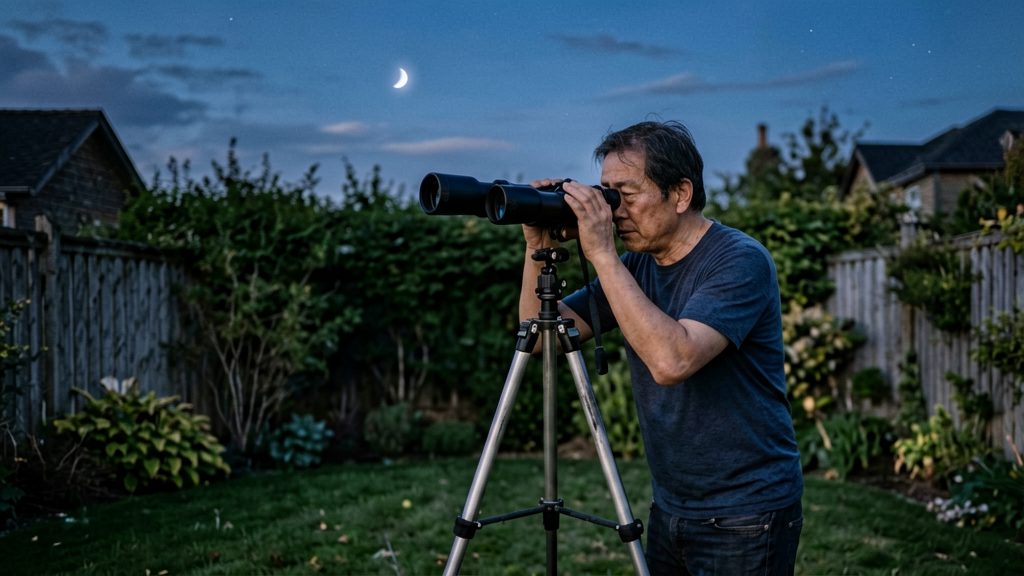
With binoculars, Jupiter appears as a bright, steady point of light, and its most rewarding feature is the set of Galilean moons lying beside it. According to the University of Colorado Boulder, Fiske Planetarium (2025-12-12), binoculars show several of Jupiter’s moons around the planet, and the planet is visible all night around its opposition. Its cloud belts are generally too faint to resolve reliably at this level.
Galilean moons as star-like points
The Galilean moons look like small stars strung out along a line on either side of the planet. Because they are so close to Jupiter, you can separate them from background stars by checking whether they sit in a straight row with the planet and stay close to it.
Moon positions shift from night to night
The moons orbit Jupiter at different speeds, so their arrangement changes within a single evening and looks different from one night to the next. Count and sketch the moons on one night, then compare the layout a few nights later. Expect the spacing and the number visible on either side to vary.
Cloud belts are too faint to resolve reliably
The dark bands across Jupiter’s disc are the cloud belts. In binoculars they usually blend into a uniform pale disc, so do not expect to see banding. Treat any belt-like shading as uncertain unless the view is steady and the sky is clear.
Setups that suit Jupiter
Steadiness matters more than anything else for spotting the moons, because a shaking image makes faint points hard to separate from one another.
| Setup | Effect on the Jupiter view |
|---|---|
| Handheld | Moons can be seen, but the image shakes and they are harder to separate |
| Braced against a wall, railing or car roof | Noticeably steadier, with the elbows resting on a solid surface |
| Tripod with a binocular adapter | Most stable option for identifying and tracking moon positions |
What will Jupiter look like in a telescope?
According to the University of Colorado Boulder’s Fiske Planetarium (2025-12-12), a telescope shows the planet’s cloud belts and zones. Through an eyepiece, Jupiter appears as a bright, slightly flattened disc crossed by parallel stripes. The stripes run parallel to the equator. The disc has a sharp edge, slightly flattened by the planet’s fast rotation.
| Feature | What it looks like | Where to look |
|---|---|---|
| Equatorial belts | Darker bands, the most prominent stripes | Around the middle of the disc |
| Zones | Lighter bands between the belts | Between and beside the belts |
| Great Red Spot | A reddish oval | South of the equator, within the disc |
Equatorial belts and lighter zones
The equatorial belts are the darker stripes nearest the middle of the disc, and the zones are the lighter bands between them. Their contrast changes from one night to the next, so a belt may look strong one evening and faint the next. Identify the belts first, then check the lighter zones on either side.
Great Red Spot: when and how to spot it
The Great Red Spot is a large reddish oval in the southern part of the disc. It is visible only when it is on the side of the disc facing you, which depends on the time of night. Use a planetary ephemeris or an astronomy app to find the time the spot crosses the central meridian, the line running down the middle of the disc as seen from Earth, and observe during that window. Its colour can look subtle in small telescopes, so patience and steady viewing help.
Eyepiece choice for the planet disc
Magnification equals the telescope’s focal length divided by the eyepiece’s focal length. Planets need higher magnification than the Moon or deep-sky objects, so choose a shorter focal length eyepiece that makes the disc large enough to show the belts without making the image too dim or soft. If detail is hard to see, try a slightly longer focal length eyepiece to reduce magnification.
When is the next Jupiter opposition?
The next Jupiter opposition falls on February 11, 2027 at 0:21 UTC, which is 6:21 p.m. CST (7:21 p.m. EST, 4:21 p.m. PST) on February 10, 2027. Observers should convert the UTC time to their own clock, since the date can change depending on the time zone.
Opposition time in common reference zones
| Reference time | Date | Time |
|---|---|---|
| UTC | February 11, 2027 | 0:21 a.m. |
| CST (Central Standard Time) | February 10, 2027 | 6:21 p.m. |
The CST figure implies a UTC−6 offset (0:21 UTC minus 6 hours gives 18:21 on the previous day).
Converting to your local time
- Find your standard UTC offset for February. Some regions observe daylight saving time, so check whether it applies in your location that month.
- Add the offset to 0:21 UTC on February 11 (for UTC+ zones) or subtract it (for UTC− zones).
- If the result falls before midnight, the date is February 10.
Worked examples using this method:
| Your offset from UTC | Local time of opposition |
|---|---|
| UTC−6 (CST) | 6:21 p.m., February 10 |
| UTC−5 | 7:21 p.m., February 10 |
| UTC+0 | 0:21 a.m., February 11 |
| UTC+1 | 1:21 a.m., February 11 |
Checks for observers outside CST
- Confirm the offset for your exact location and date, not only your country’s general time zone.
- Note whether your region is on daylight saving time on February 10 or 11, which shifts the offset by one hour.
- Compare your result with a reliable world clock or UTC converter before setting an alarm or planning a session.
Tips for observing Jupiter
Session quality depends more on air stability and optical temperature than on equipment alone. Planning around these two factors usually makes a bigger difference than upgrading a part.
Judging atmospheric seeing
Seeing describes how steady the air is between you and the planet. Turbulent air makes Jupiter’s disc shimmer and blurs the fine cloud bands, even when the sky looks clear to the eye.
- Look at Jupiter at moderate magnification first. If the image boils or swims constantly, the air is turbulent, and raising magnification will only enlarge the blur.
- Observe when the planet is high in the sky. A low target is viewed through more of the atmosphere, which usually degrades the image.
- Watch for short calm moments. Steady intervals of a few seconds often allow you to catch the belt detail that turbulence hides for the rest of the session.
- Keep a simple seeing scale in your own notes, for example 1 (poor) to 5 (excellent), so you can compare sessions later.
Controlling dew and cooling the telescope
Cold optics attract dew, which can fog the corrector plate or the eyepiece and ruin an observing session in minutes. Thermal imbalance also creates air currents inside the tube that worsen the image.
- Set the telescope outdoors well before observing so the tube and optics reach the outside air temperature. Bringing an optical tube straight from a heated room gives the mirror or lens a temperature gap to recover from.
- Use a dew shield on refractors and Schmidt-Cassegrain telescopes. A dew heater band or strip is the usual add-on when humidity rises.
- Keep a cloth or lens tissue at hand and dry the front element when condensation starts, rather than waiting for the image to degrade.
- Cover the eyepieces and the open end of the tube when you are not observing.
Logging drawings and observation notes
A dated log turns scattered sessions into a record you can compare over months. Sketching is the traditional method, and it trains you to see detail that a glance misses.
- Record the date, start time, instrument, seeing rating and sky conditions in each entry.
- Draw the disc at the eyepiece with a consistent circle size, and mark the belts, zones and any visible moons relative to the planet’s edge.
- Note the orientation of the image as you saw it, so the sketch can be read correctly later.
- Log the position of Jupiter’s moons on each sketch. Their arrangement changes from hour to hour, and the time stamp lets you check it against published moon positions.
- Keep a short note on any changes you see, such as a belt that appears darker or a feature that is hard to pick out, and whether it was visible under steady or turbulent air.
A log started now will cover a full run of observations leading up to the next closest approach.