There is no fixed calendar for bright comets, so no date can be promised for the next one visible from the United States. Instead, you can estimate timing by reading a comet’s perihelion date (its closest point to the Sun) and its magnitude forecast, then checking whether the comet will be high enough from US latitudes to observe. The National Radio Astronomy Observatory (2020) does not give a date or frequency for the next bright comet.
When will the next bright comet appear?
Perihelion as the main timing marker
Perihelion is the anchor for most forecasts. Star Walk (2026) lists perihelion dates alongside predicted brightness, so the date tells you when a comet is closest to the Sun, not when it is best seen from your backyard. For 2P/Encke, Star Walk gives perihelion on February 10, 2027, and notes that perihelion falls in the Sun glare. The suggested viewing window is late January, which is before perihelion, when the comet is further from the Sun.
Use the forecast in three steps:
| Forecast item | What it tells you | Practical check |
|---|---|---|
| Perihelion date | Closest approach to the Sun and main timing anchor | Note whether it falls in the Sun glare |
| Predicted magnitude | Expected brightness | Compare it with the naked-eye and binocular ranges |
| Suggested viewing dates | Window that observing guides recommend | Confirm it in a current ephemeris or sky app |
Reading magnitude forecasts by month
A magnitude forecast is attached to specific dates, so brightness changes within a single season. Star Walk (2026) lists 45P/Honda–Mrkos–Pajdušáková at about magnitude 6.8 at closest approach on July 22, 2027, and about magnitude 5.0 at perihelion on August 31, 2027. Read each month’s forecast against the date you plan to observe, not against the season as a whole.
Current forecasts do not show a clear naked-eye comet visible from the US in 2027. Encke and 45P come close to the naked-eye limit.
Why no fixed bright-comet schedule exists
Many comets are discovered only months before they peak, so a forecast made a year ahead can shift. Star Walk (2026) describes the nucleus size and brightness estimates for C/2026 C1 (Tsuchinshan) as very preliminary. It also says the best view may favor the Southern Hemisphere, so a forecast peak does not guarantee visibility from the US.
Comets to watch from the US in 2027
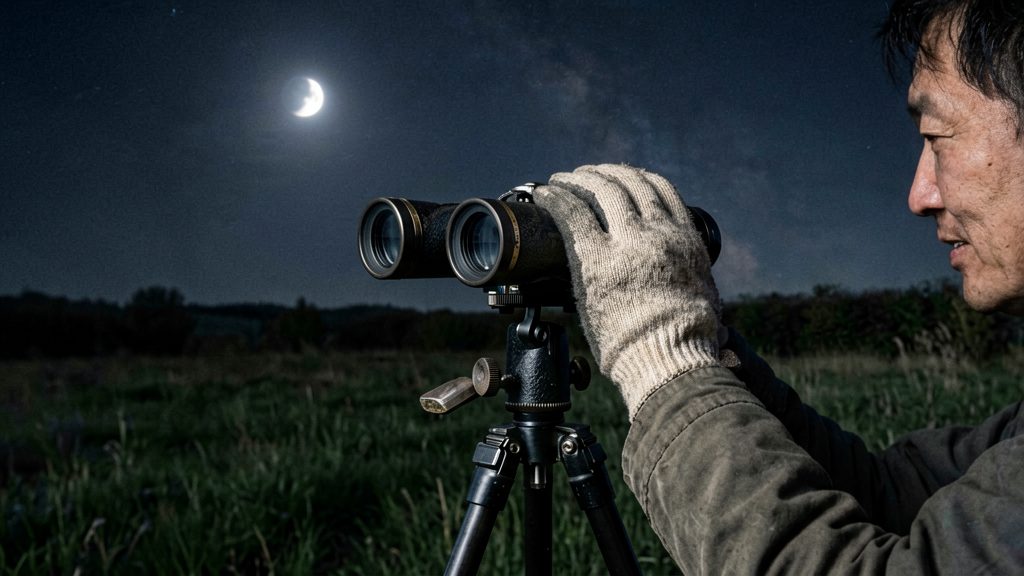
Two periodic comets are the most realistic targets for US observers in 2027, and both sit in the binocular range rather than the naked-eye range. Comet 2P/Encke reaches perihelion on February 10, 2027. Comet 45P/Honda–Mrkos–Pajdušáková offers a longer window from July to October 2027, with its closest approach on July 22, 2027 and perihelion on August 31, 2027. Several other comets listed for late 2026 and 2027 need a telescope.
Binocular targets
| Comet | Window | Predicted magnitude | Equipment |
|---|---|---|---|
| 2P/Encke | December 2026 to February 2027 | About 5.9 at perihelion (February 10, 2027) | Binoculars |
| 45P/Honda–Mrkos–Pajdušáková | July to October 2027 | About 6.8 at closest approach (July 22, 2027); about 5.0 at perihelion (August 31, 2027) | Binoculars, late July and August |
According to Star Walk (2026), both comets are predicted to reach roughly magnitude 5 to 6 at their brightest.
Telescope-only targets
- 10P/Tempel 2: about magnitude 10 in early October 2026, which falls just before the 2027 window.
- 161P/Hartley–IRAS: about magnitude 12.
- C/2025 Y1 ATLAS: about magnitude 11.3 to 11.6 from June to October 2027.
- 104P/Kowal 2: about magnitude 10.4 to 10.6 in autumn 2027.
These objects require a telescope with a wide-field eyepiece and a star chart that marks their path, because a magnitude 10 to 12 comet is invisible to the unaided eye and hard to pick out in a finder scope.
Is Comet C/2026 C1 Tsuchinshan a naked-eye target in 2028?
Comet C/2026 C1 (Tsuchinshan), formerly designated A11yzTN, is predicted to reach perihelion on November 7, 2028, at about 1.1–1.2 AU from the Sun. Star Walk (2026) puts its peak brightness near magnitude 5, which makes it a binocular target and possibly borderline naked-eye under dark skies. Since perihelion is about two years away, these figures are preliminary.
| Parameter | Current estimate | Status |
|---|---|---|
| Perihelion date | November 7, 2028 | Predicted |
| Distance at perihelion | About 1.1–1.2 AU | Predicted |
| Peak brightness | About magnitude 5 | Preliminary |
| Favoured viewing hemisphere | Southern Hemisphere | Possible, per Star Walk (2026) |
| Nucleus size | About 20–40 km | Very preliminary |
What the estimates mean for observers
- Southern Hemisphere bias: Star Walk (2026) states that best viewing may favour the Southern Hemisphere. From northern latitudes, including the US, the comet might sit lower or stay visible for less time, but the sources do not address US visibility, so this is unverified. Confirm the altitude for your own location with a current ephemeris.
- Nucleus size: The 20–40 km estimate is very preliminary. Early images show no obvious large coma (the glowing gas envelope around the nucleus), so the brightness forecast rests on limited data.
- Brightness margin: A magnitude 5 comet would need very dark skies and a clear view of the horizon to be seen without optics. Light pollution would likely prevent this from a suburban site.
What magnitude is visible without a telescope?
Comet brightness is expressed as apparent magnitude, and the scale runs backwards: the lower the number, the brighter the object. Each step of one magnitude is roughly a factor of 2.5 in brightness. Under dark skies, most observers can detect stars down to about magnitude 6 with the naked eye, so that figure is the practical threshold for spotting a comet unaided. A comet fainter than this needs optical aid.
Reading the magnitude scale
- A comet at magnitude 5 sits near the edge of naked-eye visibility under dark skies.
- A comet at magnitude 10 or fainter requires a telescope.
Why comets look dimmer than stars
A comet’s listed magnitude is a total brightness for the whole object, but its light is spread across a diffuse coma and tail rather than concentrated in a point. Because the same light covers a larger area, the object appears fainter to the eye than a star of equal total magnitude. Practically, a comet rated near magnitude 5 often looks noticeably dimmer than a star of that magnitude, which is why forecasts at the naked-eye limit usually recommend binoculars.
Star Walk’s 2026 predictions place comet C/2026 C1 (Tsuchinshan) near magnitude 5 at peak, a preliminary estimate. Its listed peak brightness is therefore borderline for the naked eye and best confirmed with binoculars under dark skies.
How to see a comet with binoculars
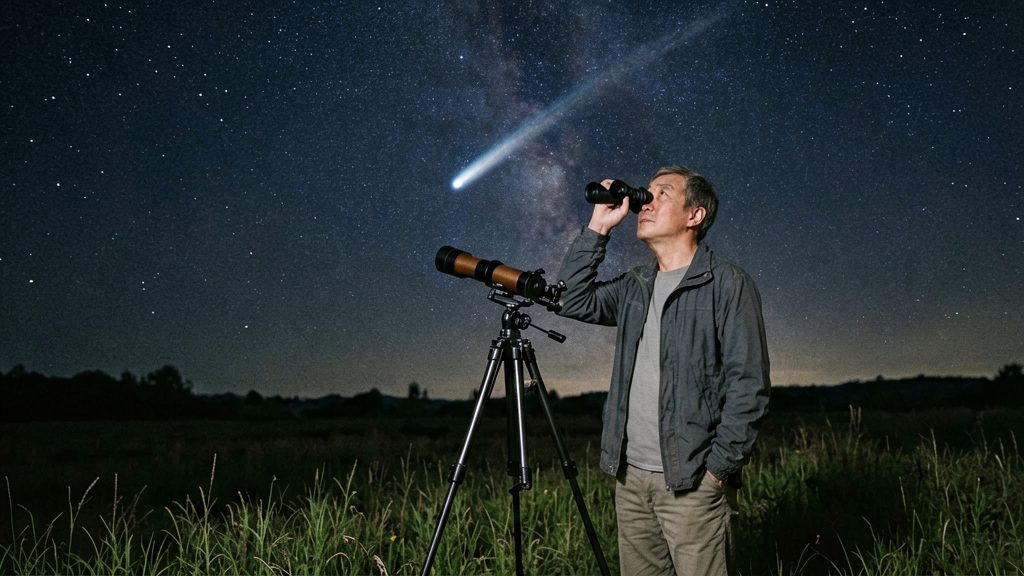
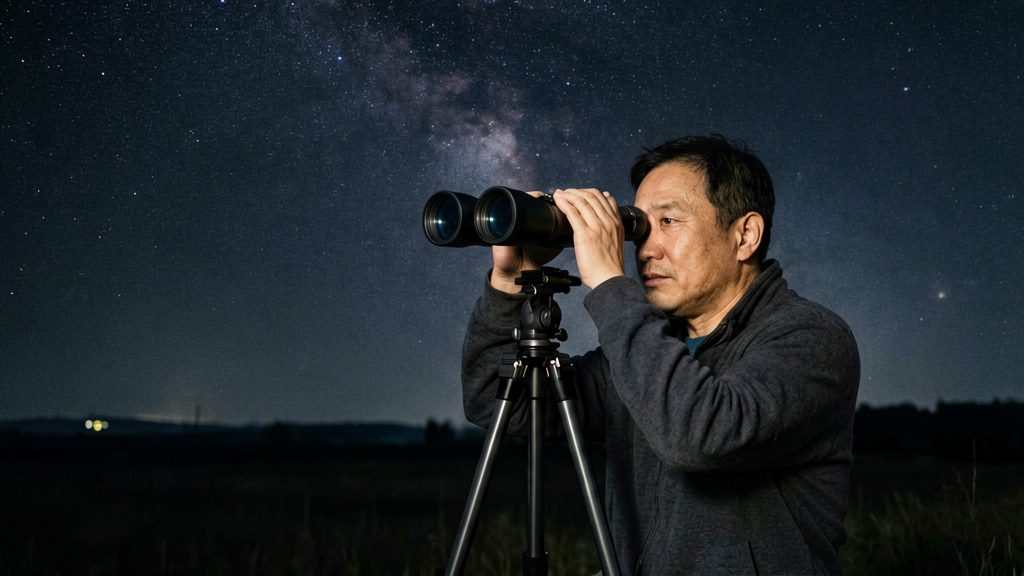
Most comets on the 2027 watch list that suit binoculars are faint, diffuse objects, so a steady pair of binoculars under a dark sky is the practical starting point. According to Star Walk (2026), the two comets it recommends for binoculars are 2P/Encke, best attempted in late January 2027, and 45P/Honda–Mrkos–Pajdušáková, best attempted in late July and August 2027. Both need a clear, dark horizon and a patient search.
Choosing binoculars: 7x50 or 10x50
Both common sizes work for dim comets, but they suit different situations:
| Feature | 7x50 | 10x50 |
|---|---|---|
| Magnification | Lower | Higher |
| Field of view | Wider | Narrower |
| Handheld steadiness | Easier to hold steady | Shakes more; a tripod or a steady rest helps |
| Best use | Finding and sweeping a faint, diffuse patch | Resolving a compact coma once located |
The “50” refers to the objective diameter. A larger objective gathers more light, which matters for faint, extended objects. Choose the 7x50 if you plan to hold the binoculars by hand, since a wider field makes the comet easier to find. Use the 10x50 when you can mount it or brace it on a fence post or car roof.
Star-hopping from bright reference stars
Comets move against the background stars, so you need to find the right patch of sky first:
- Identify two or three bright stars near the comet’s predicted position, using your star chart or astronomy app.
- Center the nearest bright star in the binocular field.
- Sweep slowly toward the comet’s position, noting the faint star pattern as you go.
- Compare the field with your chart. A comet appears as a faint, fuzzy patch with no sharp star-like point at its center.
- Confirm it by checking that the fuzzy patch matches your chart’s predicted position and keeps the same place among the surrounding stars during the session. If you suspect a reflection, shift the target within the field of view; a real comet stays with its star pattern.
Repeat the sweep on a second night. The comet’s position relative to the background stars will have shifted, which confirms it.
Dark sky and averted vision
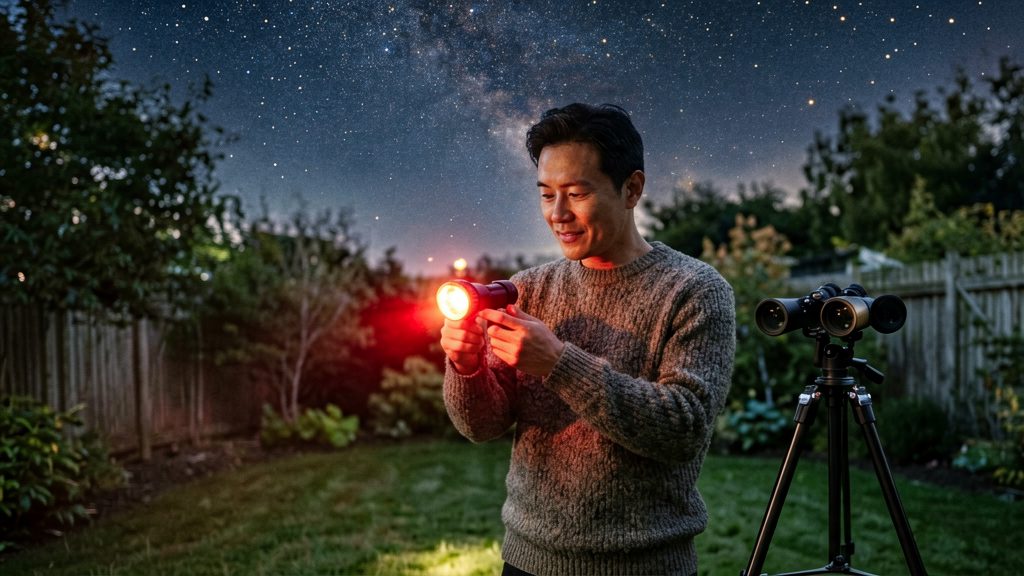
Light pollution washes out faint comets, so observe away from streetlights, and let your eyes adapt for at least 20 to 30 minutes before searching. Keep a red-filtered flashlight to read your chart without losing dark adaptation.
Averted vision helps detect faint extended objects. Look slightly to one side of the comet rather than directly at it. The outer rods in the retina are more sensitive to dim light, so the fuzzy coma often appears more clearly off-center.
Best tools and sites to track comets
For tracking a comet, the most useful tools fall into two groups: sky-map apps that show where a comet sits against the stars, and reference sites that give precise positions or visibility forecasts. Using one from each group lets you check the big picture and then confirm the exact coordinates before you go outside.
| Tool | Type | Best used for |
|---|---|---|
| Stellarium | Free sky-map software | Seeing a comet’s location on a sky map, set to your own location and time |
| SkySafari | Sky-map app | Locating a comet on a mobile or desktop sky map while observing |
| JPL Horizons | NASA/JPL ephemeris service | Requesting a comet’s precise position for a specific date, time and observer location |
| Minor Planet Center | Official designation and orbit database | Confirming a comet’s designation and orbit data |
| Seiichi Yoshida’s comet pages | Visibility list | Checking which comets are currently visible from the Northern Hemisphere |
Stellarium and SkySafari answer the question “where do I point?” Both let you set your location and time, then find a comet on the sky map. Use them to plan a session, not to measure exact coordinates.
JPL Horizons answers “exactly where is it?” Its ephemerides give positions for a chosen date and time, which helps when a comet is faint and close to a star field.
Seiichi Yoshida’s comet pages are the most practical starting point for visibility. The National Radio Astronomy Observatory (2020) points readers to this list as its reference for the next bright comet.
Why bright comets are hard to predict
Brightness forecasts for comets are approximate because the brightness depends on processes that are hard to measure from Earth before the comet is close to the Sun. Predicted magnitudes are the best current estimates, and they can change as observations accumulate.
Nucleus uncertainty
The nucleus is the solid core that produces a comet’s gas and dust. Its size and activity set the baseline brightness, and both are usually poorly constrained for a newly discovered comet. Star Walk (2026-03-21) describes the nucleus size estimate for C/2026 C1 (Tsuchinshan) as very preliminary, and notes that early images show no obvious large coma, the glowing gas envelope around the nucleus. A forecast built on an uncertain nucleus can shift substantially once better images arrive.
Outbursts and sudden brightening
Some comets release bursts of gas and dust without warning. These outbursts can raise brightness quickly and for a limited time. A magnitude forecast based on steady activity does not include them, so an outburst can make a comet appear brighter than predicted, sometimes only for days.
Fragmentation and sudden loss of brightness
A comet’s nucleus can split into pieces, especially when it is heated close to the Sun. Fragmentation can leave the total brightness lower than expected, because the material spreads over several pieces that may fade or disperse. Observers who expected a bright object may find it much dimmer after a breakup.
Gas and dust production near the Sun
As a comet approaches the Sun, sunlight drives gas and dust off the nucleus, and the output of each can change with distance and time. Gas and dust contribute differently to the visible coma and tail, so two comets with similar predicted magnitudes can look quite different. Star Walk (2026-10-01) gives approximate magnitudes for 2P/Encke and 45P/Honda–Mrkos–Pajdušáková, approximate forecast magnitudes that can change as observations accumulate.