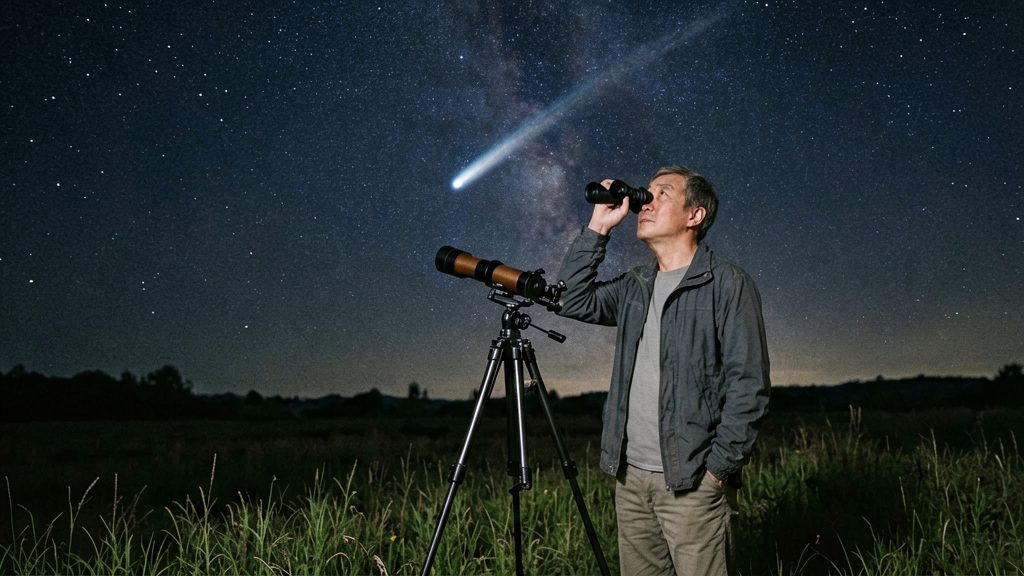
Yes. The ISS is visible to the naked eye, and no equipment is needed. Its light is reflected sunlight, mainly from its solar panels. The Planetary Society (2024-06-14) describes it as a bright, solid light crossing the sky, which makes it one of the easiest satellites to pick out with unaided eyes.
Can you really see the ISS without a telescope?
Brightness ranking
At its brightest, the ISS sits third in the sky’s brightness order, behind only the Sun and Moon.
| Object | Compared with the ISS at its brightest |
|---|---|
| Sun | Brighter |
| Moon | Brighter |
| Venus | Fainter |
| Sirius | Fainter |
This ranking applies to the ISS at its brightest, not to every pass. Its brightness varies with its position and your viewing angle, so a fainter pass is still a normal sighting.
Why reflected sunlight makes it stand out
The ISS produces no light of its own. It shines because it reflects sunlight, mainly off its large solar panels. This reflection is what gives it a brightness that rivals bright stars and planets.
What makes it distinct to the eye
- Steady, non-blinking light: The ISS glides across the sky without flashing, unlike an aircraft.
When is the best time to look?
The ISS is visible only during passes near the edge of Earth’s shadow, which usually means around dawn or dusk, according to The Planetary Society (2024). The station has no light of its own. It must be lit by the Sun while your patch of sky is dark. That combination happens during the twilight window, when the ground is dark but the station is still high enough to catch sunlight.
The twilight window
NASA’s guidance, as relayed by FOX 9, is that the best viewing time falls within a few hours before or after sunrise or sunset. Check local sunrise and sunset times for your location and plan your session around them, rather than watching at random times through the night.
Earth’s shadow edge and pass timing
- Passes that stay near the Earth’s shadow edge are the ones you can see. Passes farther from that edge are not expected to be visible.
- Because a pass is short, start watching a few minutes before the predicted time so you are already scanning the correct part of the sky.
Monthly frequency of visible passes
Most people can see the ISS at least once a month, and sometimes several times a week, according to The Planetary Society (2024). Your own frequency depends on where you live, so the number of visible passes in a given month varies from place to place.
How to find ISS pass times for your location
The quickest way to get exact timings is the free Spot the Station app, which NASA promotes for this purpose. According to NASA as quoted by FOX 9, the app shows the next sighting for your location. Pass times depend on where you are, so a listing for another town will not match your sky. Open the app, confirm it is using your current location, and check the listing before you go outside.
Setting location and time zone
- Allow the app to access your location, or enter your city or coordinates manually if you plan to observe from a different place.
- Confirm that the displayed times use your local time zone. A listing in UTC or another zone will shift the start time by hours if read incorrectly.
- Recheck after travelling. A listing made for home will be wrong at a new site.
Reading the start, peak and end times
Each pass listing gives three moments:
| Field | What it tells you | How to use it |
|---|---|---|
| Start | When the ISS becomes visible above the horizon | Look up a few minutes before this time |
| Peak (maximum height) | The highest point the ISS reaches in the sky | Shows how high to look, and where the pass is most likely to be seen clearly |
| End | When the ISS drops below the horizon or fades | Marks the end of the window |
Note the maximum height in the listing.
Using alerts
The app can send notifications ahead of a pass. BBC Science Focus (2025) reports that Spot the Station alerts can arrive about 12 hours before a sighting. This figure comes from that publication and was not confirmed against NASA’s own documentation, so check the alert settings in the app and treat the lead time as approximate.
What does the ISS look like in the sky?
The International Space Station appears as a bright point of light gliding steadily across the sky.
Where the pass begins
Look toward the western horizon at the start of the pass, then follow the station as it moves across the sky. Because the whole crossing takes only minutes, decide on your viewing spot before the pass begins.
Seeing the structure through a telescope
A telescope can reveal the station’s solar arrays and modules, which the unaided eye sees only as a single bright light. Start with your lowest-power eyepiece so the station stays in the field of view, since it crosses the sky quickly. If your mount does not track automatically, sweep the telescope by hand to follow it.
How to tell the ISS from planes and satellites
The ISS is easiest to identify by how its light behaves. It appears as a bright, solid light that moves steadily across the sky, without flashing. Aircraft and Starlink satellites can cross the same part of the sky, so three checks separate them: whether the light blinks, how bright it is, and how long it stays in view.
Steadiness compared with aircraft
- Non-blinking light: The ISS does not blink like an airplane. Its light stays constant from the moment it appears until it fades.
Brightness compared with Starlink satellites
The ISS is much brighter than Starlink satellites. A satellite that is only faintly visible is therefore more likely to be a Starlink satellite than the ISS. Brightness alone can settle the question when the object is clearly dimmer than a bright, steady light.
Duration as a further check
According to BBC Science Focus, a pass across the sky takes six minutes or less. A light that remains in view far longer than a few minutes is unlikely to be the ISS, so use the duration as a second check alongside steadiness and brightness.
How high should the pass be?
The height of a pass is measured in degrees of altitude, the angle between the horizon and the ISS measured upward along the sky. The horizon is 0°, and 90° is directly overhead, the point called the zenith. A pass that peaks low, around 10° to 20°, stays near the horizon and is easy to lose in haze or behind buildings. A pass that climbs toward 90° crosses a large part of the sky and gives the longest, clearest view.
Altitude is the single number to check before you go out. A higher pass gives more of its path to watch from the start.
Estimating altitude with your hand
You do not need a clinometer. Use your fist:
- Stretch your arm straight out in front of you.
- Hold a closed fist at arm’s length, knuckles facing you.
- Your fist spans roughly 10 degrees of sky.
- Count fist widths from the horizon to the point where the ISS peaks.
| Fist widths above horizon | Approximate altitude |
|---|---|
| 1 | about 10° |
| 2 | about 20° |
| 4 | about 40° |
| 9 | about 90° (directly overhead) |
The fist method is an estimate. Each fist width is about 10°, so count carefully and treat the result as approximate.
Do binoculars help?
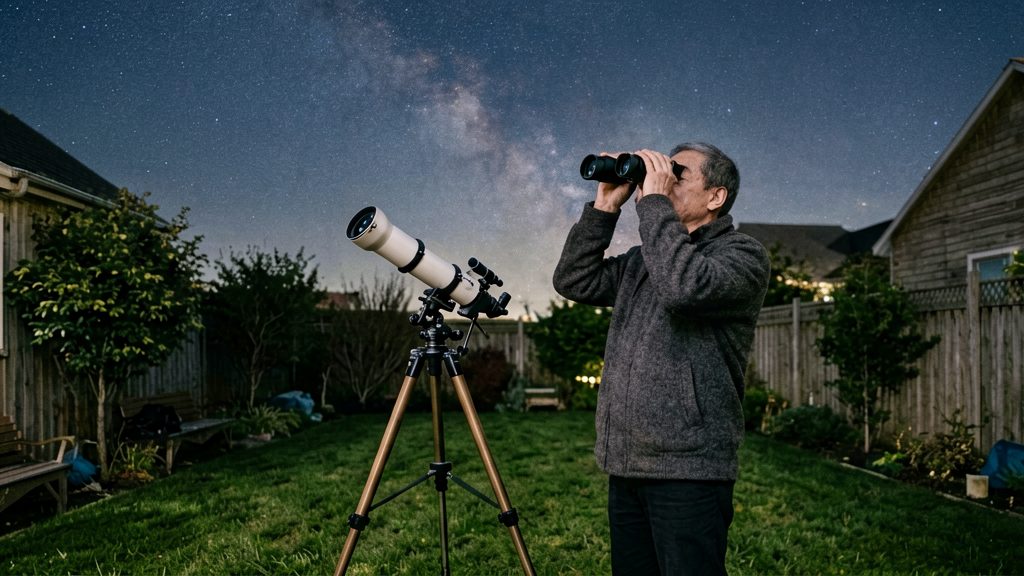
Binoculars make the ISS look brighter, but you don’t need equipment to see it. According to The Planetary Society (2024-06-14), no equipment is required, and a telescope is the instrument that reveals the station’s solar arrays and modules. Binoculars therefore improve the brightness of the view, not its structural detail. For most observers, the harder problem is keeping a fast-moving target in the field.
Brightness gain versus field of view
Higher magnification narrows the field of view. The station crosses a smaller patch of sky more quickly, so it is easier to lose. A lower-power pair with a wider field gives you more time to acquire and follow the station, which makes it the better choice for a first attempt.
- Brightness: binoculars add to the station’s existing brightness, which is already high.
- Field of view: a narrower field demands more precise pointing.
- Pass length: there is little time to reposition.
Holding steady during a pass
A stable steady hold matters more than extra magnification.
- Locate the station with your naked eye first, then raise the binoculars without moving your head.
- Brace your elbows against your chest, or lean on a wall, fence or car roof.
- Use a tripod adapter if your binoculars support one.
- Track by turning your whole body rather than swinging your wrists.
- Start following the station before it reaches the centre of the view.
Tips for city and high-latitude viewers
Viewing the ISS from a city or a high-latitude location is mostly a matter of choosing the right pass. Light pollution and the satellite’s orbit both work against you: the station is brightest when it is high in the sky, and it can stay low or never pass overhead at all. The adjustments below focus on pass height and location rather than on equipment.
Light pollution and sky glow
In a city, the sky glow reduces contrast, so a faint pass can disappear into the background. The ISS remains one of the easier objects to pick out under urban skies. Find a spot with the least artificial light nearby, such as a park or the far side of a building from the streetlights, and let your eyes adapt for a few minutes before looking up.
Maximum pass height in built-up areas
Buildings, trees and rooftops block low sky, so the height of a pass matters more in a city than in the countryside. According to BBC Science Focus (2025), in built-up areas choose passes with a maximum height of at least 40° to avoid buildings. A pass that peaks low over a skyline is often hidden for most of its few minutes.
Inclination of 51.6 degrees and high latitudes
The 51.6° inclination of the ISS sets the limit on where it can appear overhead. According to FOX 9 (quoting NASA, 2025), at latitudes north or south of 51.6°, including Alaska, the station never passes directly overhead. Viewers at high latitudes therefore see the ISS low on the horizon, which is more likely to be blocked by terrain or buildings. Expect lower passes and plan your viewing spot accordingly.
| Viewer situation | Expected pass character | Practical adjustment |
|---|---|---|
| City centre | Sky glow lowers contrast | Choose a darker spot and prefer passes at or above 40° |
| High latitude (north or south of 51.6°) | Station never passes directly overhead | Look for the highest available passes and clear horizons |