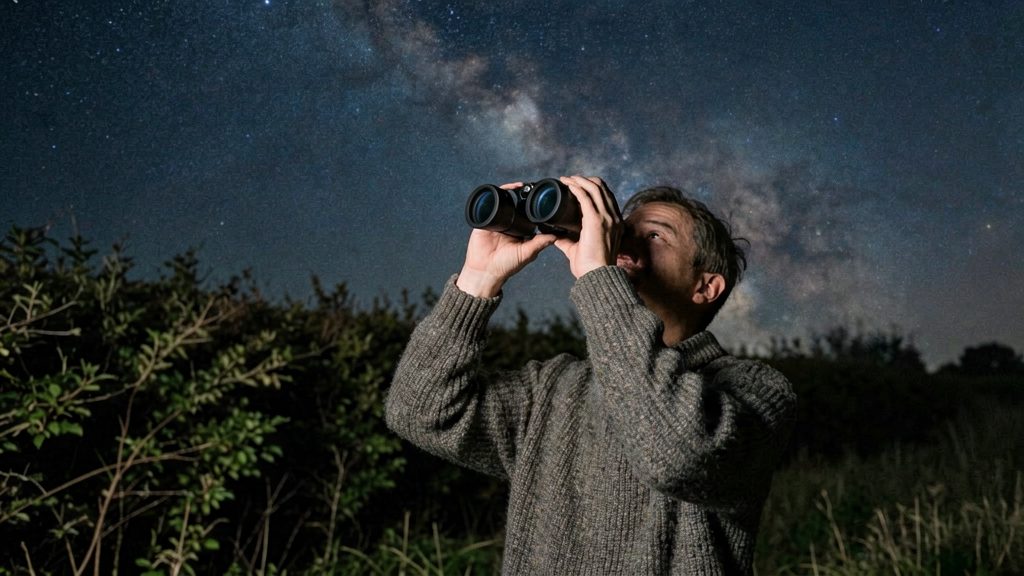
For most night-sky observers, the 8x42 is the better choice and the one to buy first. Astronomy magazine (Richard Talcott, 2023-05-18) gives the 8x42 an exit pupil of 5.25 mm, against 4.2 mm for the 10x42. Both fall inside the 4–6 mm range that the BBC Sky at Night Magazine (2026-02-13) recommends for a first pair of astronomy binoculars. The deciding factor is therefore the trade-off between brightness and magnification: the 8x42 delivers more light to the eye, while the 10x42 gives more magnification at a cost in image brightness and steadiness.
Short answer: 8x42 or 10x42?
Overall verdict: 8x42 for typical night-sky use
- Brightness: the 8x42 passes more light to the eye, as its larger exit pupil shows.
- Handling: according to Optics Trade (a retailer blog, not an astronomy specialist), handshake is less noticeable with the 8x42.
- Resolution: Optics Trade also notes that the 10x42 resolves finer detail, but it is harder to hold steady.
Summary of the brightness versus magnification trade-off
| Factor | 8x42 | 10x42 |
|---|---|---|
| Exit pupil | 5.25 mm | 4.2 mm |
| Light-gathering area at the eye | More than 20% more (Optics Trade) | Baseline |
| Handshake | Less noticeable | More noticeable |
| Resolution | Lower | Higher |
The extra magnification of the 10x42 is only useful if the image stays steady. For a general view of star fields and open clusters, the brighter view of the 8x42, which is usually (though not always) wider, tends to give more to see.
When 10x42 still earns a place on a shortlist
- You prioritise resolution and can keep the binoculars steady, either by bracing your elbows or by checking the manufacturer’s mounting guidance for your model.
- You want a higher magnification for close-up views of double stars or bright objects. Whether the 10x42 beats the 8x42 for double stars or planetary detail is plausible but not confirmed by any specialist source, so test both in person before deciding.
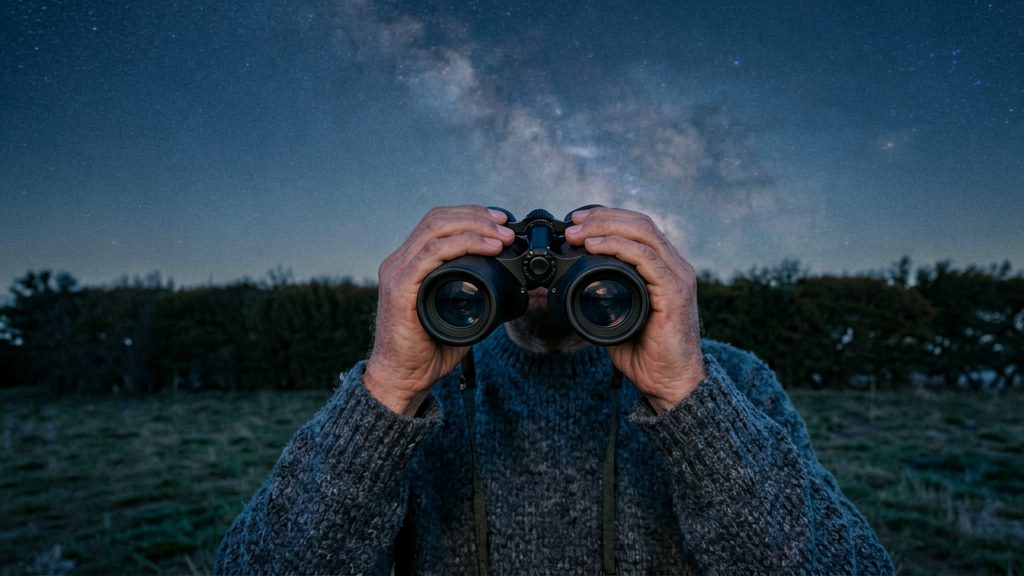
How exit pupil affects brightness at night
At night, a binocular’s brightness for the observer depends on how much light its exit pupil delivers to the eye’s own pupil. The exit pupil is the diameter of the light beam leaving the eyepiece, and it equals the aperture divided by the magnification. Both the 8x42 and the 10x42 have a 42 mm objective, so they collect the same total light. The difference lies in how that light is spread across the eye.
According to Astronomy magazine (Richard Talcott, 2023-05-18), the calculation gives these values:
| Model | Aperture | Magnification | Exit pupil |
|---|---|---|---|
| 7x50 | 50 mm | 7x | about 7 mm |
| 10x50 | 50 mm | 10x | 5 mm |
| 8x42 | 42 mm | 8x | 5.25 mm |
| 10x42 | 42 mm | 10x | 4.2 mm |
Matching the exit pupil to the dark-adapted eye
The eye’s pupil widens in the dark, and it narrows with age. Astronomy magazine (Richard Talcott, 2023-05-18) gives these approximate dark-adapted sizes:
- Under 30: about 7 mm
- In the 30s: about 6 mm
- At 40 and older: about 5 mm
When the exit pupil is smaller than the dark-adapted pupil, part of the eye’s light-gathering area goes unused. When it is larger, the extra light is lost at the eye’s edge. For adults aged 40 and older, whose dark-adapted pupil is about 5 mm, an exit pupil near 5 mm is the closest match. That value fits the 8x42 (5.25 mm) better than the 10x42 (4.2 mm). For many adults, an exit pupil near 5 mm is the closest match.
Light-gathering at the eye
Optics Trade states that the 8x42’s 5.25 mm exit pupil gives more than 20 percent more light-gathering area at the eye than the 10x42’s 4.2 mm. Treat this as supporting evidence only. The effect is greatest for extended objects such as the Moon, large star clusters and nebulae, where the surface brightness reaching the eye matters. Point-like stars are governed mainly by the shared 42 mm aperture, so the exit pupil difference shows up less clearly for them.
Can you hold 10x42 steady?
A 10x42 binocular can be hand-held by most adults, and bracing improves steadiness. Astronomy magazine (Richard Talcott, 2023-05-18) states that hand-held binoculars should top out around 10x, and both 8x42 and 10x42 fall within that hand-holdable range. Above that magnification, most people cannot keep the image sharp without a tripod. The difference between the two models is therefore a matter of image steadiness at the eyepiece, not a limit on whether the binocular can be used without mounting.
Hand tremor at 10x
Magnification amplifies every small movement of the hands. Handshake is more noticeable at 10x than at 8x, according to Optics Trade. Tremor is worse when the arms are extended and when the observer is tired or cold.
Bracing techniques
Bracing turns the arms into a rigid frame so the binocular moves as one piece. Use these methods, in order of stability:
- Elbows tucked to the ribs: rest both elbows against the torso and hold the binocular close to the face. This is the default position for short observing sessions.
- Chair back: sit upright in a chair with a firm back, lean the elbows or forearms against the backrest, and keep the binocular at eye level.
- Fence post or tree: press the shoulder or forearm against a solid vertical object such as a fence post or tree trunk. This transfers the load to the structure and is useful when standing for long periods.
Bracing does not remove tremor entirely. For sustained observation at 10x, or when the image still drifts, a tripod is an optional next step.
Which is better for the Moon and planets?
For the Moon, the 10x42 draws craters and the edges of the maria larger because of its extra power (10x against 8x). Whether this gives a better lunar view is plausible but not confirmed by a specialist source. Planets appear as very small discs at either magnification. Whether the 10x42 shows more planetary detail than the 8x42 is plausible because of its higher magnification, but no specialist source confirms it, so test both under your own sky.
| Factor for Moon and planets | 8x42 | 10x42 |
|---|---|---|
| Magnification | 8x | 10x |
| Lunar crater and maria detail | Slightly smaller image | Slightly larger image (unconfirmed benefit) |
Moon glare and contrast at high power
The Moon’s brightness is the main obstacle. Higher magnification does not add light, so the Moon’s image can look dimmer at 10x. If glare is uncomfortable, a neutral-density or moon filter can reduce it; check the filter’s label for its light transmission before buying. Observing near the terminator, the line between lit and dark parts, is practical: shadows show crater relief more clearly than a full Moon does. If glare is still uncomfortable, a neutral-density or moon filter reduces it. Check the filter’s own label for its light transmission before buying.
Planets at 8x and 10x
Neither binocular is designed to show planetary disks in detail. Use either binocular to confirm a planet’s position and colour, and steady it against a fixed support if the image keeps wobbling.
Is a field of view more important for deep-sky objects?
For deep-sky targets such as open clusters and nebulae, a wider field of view usually matters more than extra magnification, because most of these objects are large in the sky and you need to scan them to find their edges and brighter stars. According to Astronomy magazine (Richard Talcott, 2023), most binoculars have a field of view of about 6° to 7°, and wide-angle models reach about 8° to 10°.
| Binocular type | Typical field of view | Fit for deep-sky scanning |
|---|---|---|
| High-power models | About 3° to 5° | Narrow. Suits small targets, but makes it harder to keep a cluster in view |
| Most binoculars | About 6° to 7° | General-purpose range for star clusters and Milky Way fields |
| Wide-angle models | About 8° to 10° | Best for sweeping large areas such as the Milky Way |
Field of view and magnification trade off against each other. Lower magnification gives a wider view, which is why 8x42 binoculars are usually wider than 10x42 models. Field of view varies by model, so compare the stated values on each product rather than assuming a fixed difference.
For astronomy, Astronomy magazine (Richard Talcott, 2023) advises at least 7x magnification. Below that level, the view tends to lose the sense of depth and detail that makes clusters and star fields worth scanning.
Should you consider 10x50 or 7x50 instead?
Both 10x50 and 7x50 have a 50 mm aperture, which gathers more light than the 42 mm objectives of the 8x42 and 10x42. The difference shows up in the exit pupil, the bright disc of light that reaches your eye. Divide the aperture by the magnification to get it: aperture ÷ magnification.
| Model | Aperture | Magnification | Exit pupil | Inside the 4–6 mm first-pair range |
|---|---|---|---|---|
| 8x42 | 42 mm | 8x | 5.25 mm | Yes |
| 10x42 | 42 mm | 10x | 4.2 mm | Yes |
| 10x50 | 50 mm | 10x | 5 mm | Yes |
| 7x50 | 50 mm | 7x | About 7 mm | No, above the range |
Astronomy magazine (Richard Talcott, 2023-05-18) gives these exit pupil values. BBC Sky at Night Magazine (2026-02-13) recommends a 4–6 mm exit pupil for a first pair of astronomy binoculars.
The 10x50 is the more useful comparison for a first purchase. It has the same 10x power as the 10x42 but a larger aperture, and its 5 mm exit pupil sits in the recommended band. BBC Sky at Night Magazine describes the 10x50 as a popular compromise that most adults can hold steadily.
The 7x50 has the largest exit pupil of the four, at about 7 mm. That is above the 4–6 mm band recommended for a first pair. Its wider field and lower magnification make it a good sweeping instrument, but it is less suited to a first pair meant to show a range of targets. Its lower power may also make it less suited to planets and the Moon, but no specialist source confirms this.
The 8x42 is the most conservative choice of the four. Its 5.25 mm exit pupil and lower power are easier to hold steady, and its field of view is usually wider than the 10x42’s.
When a tripod makes sense
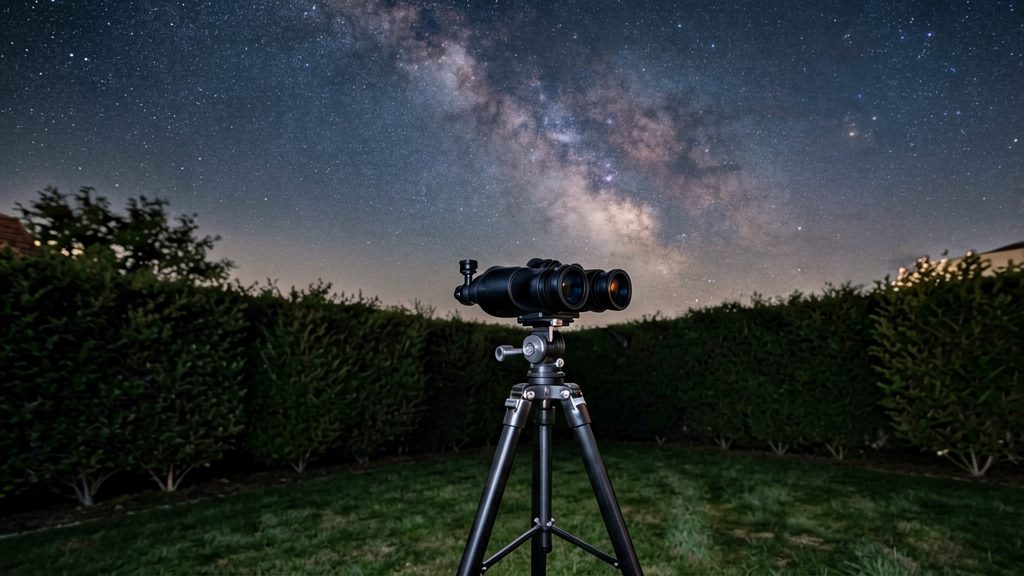
According to Astronomy magazine (Richard Talcott, 2023-05-18), binoculars above 10x and over 50 mm of aperture need a tripod. Neither the 8x42 nor the 10x42 is above 10x with an aperture over 50 mm, so a mount is optional for both. The case for one rests on comfort and observing time, not on necessity.
| Model | Magnification | Aperture | Exit pupil | Meets tripod threshold |
|---|---|---|---|---|
| 8x42 | 8x | 42 mm | 5.25 mm | No |
| 10x42 | 10x | 42 mm | 4.2 mm | No |
Mounting with a tripod adapter
A tripod adapter is a bracket that holds the binoculars and attaches to the tripod head. To set one up:
- Fix the adapter to the tripod head, then seat the binoculars in its cradle.
- Balance the binoculars so they stay level when you release your grip, and adjust the cradle if they tip.
- Set the tripod height so you can look through the eyepieces without bending your neck.
- Focus with the centre wheel, then lock the tripod head.
Comfort during long sessions
A tripod takes the weight off your arms and removes the constant small corrections that handshake introduces. This matters more for the 10x42 than for the 8x42. The 8x42’s larger exit pupil of 5.25 mm, against 4.2 mm for the 10x42, also gives a more forgiving view at the eye. Astronomy magazine (Richard Talcott, 2023-05-18) notes that a dark-adapted pupil of about 5 mm is typical for many adults aged 40 and over, so the 8x42’s exit pupil fits that range well. A mount lets you spend a longer session at the eyepiece without fatigue.
Tips for Canadian dark skies and cold nights
Canadian winter observing adds two problems to a dark site: optics that fog or collect dew, and hands that lose dexterity before you have finished a session. Both can be managed with a few routine habits. Dark-sky locations in Canada are often remote, so plan the cold-weather gear before you leave home.
Fogging and dew on lens surfaces
Fogging happens when warm, moist air from your face or a heated car meets cold glass. Dew forms on the objective lenses when they cool below the surrounding air temperature, which is common on clear, still nights.
- Acclimatize the binoculars. Store them in a cool, dry place, and let them adjust to the outdoor temperature before use. Moving them from a warm room straight into the cold can cause fogging.
- Avoid breathing on the eyepieces. Turn your head to the side while you observe, and keep the eyecups in place.
- Cap the objectives between sessions. Lens caps reduce the amount of moist air that reaches the glass.
- Wipe with a dry microfibre cloth only. Remove surface moisture before it freezes. Do not use household cleaners on coated lenses.
Warm hands and gloves for long sessions
Your hands need to work the focus wheel, adjust the diopter and hold the binoculars steady for long periods.
- Use thin liner gloves with fingertip access. Many observers use a thin glove that exposes the fingers and thumbs, so the focus wheel and diopter can be adjusted without removing the glove.
- Use a warm layer over the top, not on the optics. Keep chemical hand warmers in your pockets or gloves, not against the lenses, to avoid warming the glass unevenly.
- Take short warm-up breaks. Step away from the eyepieces regularly to restore circulation in your hands.
- Keep a spare pair of dry gloves. Damp gloves lose insulation quickly in the cold.
| Issue | Practical response |
|---|---|
| Internal fog after moving outdoors | Let the binoculars acclimatize in a cool, dry place before use |
| Dew on objective lenses | Cap the lenses between sessions and wipe with a dry cloth |
| Loss of finger dexterity | Wear thin liner gloves with fingertip access and take warm-up breaks |
Planning a dark-site visit in winter
Check the current access rules, parking and opening conditions with the park or site operator before you travel, since winter closures and road conditions vary. Organisations such as the Royal Astronomical Society of Canada and the International Dark-Sky Association maintain information on recognized dark-sky sites in Canada. Check each site’s current status before you plan a trip.