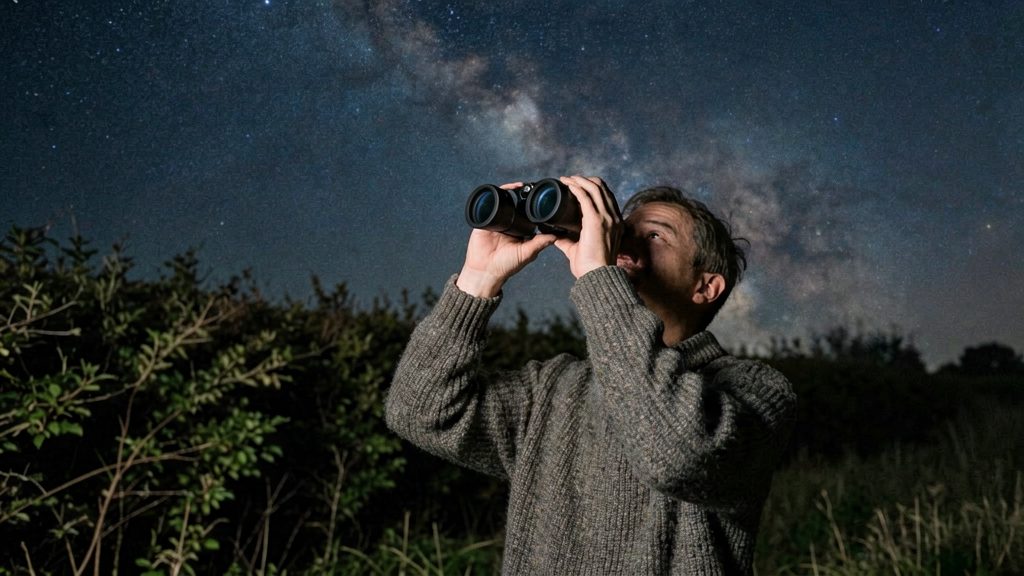
Ten-by-fifty binoculars are a practical first instrument for sky observing. They set up in seconds, show an upright image that is easy to match against a star chart, and cost less than a telescope kit with a mount and tripod. Their wide view also helps you find targets, so a beginner can spend a season learning the sky before deciding on a telescope.
Why choose 10x50 binoculars for stargazing?
Quick setup and an easy-to-follow image
Binoculars need no assembly beyond attaching the strap and adjusting the hinge to match your eye spacing. Focus the central wheel on a distant object with one eye, then set the diopter on the other eyepiece, and you can observe. Astronomy magazine notes that binoculars are easy to set up and that their wide field and upright image make objects easier to find than with a telescope (Astronomy magazine, astronomy.com).
The upright image matters for beginners. A constellation appears the same way up as it does with the naked eye, so you can match what you see to a printed or app-based star chart without first working out a reversed or rotated view.
Lower cost and smaller footprint
A telescope kit usually bundles an optical tube, a mount, a tripod and one or two eyepieces, and each part adds weight and storage space. A pair of binoculars is one self-contained unit that fits in a bag and goes out on a balcony or a short drive to a dark site without planning. Compare the price and weight of each model on the manufacturer’s listing, since they vary.
Learning sky navigation before buying a telescope
Binoculars let you practise star-hopping: finding a bright star, then moving your view step by step toward fainter objects using nearby stars as markers. This skill transfers directly to a telescope, where the field of view is narrower and finding targets is harder without it.
Use a season of binocular observing to learn:
- Which constellations are visible from your location and at what time of year
- The brightest stars and their positions relative to each other
- Where the planets sit against the background stars on a given night
- How to use a star chart or app to locate a target and then confirm it in the eyepiece
After that, your notes show which kind of telescope suits the targets you actually want to observe.
What does 10x50 actually mean?
The label “10x50” gives two numbers, and each controls a different part of the view. The first is the magnification, the second is the objective diameter. Together they set the basic character of the binoculars before optical quality or accessories come into play.
Magnification: 10x
Magnification is how many times closer objects appear. At 10x, the Moon’s craters are clearly visible, and Venus’s phases can be seen, according to Astronomy magazine (astronomy.com). Higher magnification also narrows the field of view and makes hand shake more visible.
Objective diameter: 50 mm
The objective is the large front lens. Its 50 mm diameter sets the light-gathering capacity: a wider objective collects more light, which helps show faint targets.
Reading the model label
| Label element | Meaning | In “10x50” |
|---|---|---|
| First number | Magnification | 10 |
| Letter “x” | Separator, read as “by” | x |
| Second number | Objective diameter in mm | 50 |
Some labels add a model name or series after these numbers. Check the product label or the manufacturer’s instructions to confirm the exact specifications of a given pair.
Exit pupil, field of view and handheld steadiness
Every 10x50 binocular has a 5 mm exit pupil, calculated as 50 mm objective aperture divided by 10x magnification. Astronomy magazine presents this as a general guideline for matching the exit pupil to the eye. The exit pupil is the diameter of the light beam that reaches your eye, so it determines how much of the binocular’s light-gathering capacity you can actually use. According to Astronomy magazine (astronomy.com), a 5 mm exit pupil suits observers around 40 or older, whose pupils dilate to about 5 mm in the dark. Younger observers, whose pupils can open to about 7 mm, do not use the full light of the objective.
Matching the exit pupil to your eyes
| Observer | Typical dark-adapted pupil | Effect with 10x50 |
|---|---|---|
| Around 40 or older | About 5 mm | Full use of the 5 mm exit pupil |
| Younger observers | Up to about 7 mm | Part of the light-gathering capacity is unused |
If your pupils open wider than 5 mm, the binoculars cannot use the full light your eyes could take in, so the image may look less bright than it could.
Field of view
Field of view describes the width of sky visible through the binocular at once. According to Astronomy magazine (astronomy.com), typical values by binocular class are:
- Most models: about 6° to 7°
- High-power models: about 3° to 5°
- Wide-angle models: about 8° to 10°
For the exact field of view of a specific 10x50 pair, check the manufacturer’s specification sheet before buying. A wide field helps you locate targets by star-hopping, because you can keep a reference star pattern in view while you sweep toward a deep-sky object.
Handheld steadiness at 10x
Magnification multiplies motion as well as detail. At 10x, a small hand tremor moves the image across the field far more visibly than it would in unmagnified sight.
To keep the image still:
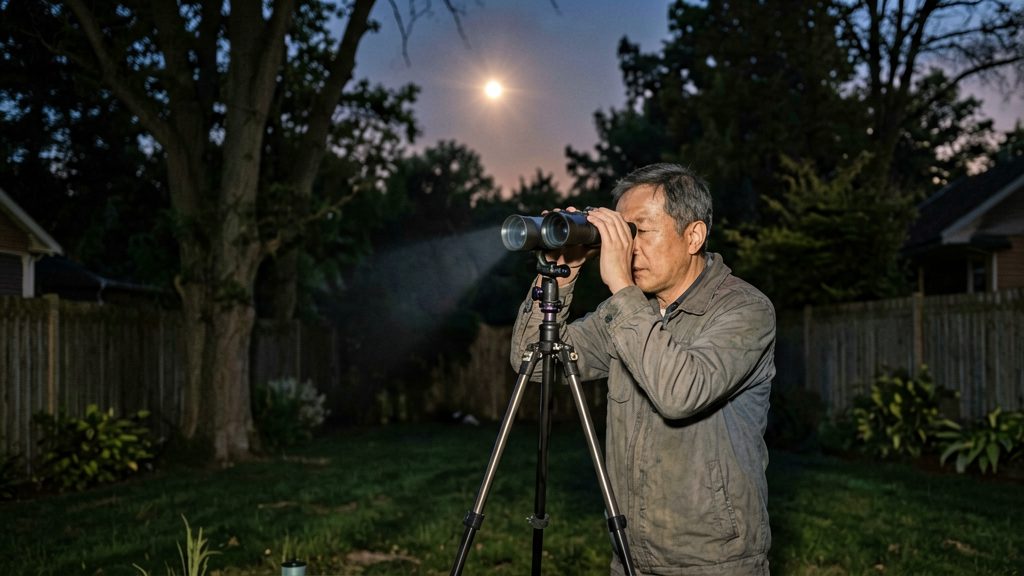
- Brace your elbows against your chest, or sit with your elbows resting on your knees or a table.
- Lean your back against a wall, a tree or a car roof.
- Exhale slowly before you observe, and hold the view while you breathe lightly.
- Use both hands and keep the binocular close to your face, with your eyes centred on the eyepieces.
Do you need a tripod?
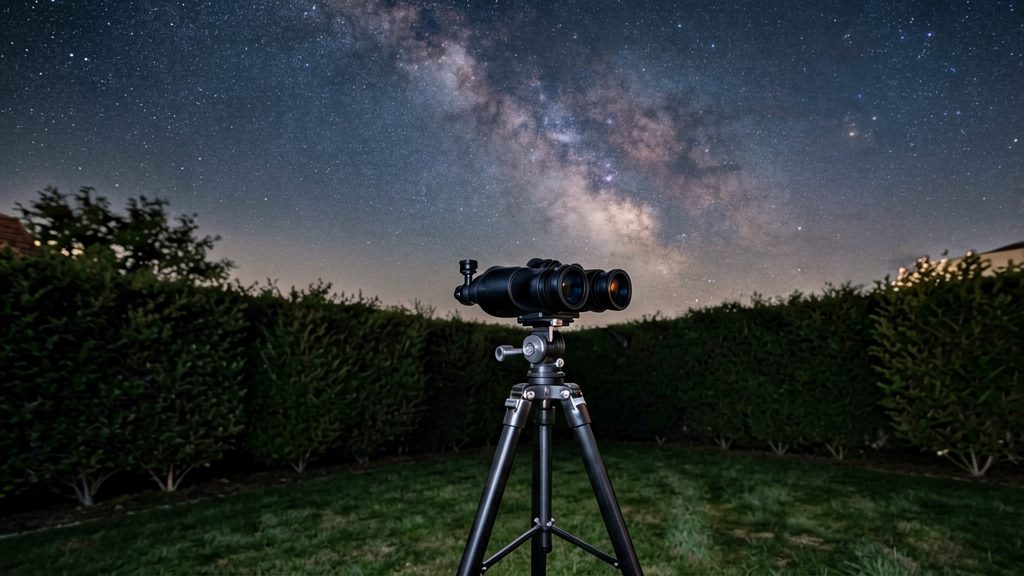
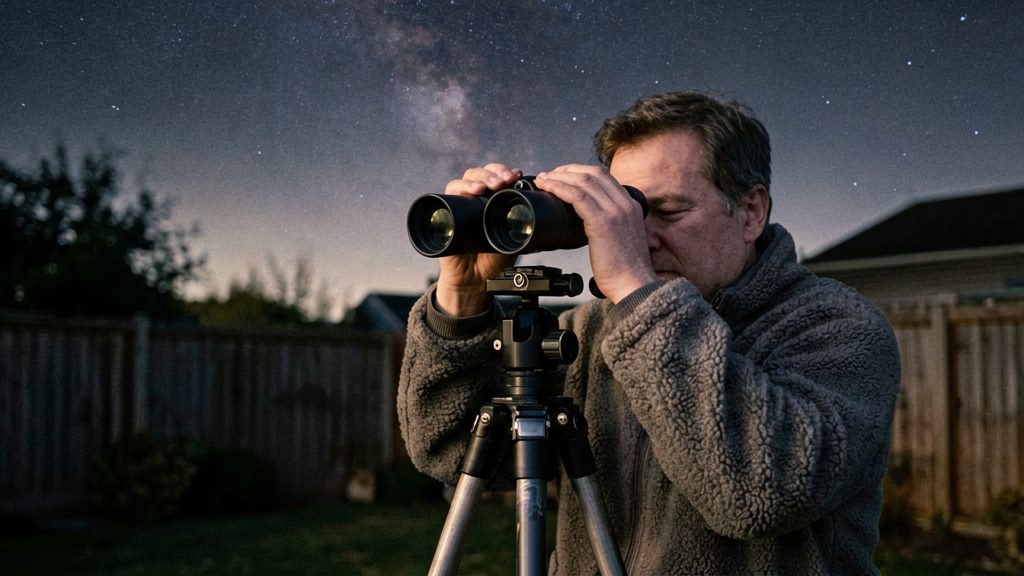
A tripod is not required for 10x50 binoculars. At 10x magnification, they sit at the practical upper limit for handheld use. According to Astronomy magazine (astronomy.com), tripods are mainly needed for giant binoculars, meaning models with magnification above 10x and apertures above 50 mm.
| Binocular type | Magnification and aperture | Tripod need |
|---|---|---|
| 10x50 | 10x, 50 mm | Not required for handheld use |
| Giant binoculars | Above 10x, above 50 mm | Mainly needed |
The reason is image shake. Higher magnification magnifies every hand movement, and a heavier body makes the arms tire faster. Both effects grow with the larger models.
Mounting giant binoculars
Giant binoculars are usually mounted on a tripod through a tripod socket on the central hinge or body. Check the manufacturer’s manual for the thread size and whether the model requires a separate adapter. Use a sturdy tripod rated for more than the weight of the binoculars, and fit a tilt or pan head that allows smooth movement across the sky.
Adapters and mounting options
- Tripod adapter: Many binoculars need a bracket or adapter that fits the central thread of the body. Confirm the adapter matches the thread before buying.
- Binocular mount: A dedicated mount holds the binoculars at the eyepiece height you choose and makes it easier to track objects across the sky.
- Chair or bench support: A reclining chair or observing bench can steady the binoculars without a full tripod setup, which helps when you observe for long periods.
What can you see with 10x50 binoculars?
A 10x50 pair gives a bright, wide, upright view of the sky that suits beginners well. Under a dark sky, the list of realistic targets is long: lunar craters, the phases of Venus, Jupiter’s largest moons, large open clusters, Milky Way star fields and the galaxies M31 and M33.
Moon and planets
The Moon is the easiest first target. Craters, maria and the terminator (the line between lit and dark terrain) are clearly visible, and the shadows along the terminator make relief easy to see. Observe near the terminator, because the shadows there show the most detail.
Venus shows phases much like the Moon, and a 10x50 pair can show its crescent and gibbous shapes. Astronomy magazine lists Venus’s phases as a binocular target.
Jupiter is the main planetary target. Its largest moons appear as small points of light lined up beside the planet. Their positions change from night to night, so a short sketch or photo helps you track them.
Open clusters
The Pleiades (M45) and the Beehive Cluster (M44) are the two best-known large clusters for binoculars. Both fill much of the field of view, so you see a group of stars rather than a single point.
Galaxies and star fields
M31, the Andromeda Galaxy, appears as an elongated haze. M33, the Triangulum Galaxy, is fainter and needs a dark sky and steady observing. Astronomy magazine lists both as binocular targets, and it reports that more than 400 deep-sky objects are reachable with binoculars from a dark-sky site. The source does not give this count for 10x50 specifically.
What features should a beginner look for?
Before buying 10x50 binoculars for astronomy, check four things: the optical coatings, the prism design, the prism glass, and whether the model is suited to the way you will hold it. According to Astronomy magazine (astronomy.com), coated optics and porro-prism designs are the recommended choices for astronomy, and higher-quality models use BaK-4 glass. These are the specifications that most affect image brightness and contrast, so check them before comparing prices.
Fully multi-coated optics
Lens coatings reduce light lost to reflection, which matters when you are looking at faint objects. Astronomy magazine recommends coated optics for astronomy. Check the manufacturer’s specifications for the coating type.
- Avoid uncoated models for astronomy; coated optics are the recommended choice.
Porro-prism design
A porro-prism binocular uses two prisms per barrel, arranged in a zigzag path. Astronomy magazine recommends porro-prism designs for astronomy. Confirm the prism type in the product description before purchase.
BaK-4 prism glass
BaK-4 is a type of optical glass used in prisms. Astronomy magazine notes that higher-quality models use BaK-4 glass. Check the spec sheet for BaK-4 before choosing between models at similar prices.
Are 10x50 binoculars right for you?
The choice between 10x50 binoculars and other setups depends on your age, your observing goals, and how much you already own. As explained above, the 5 mm exit pupil of a 10x50 suits observers around 40 or older better than younger ones.
Beginners versus experienced telescope users
For a complete beginner, 10x50 binoculars are a practical first instrument.
For an observer who already owns a telescope, binoculars serve a different role. They are faster to bring outdoors and quicker for scanning large areas, so they complement a telescope rather than replace it.
Observing goals: sky tours versus planetary detail
Binoculars suit sky tours. Their wide field and low magnification make them quick to scan across the Milky Way, large clusters and bright comets.
For planetary detail, binoculars are limited. They show Jupiter’s moons and Venus’s phases, but surface features on planets require higher magnification than 10x. If your main goal is planetary observation, a telescope with an eyepiece selection will serve you better.
Budget and upgrade path
Choose 10x50 binoculars if you want a single instrument that covers wide-field viewing without extra equipment. Once you know which targets you return to most often, you can decide whether a higher-power or larger-aperture pair suits your goals. Check the product label and manufacturer’s specifications before comparing models, since fields of view and weights vary between brands.
Using binoculars under Canadian skies
Canadian observing conditions affect a 10x50 pair in three main ways: the amount of light pollution near your home, the long nights of winter, and the cold and moisture that build up on optics. Results depend on where you stand and when you observe, and the points below show how to adjust for each.
Urban versus rural sites
- Urban sites: Streetlights and sky glow wash out faint stars.
- Rural and dark-sky sites: Milky Way star fields are the clearest reason to travel. Astronomy magazine notes that more than 400 deep-sky objects are reachable from a dark-sky site.
- Practical step: Pick a site away from direct light sources, and let your eyes adapt to the dark for several minutes before observing. Avoid white flashlights; use a red light instead.
Winter nights and seasonal visibility
Winter nights are long at Canadian latitudes, which gives more observing time per session. Seasonal change matters more than night length, though: each season brings a different set of constellations and objects above the horizon. Use a monthly sky calendar or a star chart app to see what is visible on the date and time you plan to observe, rather than relying on what you saw last season.
Cold, dew and condensation on optics
Cold air and humidity affect binoculars in predictable ways:
| Condition | What happens | Practical response |
|---|---|---|
| Cold, dry night | Focus and hinge movement can feel stiffer | Handle the binoculars gently and avoid forcing the focus wheel or hinge |
| Dew on the lens surfaces | Moisture forms on the objective and eyepiece lenses, softening the image | Wipe with a soft microfibre cloth; keep caps on between sessions |
| Moving from cold to warm air | Fog forms inside or on the lenses as warm, moist air condenses | Seal the binoculars in a bag before going indoors and let them warm slowly |