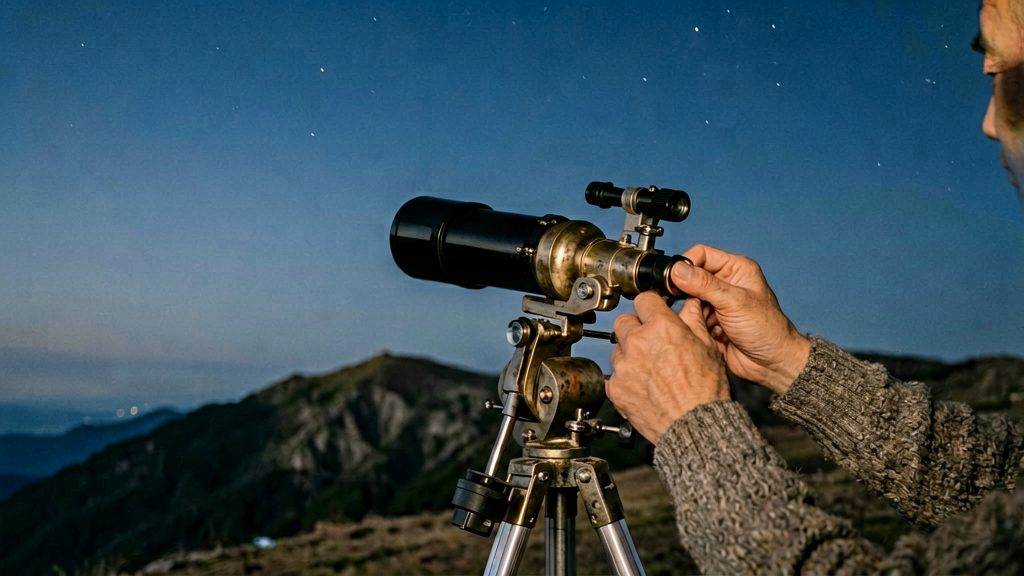
Planets fill only a small part of the eyepiece field, so the image must be magnified well beyond what a wide-field view needs before surface detail becomes visible. Short focal length eyepieces provide that power. Ultra-short 2–4 mm eyepieces suit planets and the Moon on shorter-focal-length telescopes, while 5–10 mm eyepieces suit the same targets on medium-focal-length telescopes.
Why planets need short focal length eyepieces
Because the planet’s disc is small in the field of view, Because the planet’s disc is small in the field of view, a longer eyepiece shows the planet as a tiny disc with little detail. Shorter focal lengths raise the magnification and enlarge that disc. The upper limit comes from the telescope’s aperture: according to OPT Telescopes, a retailer blog, maximum useful magnification is about 2× the aperture in millimetres (50× per inch). An 8-inch (200 mm) scope therefore tops out near 400× in theory, assuming perfect seeing.
Ultra-short eyepieces on shorter telescopes
Eyepieces of 2–4 mm give very high power. Because the focal length of the telescope limits how short an eyepiece you can use practically, these eyepieces make sense only with a suitable telescope.
Short eyepieces on medium-focal-length telescopes
The 5–10 mm range is the more common choice for this job because it reaches useful planetary magnification without the very short focal lengths.
| Eyepiece class | Focal length | Telescope type | Main targets |
|---|---|---|---|
| Ultra-short | 2–4 mm | Shorter focal length | Planets, Moon (very high power) |
| Short | 5–10 mm | Medium focal length | Planets, Moon |
Telescope School gives observer-consensus magnification ranges:
- Jupiter: 100–200×
- Saturn: 100–200× (Cassini Division at about 100–150×)
- Mars: 150–250×
- Venus: 30–100×
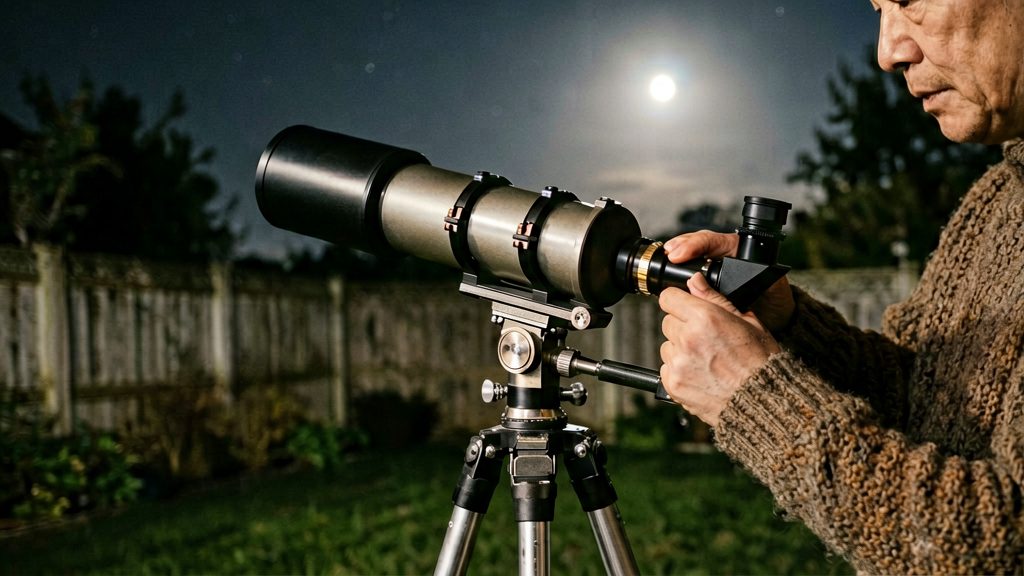
How do you calculate eyepiece magnification?
Eyepiece magnification equals the telescope’s focal length divided by the eyepiece’s focal length, with both values in millimetres. The result is a multiplier written with a times sign, such as 150×. Because the formula uses only these two numbers, you can find the power of any eyepiece on any telescope if you know both values.
The formula
- Magnification = telescope focal length ÷ eyepiece focal length
- Use the same unit for both values, normally millimetres.
- Round the result to a whole number for everyday use.
Worked example
Take a telescope with a focal length of 1500 mm and a 10 mm eyepiece:
1500 mm ÷ 10 mm = 150×
The telescope stays the same when you change eyepieces, so only the divisor changes:
| Eyepiece focal length | Calculation | Magnification |
|---|---|---|
| 5 mm | 1500 mm ÷ 5 mm | 300× |
| 10 mm | 1500 mm ÷ 10 mm | 150× |
| 15 mm | 1500 mm ÷ 15 mm | 100× |
A shorter eyepiece gives higher magnification, and a longer one gives lower power.
Reading the focal length on the barrel
Look for the number printed on the eyepiece’s metal body, the barrel marking. It gives the eyepiece’s focal length in millimetres. Use that figure as the divisor. If the barrel shows no focal length, check the product label or the manufacturer’s instructions before calculating.
What eyepiece focal length works best for planets?
For planets, aim for an exit pupil of 0.5 to 1.0 mm, calculated as aperture ÷ magnification, according to Telescope School. Staying in that exit-pupil range keeps the image bright enough. On an 8-inch scope it corresponds to 200× to 400×, so on most nights stay near the lower end. Choosing within the 5–10 mm range depends on the telescope’s focal length, so check that first.
Matching power to aperture
Telescope School states that experienced observers typically work at 20 to 30× per inch of aperture. On an 8-inch telescope, that means roughly 160× to 240×. Treat this as a guide to what your optics can handle, not a target to reach every night.
Choosing between 5 mm and 10 mm
On a telescope with a 1500 mm focal length, the two eyepieces produce these powers:
| Eyepiece focal length | Magnification on 1500 mm scope |
|---|---|
| 10 mm | 150× |
| 5 mm | 300× |
The 10 mm eyepiece gives the more usable planetary view on this scope. Use the 5 mm eyepiece only on exceptionally steady nights: 300× is above the realistic ceiling of about 250× on a good night.
Is there a magnification limit for planets?
Yes. According to OPT Telescopes (retailer blog), the maximum useful magnification is about 2× the aperture in millimetres, or roughly 50× per inch. That figure assumes perfect seeing, so it is a theoretical ceiling. For planetary work, Telescope School gives a more practical limit: about 250× on a good night, with most planets observed between 150× and 200×.
Theoretical maximum: 2× aperture
| Aperture | Theoretical maximum (2× mm) | Exit pupil at that power |
|---|---|---|
| 150 mm (6-inch) | about 300× | 0.5 mm |
| 200 mm (8-inch) | about 400× | 0.5 mm |
Practical ceiling: about 250×
The realistic limit on a good night is about 250×. At that power, an 8-inch scope gives an exit pupil of 0.8 mm (200 ÷ 250), inside the planetary range. Plan around 250× rather than 400× unless the air is steady.
How seeing limits high power
Atmospheric turbulence, often called seeing, decides how much magnification a planet can take. Air moving at different temperatures bends the light from a planet, so the image shimmers and wobbles. A higher power magnifies that movement along with the planet, which is why a view that looks sharp at low power can turn into a blurry blob at high power. The useful limit therefore depends on the night as much as on the telescope.
Atmospheric turbulence makes planets look wobbly
Poor seeing makes the Moon and planets look wobbly, and the effect grows with magnification. On a steady night, detail such as belts on Jupiter or the Cassini Division on Saturn stays put. On an unsteady night, the same detail drifts and smears. OPT Telescopes, a retailer blog, notes that poor seeing makes the Moon and planets look wobbly.
Poor nights cap useful power at 100 to 150x
According to Telescope School, poor nights limit useful power to about 100–150×. Experienced observers typically work at 20–30× per inch of aperture.
| Sky condition | Practical power ceiling (Telescope School, 2026) |
|---|---|
| Poor seeing | About 100–150× |
Start with the longest eyepiece, then increase power
The method is simple and works on any telescope:
- Begin with the longest-focal-length eyepiece you own, which gives the lowest power.
- Centre the planet and focus carefully.
- Step up to a shorter eyepiece in small increments.
- Stop increasing when the image starts to degrade, then back off to the previous eyepiece.
Best eyepiece ranges for Jupiter, Saturn and Mars
These are the magnification windows that experienced planetary observers commonly use for each target. Telescope School gives the ranges as observer consensus, meaning they reflect typical practice rather than measured limits of the eye or the telescope.
| Target | Working magnification | Notes |
|---|---|---|
| Jupiter | 100× to 200× | Full disc range |
| Saturn | 100× to 200× | Full ring system range |
| Cassini Division | about 100× to 150× | Gap in the rings, best at the lower-middle part of the range |
| Mars | 150× to 250× | Needs the highest power of the three targets |
| Venus | 30× to 100× | Observer-consensus range |
To turn these ranges into eyepiece focal lengths, divide your telescope’s focal length by the target magnification. Using a 1500 mm telescope as an example:
- Jupiter and Saturn at 100× to 200×: 15 mm down to 7.5 mm
- Cassini Division at 100× to 150×: 15 mm down to 10 mm
- Mars at 150× to 250×: 10 mm down to 6 mm
Use the focal length of your own telescope, which is printed in the manufacturer’s specifications, not the eyepiece’s, and check the result against the eyepiece you own.
Jupiter and Saturn are the usual starting targets because they hold detail across the whole 100× to 200× window. Mars is the exception: its disc is small, so it calls for the upper part of its observer-consensus range, 150× to 250×, when seeing allows.
Should you use a Barlow lens instead?
A Barlow lens is a negative lens placed in the light path before the eyepiece. It multiplies the telescope’s effective focal length by its rated factor, so the eyepiece behaves as if it had a shorter focal length. Using the formula magnification = telescope focal length ÷ eyepiece focal length, a 10 mm eyepiece with a 2× Barlow acts like a 5 mm eyepiece. Check the factor printed on your Barlow, because ratings vary by model.
On a 1500 mm focal length telescope, the effect looks like this (2× used as an example factor):
| Setup | Effective focal length | Magnification |
|---|---|---|
| 10 mm eyepiece alone | 10 mm | 150× |
| 10 mm eyepiece + 2× Barlow | 5 mm | 300× |
| 5 mm eyepiece alone | 5 mm | 300× |
The Barlow therefore reaches the same power as a 5 mm eyepiece while keeping the 10 mm eyepiece you already own. At 300× this telescope would exceed the realistic ceiling on most nights, so a Barlow does not automatically improve planetary views. Stepping up gradually and comparing results is the practical test.
Trade-offs for planetary viewing
- Focus position: A Barlow changes where the image comes to focus. Check that you can still reach focus comfortably with your focuser.
- Image quality: Extra glass in the light path can affect sharpness and contrast. Compare the same planet with and without the Barlow on the same night, and judge the result by detail visible on the disc, not by magnification alone.
- Compatibility: Confirm in the manufacturer’s instructions that the Barlow is designed for your eyepiece and focuser type.
Eyepiece tips for Canadian observers
Cold nights cause two separate problems. Condensation forms when cold glass meets warmer, moist air, so a cold eyepiece taken indoors fogs, and a warm eyepiece carried outside can fog or frost. Dew forms on exposed optics during long sessions when the surfaces cool to the surrounding air’s dew point.
Acclimatising eyepieces
Keep eyepieces in a sealed case or bag while indoors, and store them somewhere that does not cool quickly. Carry the case out with the telescope so the eyepieces reach outdoor temperature before use. Avoid moving a cold eyepiece into a heated room during a session: wait until it has warmed fully, with its caps on, or the lens will fog.
Dew control during planetary sessions
- Keep caps on the eyepiece and the telescope’s dust cover between observations.
- Swap in a dry spare eyepiece if one lens fogs, and let the fogged one warm up indoors.
- Use a dew heater strip or band on the telescope’s corrector or objective, if your model has one, and follow the manufacturer’s instructions for power use.
- Wipe lenses with a soft microfibre cloth rather than breathing on the glass.