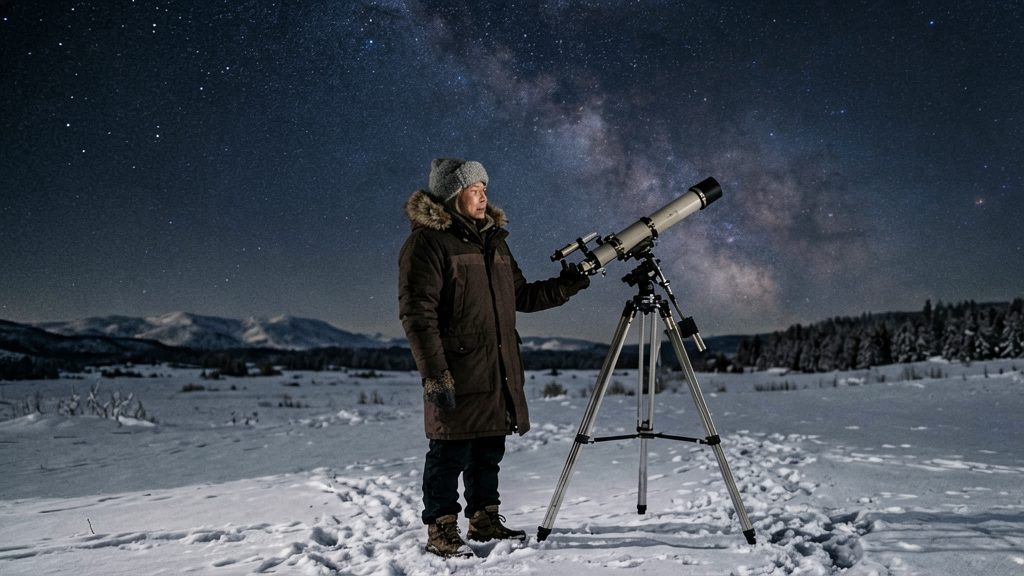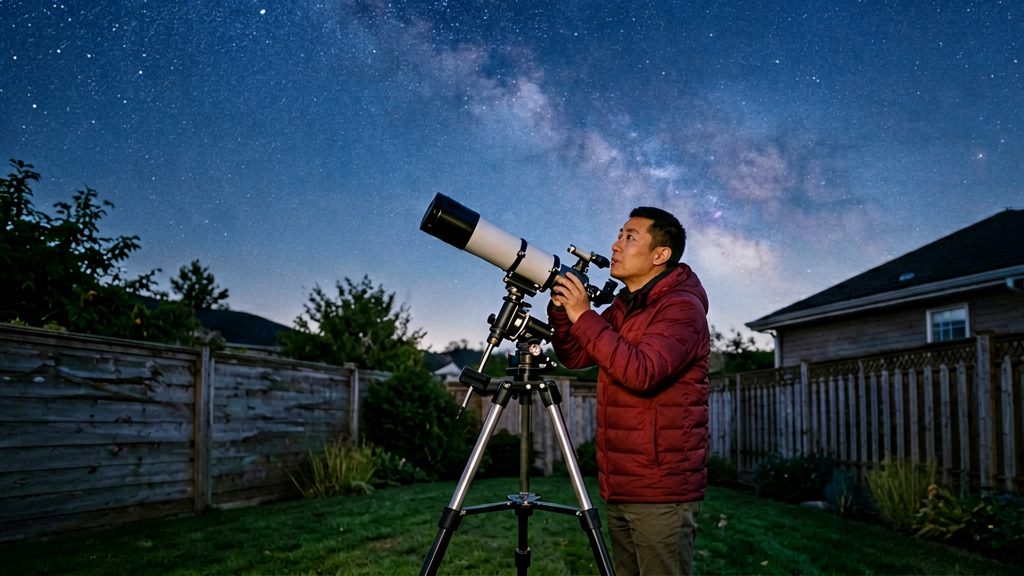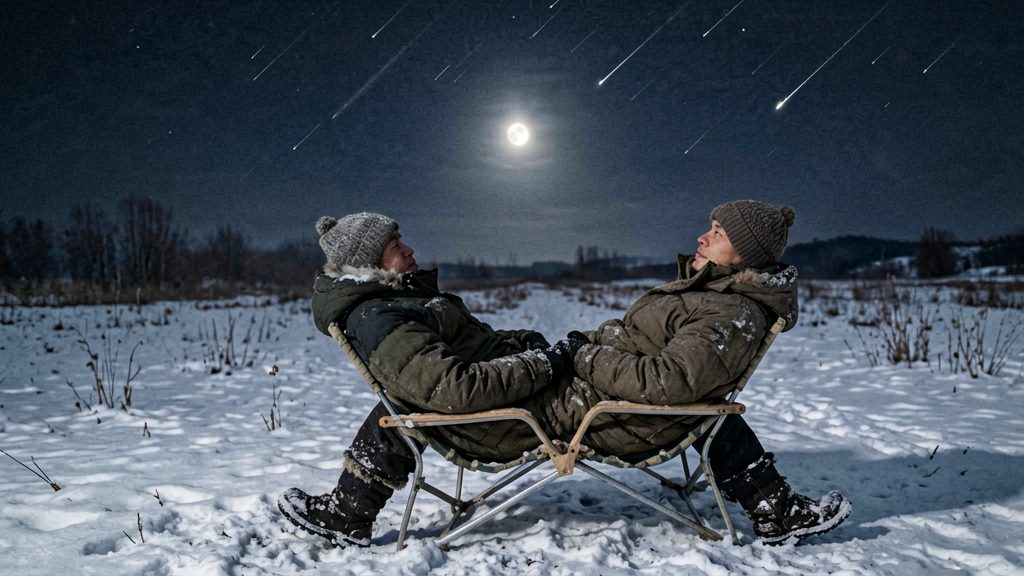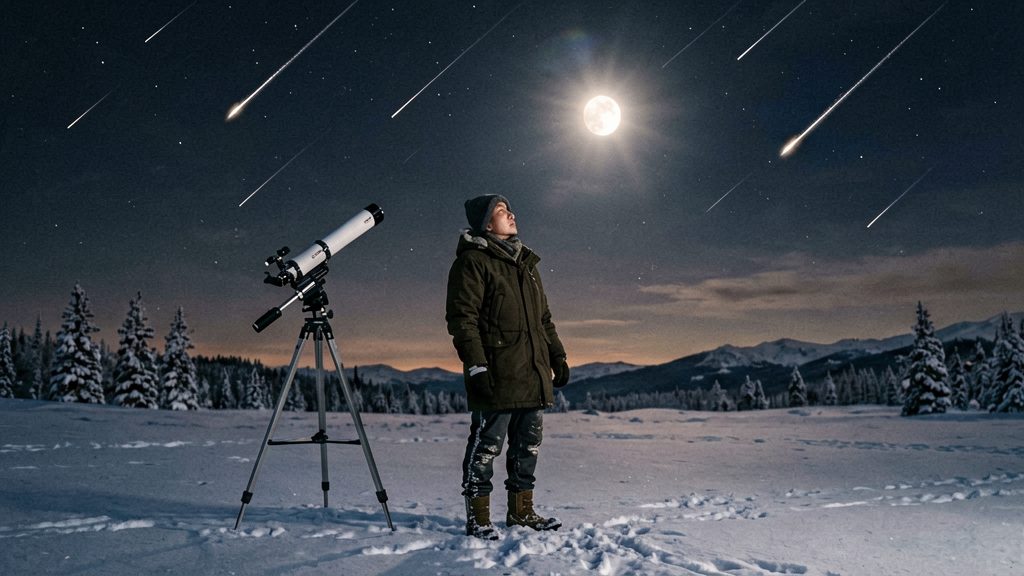
January in Canada offers a mix of events you can watch with the naked eye and others that reward binoculars or a telescope. This guide uses The Weather Network’s January 2026 listing for Canada as a worked example: the Quadrantid meteor shower, a Full Wolf Supermoon, Jupiter at opposition, and two close pairings of Saturn and Jupiter with the Moon. Those dates apply to 2026 only. For January 2027, this article confirms only the Quadrantid peak prediction and the New Moon date. Most need no equipment at all, but cloud cover and cold decide whether you see any of them, so the weather is the constraint to plan around first.
Which astronomical events happen in January in Canada?
January sky highlights at a glance
| Event | Date (January 2026 listing) | Equipment needed |
|---|---|---|
| Quadrantid meteor shower | Peak night of Jan 3–4, roughly 75–100 meteors per hour | None, naked eye |
| Full Wolf Supermoon | Jan 2–3 | None |
| Jupiter at opposition | Jan 9–10, its brightest of the past year | None to spot; binoculars or a telescope to see its moons |
| Saturn near the waxing crescent Moon | Jan 22–23 | None to spot; a telescope to see its rings |
| Jupiter near the waxing gibbous Moon | Jan 30 | None to spot |
Naked-eye events versus those needing optics
- Naked-eye events: meteors, the Full Wolf Supermoon, and the bright planets at the Moon pairings. Set up a reclining chair and let your eyes adapt to the dark for about 20 minutes.
- Optical events: Jupiter’s moons and Saturn’s rings. Binoculars show Jupiter’s four largest moons as points of light. A telescope is needed for the rings.
- A bright Moon reduced the number of visible Quadrantid meteors in 2026, so a naked-eye meteor watch works best on a night when the Moon is not dominating the sky.
Clear-sky odds and weather as the main constraint
No clear-sky percentages are available for January in Canada, so check the local forecast for each night rather than relying on a single date. Cold nights also affect equipment: dew can form on eyepieces and optics, and batteries drain faster.
Quadrantid meteor shower: when to watch
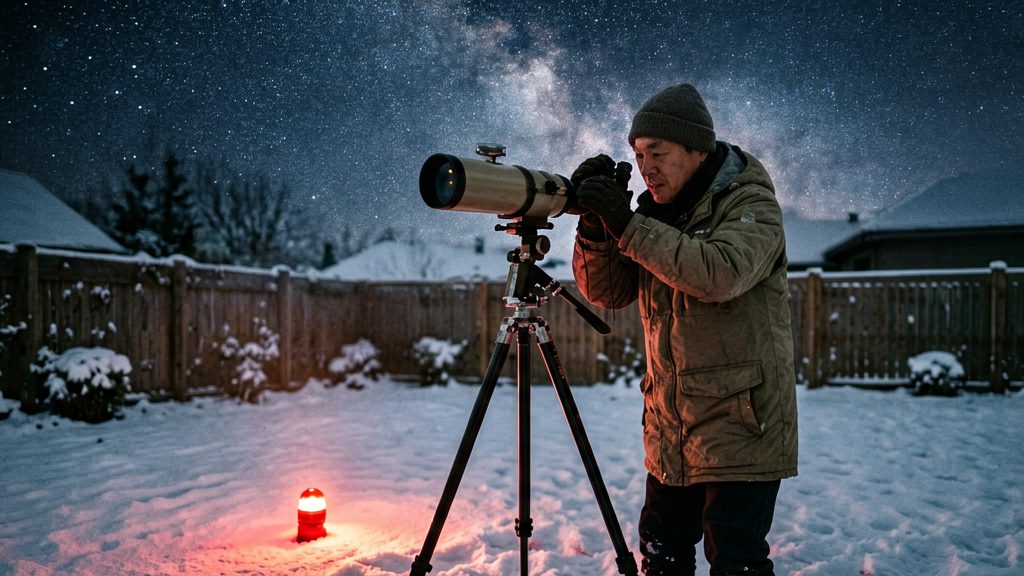
The 2027 Quadrantid meteor shower is predicted to peak at 05:47 UTC on January 4, 2027, according to EarthSky (2026). Another published prediction gives about 03:30 UTC, so treat the time as provisional. For Canadian observers, that is 12:47 a.m. Eastern on January 4 and 11:47 p.m. Central on January 3. The peak is brief, lasting about six hours, and under ideal dark skies the rate can exceed 100 meteors per hour.
Peak time by time zone
| Reference | Clock time | Date |
|---|---|---|
| UTC | 05:47 | January 4, 2027 |
| Eastern Time | 12:47 a.m. | January 4, 2027 |
| Central Time | 11:47 p.m. | January 3, 2027 |
Radiant position and the pre-dawn window
The radiant is the point in the sky from which the meteors appear to spread. For the Quadrantids, it lies near the Big Dipper. It rises in the north-northeast after midnight and is highest in the sky before dawn, so plan to observe during the final hours before morning rather than early in the evening.
Planning checklist
- Face north-northeast, where the radiant is rising, and let your gaze cover a wide area rather than fixing on one point.
- Published 2027 predictions are not always identical, so confirm the time with the International Meteor Organization or the RASC Observer’s Handbook before the night.
What’s the Moon doing this January?
The Moon’s phase is the largest single factor in whether a January session suits faint targets. A bright Moon scatters light across the sky and lowers the contrast of galaxies, nebulae and faint meteors. A thin or absent Moon leaves the sky dark enough for deep-sky work. In January 2026, the Full Wolf Supermoon fell on Jan 2–3 and the New Moon on Jan 18, according to The Weather Network (2026-01-01). In January 2027, the New Moon falls on Jan 7 at 20:24 UTC, according to EarthSky (2026-01-25).
Why Full Moon glare washes out faint targets
A Full Moon reflects enough light to brighten the whole sky, so faint objects blend into the background. Bright Moon conditions also reduce the number of meteors you can see. The Weather Network (2026-01-01) reported that a bright Moon washed out many meteors during the 2026 Quadrantid shower. Full Moon nights are better spent on bright targets such as the Moon itself, planets and double stars, which hold their detail under a brighter sky.
Waxing and waning phases for planning dark-sky sessions
The Moon’s phase tells you when the dark part of the night begins:
- Waxing phases (growing Moon): the Moon is visible in the evening and sets later each night. The early evening is brighter, so wait until after moonset for faint targets.
- Waning phases (shrinking Moon): the Moon rises later each night. The pre-dawn hours are brighter, so finish faint-target work before moonrise.
| Date | Moon phase | Observing implication |
|---|---|---|
| Jan 2–3, 2026 | Full Wolf Supermoon | Bright sky; suited to Moon, planets and double stars |
| Jan 18, 2026 | New Moon | Darkest sky around this date |
| Jan 22–23, 2026 | Waxing crescent | Thin Moon sets soon after dusk, leaving a dark later evening |
| Jan 30, 2026 | Waxing gibbous | Brighter evening sky limits faint-target sessions |
| Jan 7, 2027 (20:24 UTC) | New Moon | Darkest window of January 2027 |
New Moon as the darkest window
The New Moon is the phase when the Moon is closest to the Sun in the sky, so it is largely absent from the night. The nights either side of it give the longest stretch of dark sky. For January 2027, EarthSky (2026-01-25) states that a waning crescent should not interfere with the night of the Quadrantid peak.
Planets to spot in the winter evening sky
In January 2026, Jupiter is the planet to find first. According to The Weather Network (2026), Jupiter reached opposition on January 9–10, which it described as its brightest point of the past year. Saturn is also in the evening sky that month, though it is much fainter and needs a sky chart to find. Both planets are easier to locate with the Moon as a guide during the second half of the month.
Why opposition makes Jupiter brightest
At opposition, Earth sits between the Sun and the planet, so Jupiter is on the opposite side of the sky from the Sun. It rises around sunset, is visible all night, and is at its closest approach to Earth. Its brightness peaks at this point, which is why opposition is the best time to observe it each year.
January 2026 planet events
| Date (2026) | Event | Practical use |
|---|---|---|
| Jan 9–10 | Jupiter at opposition | Brightest point of the year; visible most of the night |
| Jan 22–23 | Saturn near the waxing crescent Moon | Use the thin Moon as a pointer to Saturn |
| Jan 30 | Jupiter near the waxing gibbous Moon | Use the brighter Moon to locate Jupiter, then check the planet itself |
Finding Saturn by eye
- Start with the Moon. On Jan 22–23, the waxing crescent Moon lies close to Saturn, so look for the Moon first and then the nearby point of light.
- Check the colour and steadiness. Jupiter is the brightest starlike object in the evening sky. Saturn is noticeably fainter, and its light is steadier than a twinkling star.
- Confirm with a star chart app. Set the app to your location and the date, then compare the planet’s position with the surrounding stars.
Seeing Jupiter’s four largest moons
A small telescope shows Jupiter’s four largest moons, the Galilean moons (Io, Europa, Ganymede and Callisto), as small points of light lined up on either side of the planet.
- Centre Jupiter in the field of view first, then observe at low power to take in all four moons.
- Sketch or note their positions. The moons change position from night to night as they orbit Jupiter.
- Use a star chart app or planetarium software that displays the moons for your observing date and time to confirm which moon is which.
Why is Earth closest to the Sun in the Canadian winter?
Earth reaches perihelion, its closest point to the Sun, in early January, yet Canada is in deep winter at that time. Distance does not set the seasons. The axial tilt of Earth’s rotation axis does. In January the Northern Hemisphere leans away from the Sun, so sunlight strikes Canada at a shallow angle for fewer hours. Perihelion and winter overlap because of orbital timing, not because Canada receives more heat in early January.
Perihelion in early January
According to Ontario Parks (2024), perihelion fell on January 4 in the 2025 guide.
Day length at 45°N
The Ontario Parks (2024) guide gives these sunrise and sunset times for 45°N in January 2025. Daylight values are calculated from those times.
| Date (January 2025, 45°N) | Sunrise | Sunset | Daylight |
|---|---|---|---|
| January 1 | 8:07 a.m. | 4:51 p.m. | about 8 h 44 min |
| January 31 | 7:49 a.m. | 5:30 p.m. | about 9 h 41 min |
Across the month, sunrise moves about 18 minutes earlier, and sunset moves about 39 minutes later. Most of the gain in daylight therefore comes in the evening. Early-January perihelion does not produce these changes. Tilt and the Sun’s position in the sky do.
Winter constellations and the Winter Triangle
Orion is the most useful starting point for January skywatching in Canada. Once you locate its three-star belt, you can use it to find the Winter Triangle, a large asterism formed by Betelgeuse, Sirius and Procyon, and then follow a short route to the Pleiades in Taurus. This method, called star-hopping, works with the naked eye or binoculars and needs no star chart.
| Star or object | Constellation | How to find it from the belt |
|---|---|---|
| Betelgeuse | Orion | Upper left of the belt, at Orion’s shoulder; it appears reddish |
| Sirius | Canis Major | Down and to the left of the belt, extending the belt line |
| Procyon | Canis Minor | Northeast of Sirius, completing the triangle with Betelgeuse |
| Aldebaran | Taurus | Up and to the right of the belt, extending the belt line the other way |
| Pleiades | Taurus | A short hop from Aldebaran, toward the upper right |
To star-hop, start with Orion’s belt, the three nearly evenly spaced stars in a line. Extend the line down-left to reach Sirius, the brightest star in the night sky. Then, from Sirius, move north to Procyon, and back to Betelgeuse to close the triangle. Extending the belt the opposite way, up-right, leads to Aldebaran, the orange star that marks the eye of Taurus. From Aldebaran, the Pleiades is a compact, fuzzy cluster that is easy to spot without optics.
How to stay warm and see more: dark skies and gear
Cold winter nights in Canada reward a short, repeatable setup: a stable pair of binoculars, a dark site you have checked in advance, and clothing and equipment managed so that dew and cold do not end your session early. Most observing time is lost to discomfort or fogged optics rather than to the sky itself, so plan these three elements before you go out.
Binoculars for winter sky sweeps
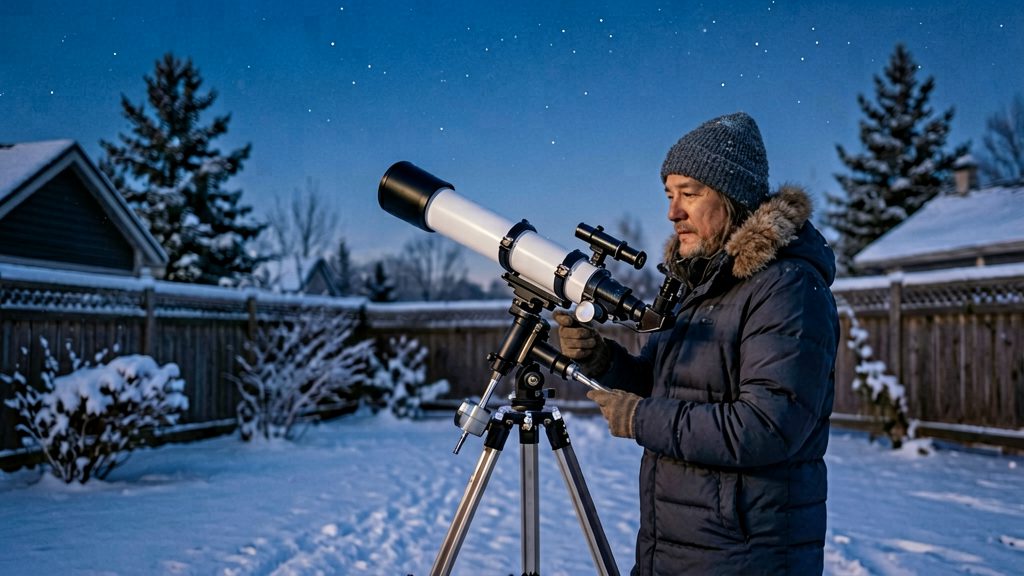
A pair of 10x50 binoculars is a common choice for sweeping the winter sky. 10x is about the highest magnification most people can hold reasonably steady by hand, and the 50 mm objective gathers enough light for star clusters. Mount them on a tripod or a monopod with a tilt head if you plan to observe for longer than a few minutes, because arms tire quickly in cold weather. Check the manufacturer’s label for the exact field of view before you buy, since it varies by model.
Mapping light pollution and the Bortle scale
Before choosing a site, look up its sky brightness with an online light pollution map, such as lightpollutionmap.info. The Bortle scale is a numbered classification from dark to bright skies. Lower numbers indicate darker skies. Use the map to find a location with a low value near your home, then visit it in daylight to check for access, parking, and safe footing on snow or ice. For local dark-sky sites, contact your regional astronomy club, such as a centre of the Royal Astronomical Society of Canada, which can name sites that members use regularly.
Dew control
Dew forms when optics cool below the surrounding dew point, and winter air often reaches that threshold quickly on clear nights. Dew on eyepieces, finder scopes, and corrector plates reduces contrast, so:
- Fit a dew shield or lens hood to the front of the tube.
- Use a dew heater strip or band on the objective or corrector if your telescope accepts one.
- Keep a microfibre cloth and spare caps for eyepieces in a warm pocket.
- Avoid bringing cold optics into a heated room, because condensation will form on them. Let them warm gradually in a sealed bag.
Layered clothing and warm-up habits
Layers trap warm air and let you remove one piece without fully exposing your body. A typical arrangement is:
| Layer | Purpose | Example use |
|---|---|---|
| Base | Moves sweat away from skin | Thermal top and bottoms |
| Mid | Insulates | Fleece or down jacket |
| Outer | Blocks wind | Windproof shell |
| Extremities | Keeps hands and feet warm | Insulated boots, gloves, warm hat |
Stand on an insulating pad or a folded foam mat rather than metal or bare snow, since the ground draws heat from the body. Keep chemical hand warmers in gloves or pockets, and take short breaks indoors or in a vehicle to warm up before returning to the eyepiece. Eating a warm snack and drinking warm fluids before the session also helps maintain body heat. Go indoors right away if you notice numbness in fingers or toes, uncontrollable shivering, or confusion, and skip the session during extreme-cold warnings.
Apps and calendars to check local times
Planetarium apps and printed or online sky calendars are the two main ways to turn a sky event into a time you can observe from your location. A calendar entry is only useful if you confirm which time zone and year it applies to before you set an alarm. In the 2026 Canadian calendar entries reported by The Weather Network (2026-01-01), the Full Wolf Supermoon fell on Jan 2–3, Jupiter reached opposition on Jan 9–10, and the New Moon was on Jan 18. Those are the kinds of dates a calendar should list, but they describe 2026, not later years.
Planetarium apps
- Use an app that shows a live sky map for your exact location and time. Set your city or coordinates manually if the app’s automatic location is imprecise.
- Check the date and time settings after installing, and after any travel between provinces, since the app may keep the time zone of your previous setup.
- Use the app to confirm where an object will be in the sky at your observing time, such as Jupiter near the waxing gibbous Moon on Jan 30, 2026, rather than relying only on a calendar’s date.
Almanacs and sky calendars
- Confirm the publication year on the first page. A calendar printed for one year does not give correct times for the next.
- Look for whether times are given in local time or in UTC. If they are in UTC, convert them using the offset for your province before you observe.
- Compare at least two independent sources for any event you plan to photograph or observe at a specific minute.
Verifying times against your province’s time zone
- Note whether the source gives local time or UTC.
- Identify your province’s time zone, and whether that zone is on standard time or daylight saving time on the date in question. Daylight saving time does not apply in January.
- Convert the time, then check the result against your app’s live map.
- Recheck the conversion if you are observing from a different province than the one the calendar was written for.