December gives Canadian observers the longest dark hours of the year, which makes it one of the strongest months for deep-sky work. According to Ontario Parks (2024), the earliest sunset of the year falls around December 10 at 45°N, and the solstice, around December 21, brings the least daylight. The extended darkness gives observers more time per session, although December weather is cold and often cloudy, so clear nights are worth planning around.
Why is December a good month for stargazing in Canada?
Key sunset and daylight dates
| Milestone | Approximate date | What it means for observers |
|---|---|---|
| Earliest sunset of the year (45°N) | Around December 10 | Darkness arrives earlier in the evening |
| Winter solstice | Around December 21 | Least daylight of the year, longest dark period |
Source: Ontario Parks (2024). Exact times depend on your latitude and longitude, so treat these dates as a guide.
Long darkness for deep-sky sessions
The extended night suits deep-sky sessions, which depend on hours of darkness to bring out faint targets such as galaxies, nebulae and star clusters. Because sunset comes early, full darkness arrives earlier in the evening and the dark period is longer. Wait until twilight has ended before hunting faint galaxies and nebulae; bright targets can be observed sooner.
Cold, dry air and sky transparency
Cold, dry air often supports sky transparency on clear nights. Less moisture in the atmosphere generally means less haze and scattered light, so faint stars and fine detail can stand out more clearly. Transparency still varies from night to night, so judge each session by what you can see.
Geminids: one of the year’s best meteor showers
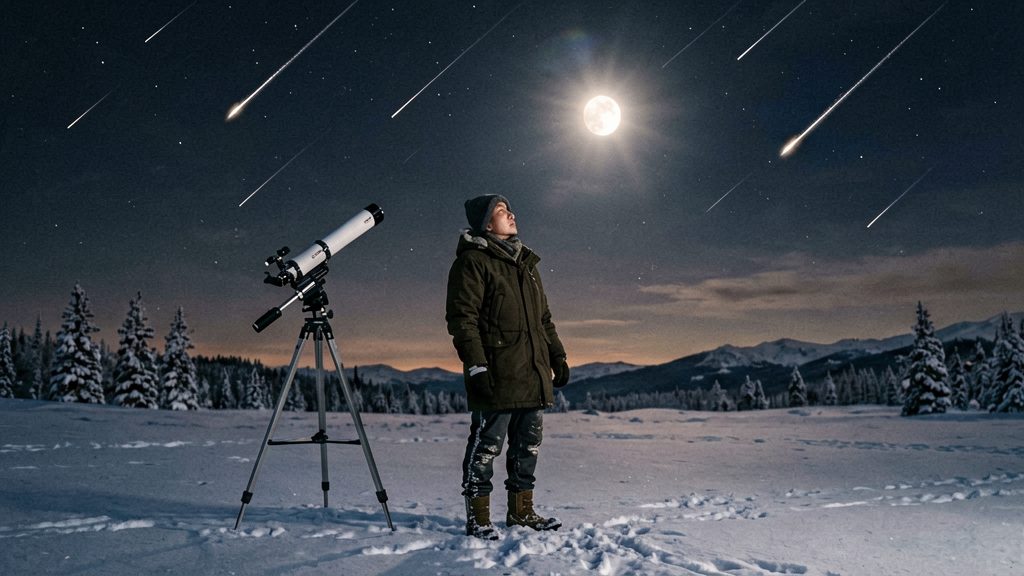
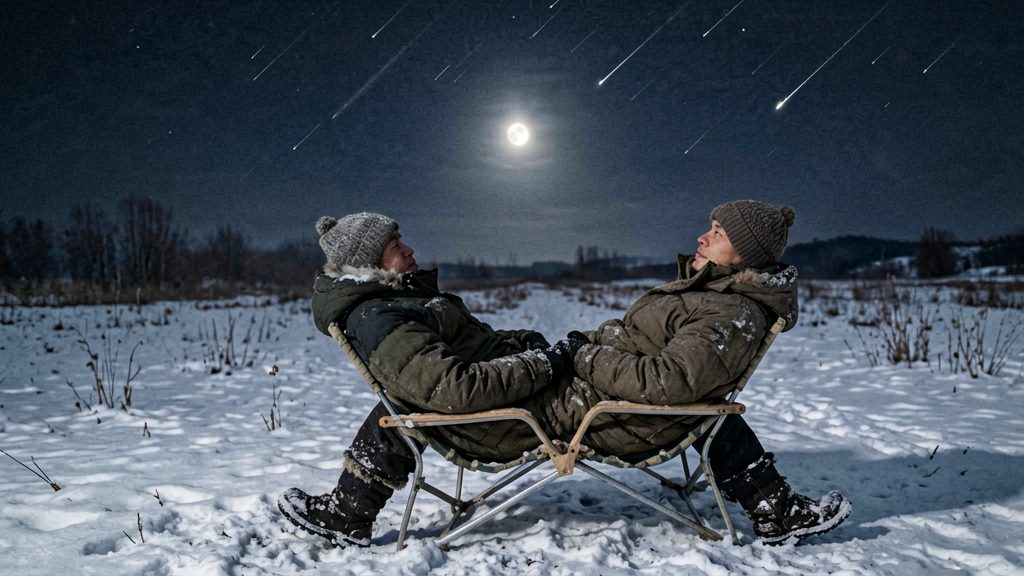
The Geminids peak on the night of December 13 to 14, and Ontario Parks (2024) describes them as one of the best annual meteor showers. Under perfect conditions they can reach 100 or more meteors per hour. Moonlight is the variable that most affects what you will see. The Weather Network (2024) reported that a bright Moon cuts the rate to roughly 50 to 60 per hour, so the Moon phase on the peak night matters as much as the shower itself.
How the Moon changes the count
| Viewing condition at peak | Meteor rate (per hour) |
|---|---|
| Perfect conditions, per The Weather Network (2024) | 100 or more |
| Bright moonlight, 2024 example with a Full Moon on December 15 | Roughly 50 to 60 |
The two figures describe the same shower under different skies. Moonlight washes out fainter meteors, so the visible count drops even though the shower’s activity has not changed.
Planning around the peak
- Check the Moon phase for your peak year. The 2024 figures do not carry over to other years.
Ursids and the winter solstice
The Ursids are a weak meteor shower that stays active for about ten days, so it rewards patient observers more than dramatic displays. According to Ontario Parks (2024), the shower peaks around December 21 at about 10 meteors per hour at best. The Weather Network (2024) places its activity from about December 16 to 26. Both figures come from 2024 coverage, so confirm the 2026 peak and activity dates before you plan a session.
With only about 10 meteors per hour at best, the Ursids call for a longer, steadier watch than the Geminids. A low hourly rate means you need a longer, steadier watch to see a meaningful number of meteors, and a dark sky with a clear horizon matters more than for a higher-rate shower.
The solstice falls on the same date as the Ursid peak, which gives the night a second, astronomical meaning. The earliest sunset comes before the solstice and the latest sunrise comes after it, in early January, which is why the shortest day does not coincide with either.
| Event | Approximate date | Source |
|---|---|---|
| Ursid activity | December 16 to 26 | The Weather Network (2024) |
| Ursid peak | Around December 21 | Ontario Parks (2024) |
| Ursid rate at best | About 10 meteors per hour | Ontario Parks (2024) |
Which planets were visible in December 2024, and how do you check this year?
According to The Weather Network (2024), Venus, Saturn, Jupiter and Mars were all on show in December 2024. That is the only verified planet listing for this section, and it applies to 2024, not to the coming December. Planet positions change from year to year and shift across each month, so check the current sky before planning a session.
Telling planets from stars
Planets shine with a steady, non-twinkling light, while stars flicker. Stars near the horizon flicker most, because their light passes through more air.
- Find a bright point of light and watch it for a short while.
- If the light stays steady, it is likely a planet. If it flickers noticeably, it is likely a star.
- Check the point against your star chart or app for the date and time you are observing.
Why planet visibility changes through the month
Planets move against the background stars, so a planet that is easy to find early in the month can sit lower or closer to the Sun by the end of it.
Moon phases and observing dates
Planning a December session comes down to two checks: the Moon’s phase and the time it rises at your location. A bright Moon washes out faint targets, while a Moon that rises late leaves the early hours dark. The Weather Network (2024) advised that when the Moon rises late, the first half of the night is the best window for observing. The 2026 Moon phase dates for December have not been confirmed here, so check them before fixing a date.
Moon phase and moonrise time are the two inputs to check for each night of your window.
- Confirm the December 2026 phase dates in the RASC Observer’s Handbook or its calendar, or in Stellarium.
- In Stellarium, set the location to your town, then read the moonrise time for each night.
- Match your targets to the sky’s conditions for that night.
| Moonrise time | Suggested window | Target type |
|---|---|---|
| After dark (late moonrise) | First half of the night, before moonrise | Faint deep-sky objects |
| Before dark (Moon already up) | Whole evening under moonlight | Bright targets such as the Moon, planets and double stars |
Winter constellations to find
Orion is the simplest anchor for December star-hopping. Its three-star Orion’s belt is short and bright, so you can use it to reach several nearby targets without a finder chart. Start by locating the belt, then extend its line in each direction. Facing south in the Northern Hemisphere, the line running down and to the left leads to Sirius, the brightest star in the night sky. The line running up and to the right leads to Aldebaran, the orange star in Taurus.
| Target | Star-hop from | Direction from the belt (facing south) |
|---|---|---|
| Sirius (Canis Major) | Orion’s belt | Extend the belt line down and to the left |
| Aldebaran (Taurus) | Orion’s belt | Extend the belt line up and to the right |
| Pleiades (Taurus) | Aldebaran | Continue up and to the right, past the V-shaped Hyades |
| Castor and Pollux (Gemini) | Orion’s shoulder, Betelgeuse | Go up and to the left, past the red star Betelgeuse |
Taurus and the Pleiades
From Aldebaran, look for the Pleiades, a compact open cluster of young stars. Aldebaran marks one tip of the V-shaped Hyades, and the Pleiades lie farther along the same upward direction. Binoculars show the cluster as a tight group of many stars, while the naked eye usually picks out a handful. The cluster makes a good low-power target because it fits easily in a wide field.
Gemini and the Geminid radiant
Castor and Pollux, the twin bright stars of Gemini, lie up and to the left of Orion, beyond Betelgeuse. They mark the Geminid radiant, the point in the sky from which the Geminid meteors appear to spread. Meteors can appear anywhere in the sky, so you do not need to look directly at the radiant. A wide view of a dark part of the sky, some distance from the radiant and away from any Moon, usually shows the most meteors.
How do you stay warm and keep gear working in the cold?
December observing in Canada is hard on both the observer and the equipment. According to Ontario Parks (2024), December weather is cold and often cloudy, so sessions tend to be short and gear may sit outdoors for long stretches. Keeping yourself comfortable, keeping optics clear and keeping power stable are separate tasks, each with its own fix.
Layered clothing and warm-up breaks
Standing still at an eyepiece drains body heat quickly. Dress in layers you can remove or add:
- A thermal base layer next to the skin
- A fleece or wool middle layer
- A windproof outer shell
Add a hat and insulated gloves that still let you turn focus knobs and handle small parts. Sit on an insulated pad rather than bare metal or plastic. Schedule indoor warm-up breaks at regular intervals, and keep a flask of warm drink within reach.
Dew and frost control on lenses and eyepieces
Optics cool to the outside air temperature and then collect condensation or frost. Practical steps:
- Let the telescope acclimatise outdoors before observing, so the glass is not fogging from a warm-to-cold change.
- Carry eyepieces in a sealed case or bag when moving between a heated room and the cold, and let them warm gradually.
- Use a dew shield or a dew heater strip if your telescope or corrector plate is prone to fogging.
- Wipe glass with a soft microfibre cloth, without pressing hard.
Battery capacity in cold power packs
Lithium and other battery packs deliver less usable energy as temperature falls, so a pack that runs a mount or dew heater comfortably in autumn may run out early in December. Check the operating temperature range printed on the pack or in its manual, keep the pack inside a jacket or insulated bag until you connect it, and carry a spare charged unit.
| Gear | Cold-weather risk | Practical step |
|---|---|---|
| Power pack | Less usable capacity at low temperature | Keep warm until use, carry a spare, check the rated temperature range |
| Eyepieces | Condensation when moved from indoors | Seal in a case and let them warm gradually |
| Telescope optics | Dew or frost on the glass | Dew shield or dew heater, soft cloth |
Dark-sky sites across Canada
Canada has protected dark-sky places where artificial light is restricted, and two well-known examples are the Mont-Mégantic International Dark Sky Reserve in Quebec and the Torrance Barrens Dark Sky Preserve in Ontario. Both suit observers who want to see fainter deep-sky objects than a city sky allows. Designations, access rules and visitor facilities can change, so confirm them on each site’s official page before you travel.
| Site | Province | What to check before you go |
|---|---|---|
| Mont-Mégantic International Dark Sky Reserve | Quebec | Current visitor and observing information on the reserve’s official pages |
| Torrance Barrens Dark Sky Preserve | Ontario | Access rules and whether the preserve is open to the public |
Rating sky darkness with the Bortle scale
The Bortle scale is a numbered system that rates sky darkness. Lower classes describe darker skies, and higher classes describe more light pollution. Use it to compare candidate sites with your home sky:
- Look up a site’s rating on a light pollution map or in its own published documentation, and note when that rating was published.
- Compare the rating with the sky you see from home. A large difference is what makes a trip worthwhile.
- Treat the rating as an estimate of typical conditions. Haze, humidity and local lighting can change how dark the sky looks on a given night.