When do the Geminids peak in 2026?
The Geminids peak on the night of December 13–14, 2026. EarthSky (2026) gives a predicted maximum at 5:44 UTC on December 14. Star Walk (2026), citing the International Meteor Organization (IMO), gives a different time, so the peak moment is uncertain. The practical approach is to observe across the whole night of December 13–14 rather than aiming for one minute.
Predicted maximum
EarthSky (2026) places the 2026 maximum at 5:44 UTC on December 14, which falls within the night of December 13–14. Peak times for meteor showers are forecasts, so treat this value as an estimate rather than a fixed moment.
IMO enhanced activity window
Star Walk (2026), citing the IMO, describes enhanced activity from about 21:00 GMT on December 13 to 18:00 GMT on December 14. This window runs well beyond the predicted maximum on both sides, so the maximum sits inside a much broader period of elevated activity.
Conflicting maximum times
| Source | Stated maximum | Note |
|---|---|---|
| EarthSky (2026) | 5:44 UTC, December 14 | Predicted maximum |
| Star Walk (2026), citing IMO | About 14:00 GMT, December 14 | About 9 a.m. EST (daylight in the east); about 6 a.m. PST (before dawn in the west) |
The two estimates differ substantially. The 14:00 GMT figure is about 9 a.m. EST, which is daylight in eastern Canada. In the west it is about 6 a.m. PST, still before sunrise. Either way, the whole night of December 13–14 remains the safest window.
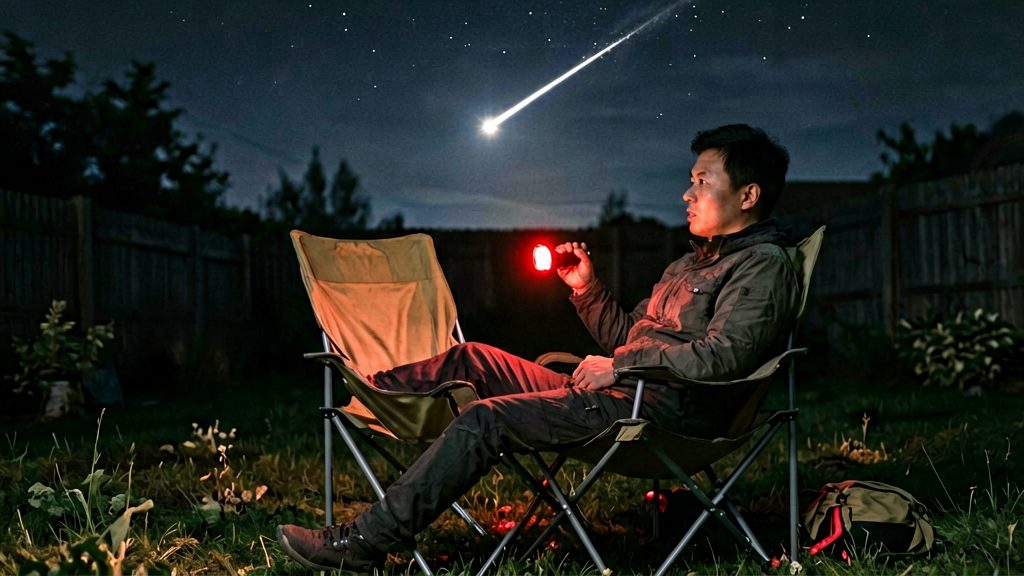
What time should you watch from Canada?
The Geminids’ predicted maximum for 2026 is 5:44 UTC on December 14, according to EarthSky (2026). That moment is about 12:44 a.m. Eastern Standard Time (EST) on December 14 and 9:44 p.m. Pacific Standard Time (PST) on December 13. These are Canadian clock conversions of the UTC figure, not values published by EarthSky.
Best viewing hour
EarthSky (2026) gives the best time to watch as around 2 a.m. local time. Use that as your target for the strongest viewing, with the local clock in your own time zone:
| Time zone | Around 2 a.m. local | Peak prediction (UTC 5:44 Dec 14) |
|---|---|---|
| Eastern (EST) | 2:00 a.m. Dec 14 | 12:44 a.m. Dec 14 |
| Pacific (PST) | 2:00 a.m. Dec 14 | 9:44 p.m. Dec 13 |
For Pacific observers, the predicted maximum (9:44 p.m. PST) falls while the radiant is still low. Keep around 2 a.m. local time as the main target and watch through the rest of the night.
All-night session or short window
EarthSky (2026) notes you can watch all night on December 13–14. A full night session covers the evening onset, the 2 a.m. high point, and the pre-dawn hours, which is the most reliable way to catch the peak regardless of which source’s time is correct. A short window of one to two hours around 2 a.m. local time gives less margin if the peak shifts toward the evening, and it gives you less time to adapt your eyes to the dark.
Where is the radiant, and where should you look?
The Geminid radiant sits in the constellation Gemini, close to the bright star Castor. Meteors do not stay near that point, though. They spread across the whole sky, so the radiant is a reference for where the streaks seem to originate rather than the only place to look.
- Radiant position: near Castor in Gemini, which is where the meteor trails appear to come from.
- Rise time: the radiant rises in mid-evening, so it is still low for much of the early night.
- Direction on peak night in Canada: the radiant sits in the southeastern sky on peak night, according to The Weather Network (2024-12-13).
Practical approach
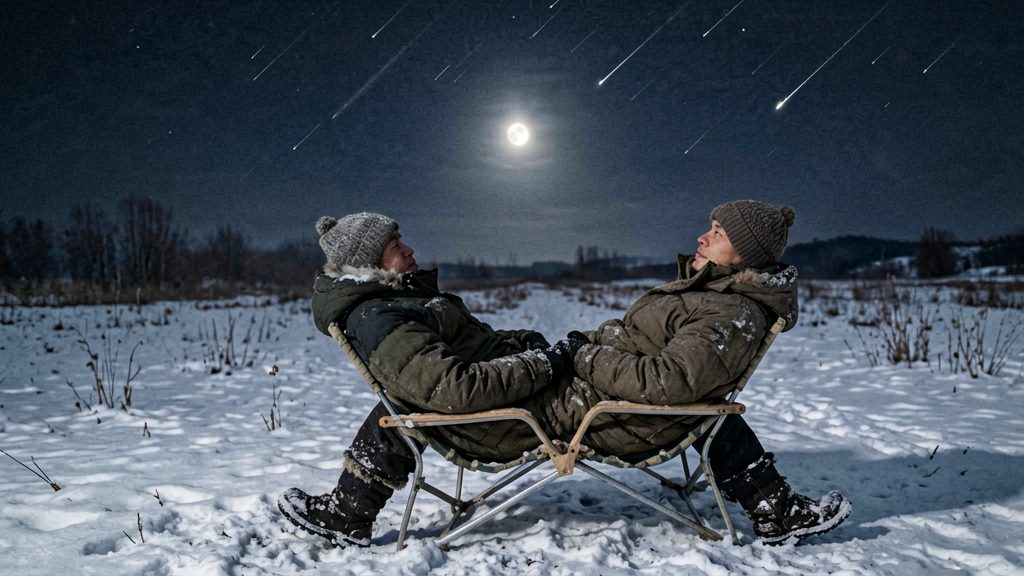
Lie back on a reclining chair or blanket and face the open part of the sky that is clear of trees, buildings and streetlights. You do not need to aim at Castor. Watch a broad area, roughly the whole dome, and let your peripheral vision pick up faint streaks. Looking at the radiant directly gives you less coverage, because the meteors are not confined to it.
Will the Moon interfere this year?
In 2026 the Moon should not interfere with the Geminids. EarthSky (2026) places the peak on the night of December 13–14, when the Moon is a waxing crescent, a thin sliver that gives little light. The first quarter Moon falls on December 17, after the peak, so it does not affect the main observing window.
| Date | Moon phase | Source |
|---|---|---|
| Dec 13–14, 2026 | Waxing crescent, around the peak | EarthSky (2026) |
| Dec 13–14, 2026 | About 20% illuminated | Star Walk (2026) |
| Dec 17, 2026 | First quarter | EarthSky (2026) |
Illumination figures for the peak nights conflict. Star Walk (2026) gives about 20%, while another source reports 25–30%. Neither figure is fully confirmed, so check the exact percentage in a planetarium app for your location.
Moonset times for Canadian cities were not verified here. Look up the moonset for your city before the night. An early moonset leaves more of the dark hours free of moonlight.
A waxing crescent is a minor factor, but moonlight can still wash out the faintest meteors. Moonlight reduces contrast, so keep the Moon outside your field of view. Turn your back to it and scan the sky away from it.
How many meteors can you expect?
The Geminids are usually counted in two ways: the zenithal hourly rate (ZHR), which is the theoretical count for a perfectly dark sky with the radiant directly overhead, and the number of meteors a single observer actually sees. EarthSky (2026) gives a ZHR of 120 under ideal dark, moonless skies. On a dark night near the peak, EarthSky expects at least about 50 meteors per hour.
Other sources report different peak rates. Star Walk (2026) cites up to 150 per hour without naming its basis, and The Weather Network (2024) cites up to 100 per hour. Treat these figures as a range rather than a fixed number.
Why your count will be lower than the ZHR
The ZHR assumes conditions that are rarely met in practice:
- Radiant altitude: The ZHR assumes the radiant at the zenith, a position it does not reach from Canada on peak night.
- Limiting magnitude: The ZHR assumes you can see stars down to about magnitude 6.5. Light pollution or haze reduces the number of faint meteors you can detect.
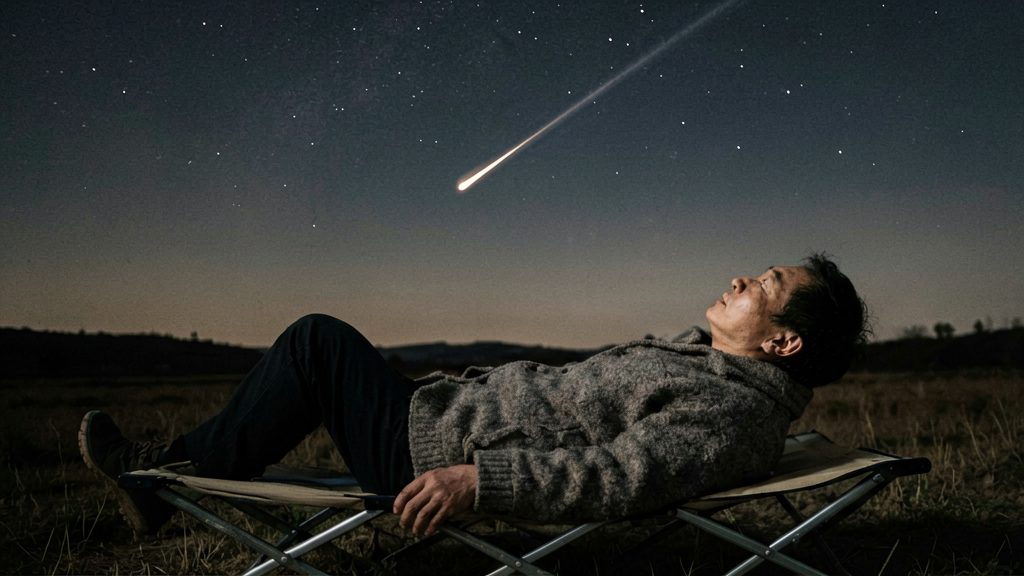
How to dress and prepare for a Canadian December night
Plan to spend at least one hour outside, and treat the first 20 minutes as adaptation time. According to EarthSky (2026), your eyes need about 20 minutes to adjust to the dark before faint meteors become visible. Cold often cuts a session short, so dress for the temperature you expect to be standing in, not the one at the start of the evening. Stop observing and go indoors to warm up straight away if you cannot stop shivering or if your fingers or toes go numb. Numbness is a warning sign of frostbite. If skin looks white, waxy or hard, or if you feel confused or have slurred speech, get urgent medical attention.
Layering for long, still observing
Observing involves long periods of standing or lying still while your body loses heat, so layers you can add or remove work better than a single heavy coat.
| Layer | Purpose | What to look for |
|---|---|---|
| Base | Moves moisture away from the skin | Synthetic or wool, not cotton |
| Mid | Holds warm air | Fleece or a light insulated jacket |
| Outer | Blocks wind | Windproof, water-resistant shell |
| Extremities | Limits heat loss | Hat or hood, gloves that allow you to adjust eyepieces, warm socks |
Choose gloves that let you handle small controls and a phone screen without taking them off. Bare hands lose heat quickly, and a cold, stiff hand makes fine adjustments harder.
Footwear and seating
Insulated footwear matters more than most beginners expect, because cold ground draws heat up through the soles. Wear boots with thick, insulated soles, and add a closed-cell foam pad or a thick mat underfoot if you stand on snow or frozen grass.
If you sit, a reclining seat keeps your back and neck from locking in one position, which helps you watch the sky for longer. Put a blanket or insulated pad under the seat, since a chair with a thin cushion loses heat to the ground. Keep a thermos of warm drink within reach so you can warm up without going back indoors, which would reset your dark adaptation.
Do you need a telescope or binoculars?
No optical aid is needed for the Geminids.
Binoculars and telescopes work against you for meteor watching. Both show a small patch of sky at a time, so a streak that crosses the view often leaves the field before you notice it. Their magnification also does nothing for a meteor, which is a brief flash rather than a detailed object. Telescopes add a further problem: their tube or mount takes up attention and can block a part of the sky you were scanning.
Optical aids are useful for other targets on the same night, such as the Moon or double stars, but not for counting meteors. Switch to them only after your observing session is finished, or set them aside entirely while you watch.
Phone or camera capture of Geminid streaks
A phone or camera can record Geminids, but it is a separate task from visual watching. Mount the device on a tripod or a stable surface so it does not shake, and point it at the open sky with a wide field of view. Recording video for an extended period lets you review it later for streaks you missed by eye.
Best Canadian dark-sky spots and cloud-check tools
Canadian observers get the most from a Geminid night by choosing a designated dark-sky place, confirming cloud cover for that exact spot, and checking a light-pollution map before travelling. Jasper, Grasslands and Mont-Mégantic are the designated places to start with. For the 13–14 December window, the best site is the one that combines a dark sky with a clear forecast at your coordinates.
Designated dark-sky places
| Place | Designation | What to check before going |
|---|---|---|
| Jasper, Alberta | Dark-sky designation in Jasper National Park | Current access, parking and night-use rules on the Parks Canada site |
| Grasslands, Saskatchewan | Dark-sky designation in Grasslands National Park | Road conditions, camping rules and opening hours for the night |
| Mont-Mégantic, Quebec | Dark-sky reserve around Mont-Mégantic National Park | Observation-night schedules and access on the park’s official site |
Designations describe the area’s protection from light pollution. They do not guarantee clear skies on a given night, so pair the designation with the forecast below.
Cloud-cover forecasts
Clear Outside and Meteoblue both show cloud cover by hour. Use them as follows:
- Enter the exact coordinates of your viewing site, not the nearest city. Cloud cover can differ noticeably between a valley floor and an open ridge.
- Check the hours from early evening to pre-dawn, not only the peak time.
- Compare the two services. If they disagree, give more weight to the forecast issued closest to the night.
- Re-check within a day of the event, since forecasts for a single night become more reliable as the date approaches.
Light-pollution maps
Open an online light-pollution map and zoom to each candidate site before you drive out:
- Mark two or three candidate sites within reach.
- Compare how dark each one is on the map, paying attention to nearby towns and highways.
- Pick the darkest site with an acceptable cloud forecast.
- On arrival, confirm the map with your own eyes. Check how many stars and how much of the Milky Way you can see once your eyes have adapted.