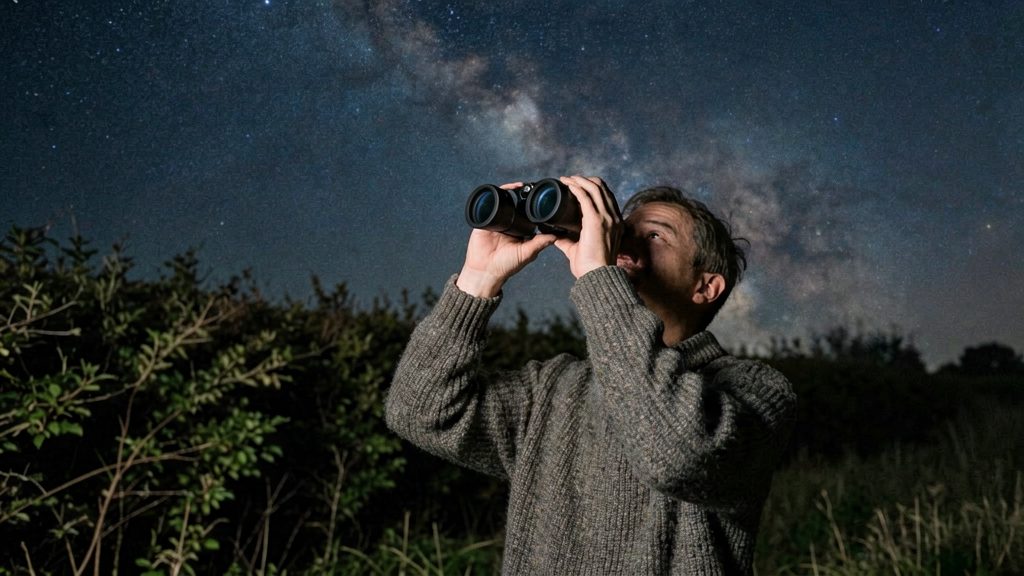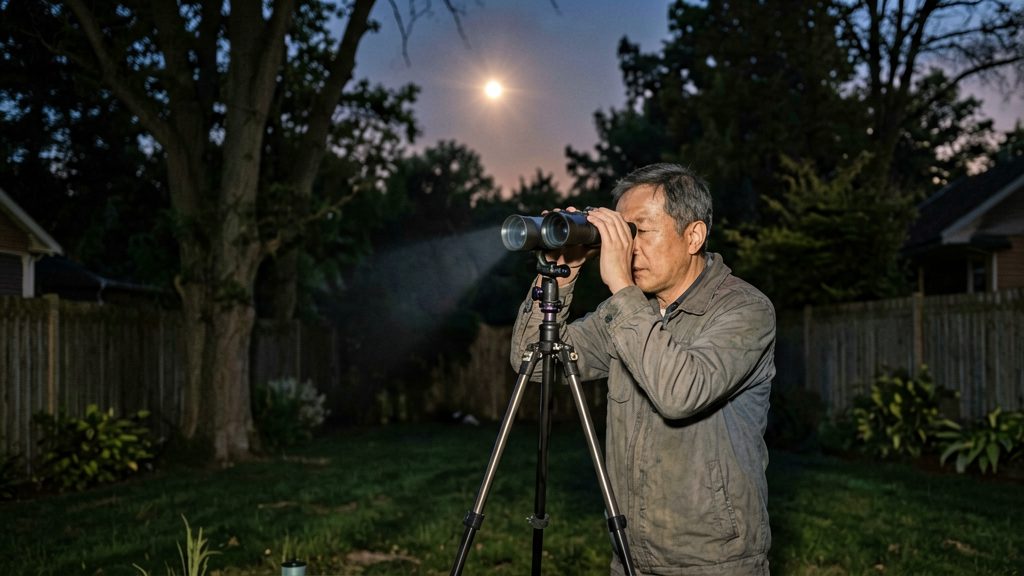
Yes. According to Perimeter Institute (Canada), you can easily see all four Galilean moons, Io, Europa, Ganymede and Callisto, with binoculars on a clear evening. Through binoculars, each moon appears as a starlike point of light rather than a disc, and they usually sit in a rough line with Jupiter at the center. Because a moon can be hidden behind or in front of Jupiter, you may see only some of the four at once, and the arrangement changes from night to night.
Can you really see Jupiter’s moons with binoculars?
How the moons look in the field of view
- Starlike points: At binocular magnification the moons look like small stars. Their disc size is too small to show detail.
- A line through the planet: EarthSky describes the moons as lined up in a row that crosses Jupiter. Skymania notes they usually appear in a line on either side of the planet, because their orbits are seen nearly edge-on from Earth.
- Partial views: You may see only one or two moons at a time.
Moon order and brightness
| Moon | Order outward from Jupiter | Brightness (Skymania) |
|---|---|---|
| Io | 1st | Among the brightest |
| Europa | 2nd | Fainter group |
| Ganymede | 3rd | Among the brightest |
| Callisto | 4th | Fainter group |
Skymania gives no exact magnitudes, so use the table as a relative guide.
What gear do you need?
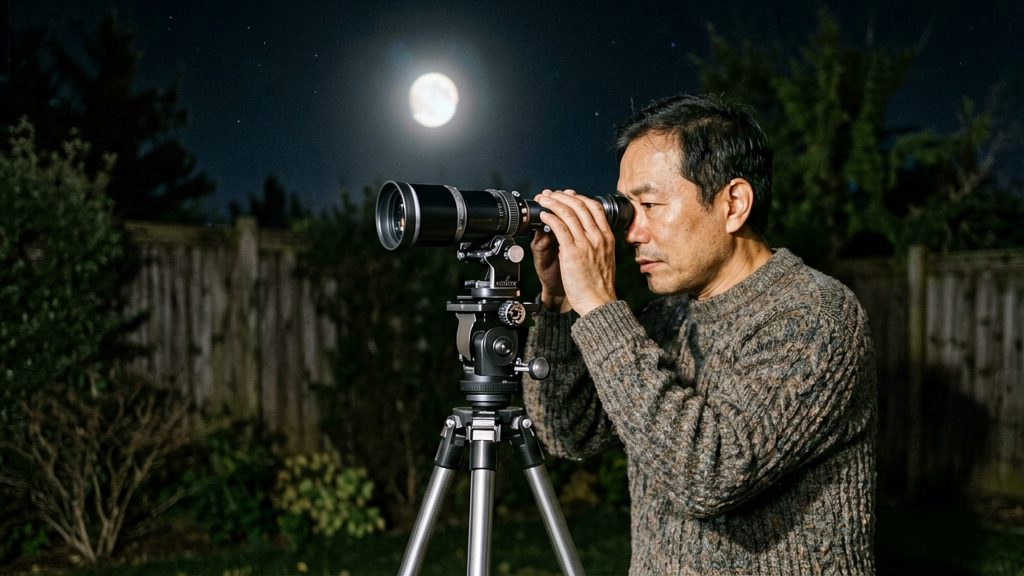
For Jupiter’s moons, the binoculars need enough aperture to make faint points of light visible, a wide enough view to frame the planet and the moons, and a weight you can hold steady. The Perimeter Institute (Canada) lists a good pair of binoculars, a tripod and a clear sky as the recommended kit for seeing all four Galilean moons. Other features matter much less for this target.
| Specification | Why it matters for Jupiter’s moons | Priority |
|---|---|---|
| Objective diameter (the second number in the label) | Gathers the light needed to show the fainter moons | High |
| Field of view | Must span the line of moons on both sides of the planet | High |
| Weight and steadiness | Shake blurs small points of light; heavy binoculars tire you quickly | High |
| Magnification (the first number) | Affects how large and steady the view looks, not whether the moons appear | Medium |
| Brand and accessory extras | Do not change what the moons look like through the optics | Low |
Choosing between 7x50 and 10x50
Binoculars such as 7x50 and 10x50 are often used for this kind of observing, though the sources do not name a best size. The second number is the objective diameter in millimetres, and both sizes share the same 50 mm objective. The first number is magnification: 10x shows Jupiter and its moons larger, but it also magnifies hand movement more, while 7x gives a wider, steadier view. Sources do not establish one size as the right choice for every observer, so compare the two in a shop or with a friend’s pair if you can.
Brightness of the moons
Ganymede and Io appear brightest, followed by Europa and Callisto, according to Skymania. The two brightest moons are the easiest to pick out, though a moon close to Jupiter can be lost in the planet’s glare.
Field of view
Check that the binoculars’ field of view is wide enough to take in the line of moons on both sides of Jupiter, and do not assume that a larger magnification gives a wider view. The field-of-view figure is listed on the manufacturer’s specification sheet.
Weight and steadiness
Choose binoculars whose weight you can hold for a full observing session.
How do you hold binoculars steady?
Steady support matters more than optical quality when you look for Jupiter’s moons, because Io, Europa, Ganymede and Callisto appear as small points of light that smear into a blur with even slight hand movement. Two physical methods do most of the work: a tripod with a binocular adapter, or a fixed body support such as a wall or tree trunk. Both can be combined with a relaxed stance and controlled breathing.
Tripod mount with a binocular adapter
A tripod is the recommended option for steady viewing. Mount the binoculars on a tripod through a binocular adapter (a bracket that threads onto the tripod head and holds the binocular body), then aim at Jupiter and lock the head before you observe. A stable platform lets you watch the moons over several minutes and notice small changes in their positions.
Leaning against a wall or tree trunk
If you do not have a tripod, lean your upper body against a solid, vertical surface such as a wall or tree trunk. Press your forehead or the binocular barrels lightly against the support, keep both feet planted, and let the surface carry the weight of the binoculars. This method costs nothing and works on most clear evenings, though it limits the directions you can aim.
Elbow support and steady breathing
Without a tripod or wall, rest your elbows against your ribs or on a stable object such as a car roof, and hold the binoculars close to your face. Breathe slowly and pause briefly between breaths, since large chest movements shake the view. Adjust focus with small, slow turns of the central knob, and take short breaks during a long session to limit fatigue.
How do you find Jupiter first?
Jupiter is usually one of the brightest starlike points in the evening sky, so the easiest way to find it is to look for a steady, bright dot and then confirm it with a sky app. Start with a clear, dark-enough sky and a fixed view of the horizon, then locate the planet before you try to resolve any moons. Once you have Jupiter in the field of view, the moons become a matter of comparing the planet to the stars around it.
Look for a steady light. Planets do not twinkle the way stars do. Stars flicker, especially near the horizon, because their light passes through turbulent air. Jupiter holds a calm, even glow. If a bright point seems to shimmer strongly, it is probably a star, so check the next candidate.
Star-hop from landmarks. Pick a bright, easily recognised star or asterism near Jupiter, centre it in your binoculars, and move slowly toward the planet. Keep the Moon out of the field if it is bright, since it can make Jupiter harder to pick out.
Confirm with a sky map or app. The apps listed below show Jupiter’s position and the moons’ arrangement.
| Tool | What it helps with |
|---|---|
| The Sky Live | Exact positions of Jupiter and its moons for your time and place |
| SkySafari | Same position data, plus a planetarium view for star-hopping |
| Stellarium | Identifying which dot is which moon once Jupiter is in view |
Which moon is which?
Once you see a row of starlike dots beside Jupiter, you can name each one using two cues: its distance from the planet and its brightness. Listed outward from Jupiter, the Galilean moons are Io, Europa, Ganymede and Callisto, so their order from the planet identifies them.
Brightness splits the four into two pairs. Ganymede and Io form the brighter pair, while Europa and Callisto form the fainter pair.
| Order from Jupiter | Moon | Brightness group |
|---|---|---|
| 1st (closest) | Io | Brighter pair |
| 2nd | Europa | Fainter pair |
| 3rd | Ganymede | Brighter pair |
| 4th (farthest) | Callisto | Fainter pair |
Matching by position
Count outward from Jupiter on the side where the dots lie. The dot nearest the planet is Io, the next is Europa, then Ganymede, and the outermost is Callisto. Count each side separately.
If one or more moons are hidden behind or in front of the planet, you will see fewer dots, and a simple count may not work. In that case, move to the brightness cue.
Matching by brightness
When only two dots are visible, compare their brightness first. A brighter dot is Io or Ganymede, and a fainter dot is Europa or Callisto. Then use distance from Jupiter to decide between the two candidates, but only when both dots are on the same side of the planet. If in doubt, confirm with a planetarium app.
Confirming with a planetarium app
Check your identification against a planetarium program. Skymania recommends Stellarium for identifying each moon. Perimeter Institute (Canada) suggests The Sky Live or SkySafari. Compare the app’s chart with what you see before you label the dots.
How do the moons change night to night?
Jupiter’s four bright Galilean moons, Io, Europa, Ganymede and Callisto, do not hold fixed positions relative to the planet. Their arrangement shifts noticeably from one night to the next, so the same line of dots you saw on Monday will look different on Tuesday. The exact spacing changes as they travel around the planet.
Why the arrangement shifts
Each moon completes its orbit at its own rate, so their relative positions keep changing. The moons appear to swing back and forth rather than moving in open circles. Over a single night the change is visible in the eyepiece, and over several nights the pattern becomes clearly different.
Charting the moons over several nights
Sketch or photograph the arrangement at the same time each night, then compare the sketches. This is the method Galileo used when he tracked the moons over a few nights.
- Note the time of each observation and the moon closest to Jupiter.
- Record which side of the planet each moon sits on.
- Check the app against your sketch to confirm each dot’s identity.
Moons hidden behind or in front of Jupiter
A moon can pass behind Jupiter or cross in front of it, which is why you may see only one or two moons at a time. On a long observing session, you may watch a moon disappear behind the planet or reappear from behind it. Check the app’s timing for these events before you start, since they are not visible at every point in the night.
When is Jupiter at its best, and how do you check it from Canada?
Jupiter’s next opposition falls on 11 February 2027, according to EarthSky. During opposition, the planet is at its brightest and is up all night, so it is visible for the full length of darkness. For binocular observers, the nights around this date offer the best conditions for finding Jupiter and its four large moons.
Canada’s long winter nights add to this. More hours of darkness give more time to observe the planet and its moons in a single session.
What can’t binoculars show?
Binoculars reach the four Galilean moons, Io, Europa, Ganymede and Callisto. Jupiter’s other moons are much smaller than these four and are hard for amateurs to spot, so they remain out of reach for binoculars. The smaller moons need a larger instrument and careful identification.
Binoculars also show Jupiter as a small, bright disc without surface markings. Features such as the Great Red Spot and fine cloud bands are not resolved at this level and need a telescope.
The Moon shows the same limit in a different way. Binoculars do show the Moon’s larger craters and dark plains, but they do not show Jupiter’s cloud bands or its smaller moons.