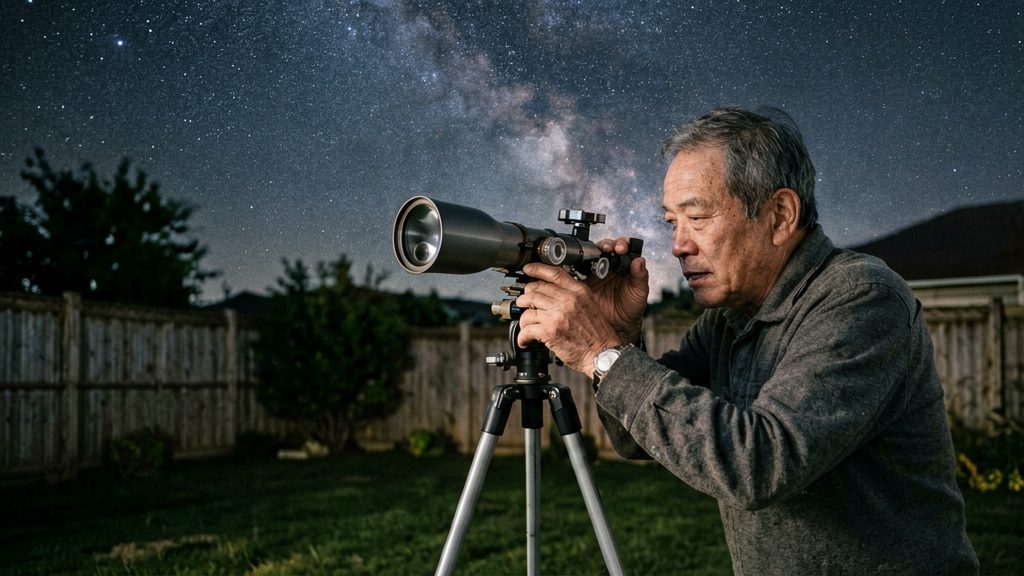
Almach (Gamma Andromedae) is a rewarding autumn double for small telescopes. Cosmic Pursuits includes it among five fall doubles it recommends, without ranking them. It combines a bright +2.26 primary, a main pair roughly 9 to 10 arcseconds apart that small instruments can split, and a striking colour contrast. Its brighter component is magnitude +2.26. Its main pair is roughly 9 to 10 arcseconds apart, a separation that small instruments can split. Its colour contrast is also striking. It is one of five fall doubles that Cosmic Pursuits recommends for small telescopes. It also appears on Cosmic Pursuits’ list of five fall doubles for small telescopes, with a primary of magnitude 2.3 and a companion of magnitude 4.8.
Why Almach is the top autumn double
A single 2nd-magnitude star to the naked eye
Without optics, Almach reads as one 2nd-magnitude star. The brighter component is +2.26, and the faint companion is itself a close pair (B and C) about 0.3 arcseconds apart, which is too tight to split in a small scope. The duplicity is therefore only revealed through a telescope, and the naked-eye view gives the observer an easy starting point.
Suitability for small scopes
The main pair’s separation is the key factor for small instruments. EarthSky gives about 10 arcseconds, and Cosmic Pursuits gives about 9.4 arcseconds. Other sources give 9.6 to 9.8 arcseconds, so the working figure is roughly 9 to 10 arcseconds.
How Almach compares with the Cosmic Pursuits list
According to Cosmic Pursuits, five fall doubles suit a small telescope. The table compares them using only the data that source provides.
| Double | Separation | Notes |
|---|---|---|
| Albireo | 35 arcseconds | Widest pair on the list, so the easiest to split |
| Almach | About 9.4 arcseconds | Primary of magnitude 2.3, companion of magnitude 4.8 |
| Eta Cassiopeiae | About 13 arcseconds | Sun-like primary with a yellow-orange companion of about magnitude 7.5 |
| Sigma Cassiopeiae | 3.1 arcseconds | Lies near the open cluster NGC 7789 |
| Struve 7 | 1.3 arcseconds | Tightest pair on the list, the most demanding test |
Almach offers a bright, easily found primary and a split that small scopes can reach, but the source does not rank the five doubles. Albireo is wider and simpler to split, and the list gives it no clear disadvantage in primary brightness. Eta Cassiopeiae is wider than Almach, but its companion is about magnitude 7.5, which is much fainter. Sigma Cassiopeiae and Struve 7 are tighter and more demanding. Albireo is wider and simpler to split, but the list does not give it a clear advantage in primary brightness. Sigma Cassiopeiae and Struve 7 are too tight to serve as an introduction for a small instrument.
How to find Almach from the Great Square
Almach (Gamma Andromedae) is reached by starting at the Great Square of Pegasus, moving to Alpheratz, and then following Andromeda’s star chain for three more stars. Almach is about 350 light-years away, according to EarthSky. Because the route is only a few star-hops long, you can locate the target by eye or with binoculars before you move to a telescope.
Step 1: Identify the Great Square
The Great Square is a large, nearly square asterism in the autumn sky, made of four fairly bright stars. Locate it first, since every later step depends on it. Use a star chart or astronomy app to confirm the square’s orientation for your date, time and location.
Step 2: Reach Alpheratz
Alpheratz sits at the north-eastern corner of the square. It is the shared star that marks the start of Andromeda, so it is the first star you should identify. Treat it as your anchor point: once you confirm it, the rest of the route follows from it.
Step 3: Follow Andromeda’s lower star stream
From Alpheratz, follow the line of stars that extends toward the lower part of Andromeda. Count the three stars along this stream. Keep your eyes moving along the line rather than jumping to isolated stars, because the chain is what separates Andromeda from the surrounding fields.
Step 4: Confirm Almach
Almach is the endpoint of this route.
| Step | Star or marker | Action |
|---|---|---|
| 1 | Great Square of Pegasus | Find the four-star square |
| 2 | Alpheratz | Locate the north-eastern corner star |
| 3 | Andromeda’s lower stream | Count three stars along the chain |
| 4 | Almach | Confirm a single second-magnitude star by eye |
What will you see in a small telescope?
Almach (Gamma Andromedae) is a rewarding double for a small telescope, and the main pair can be split at modest magnification. The main pair sits roughly 9 to 10 arcseconds apart, depending on the source: Cosmic Pursuits gives about 9.4”, while EarthSky gives about 10”. The brighter primary is magnitude +2.26, and the two stars present a golden and indigo-blue contrast that is the main reason observers single it out.
The golden and blue pair
In a modest scope, the primary shows a golden tone and the secondary appears indigo-blue. The colour contrast is the defining feature of this target.
The faint companion
The fainter component is not a single point. It is itself a close pair, designated B and C, separated by about 0.3 arcseconds. Resolving this split is beyond a small telescope. At about 0.3 arcseconds it needs a much larger aperture and exceptional seeing. In a small scope the companion will look like a single point, which is normal and not a fault of the instrument.
Which magnification and eyepiece work best?
Almach is a good test of eyepiece choice. Its main pair, roughly 9 to 10 arcseconds apart, is wide enough to split at moderate power, and the colour contrast between the golden and blue-tinted stars is what makes the view worth the effort.
Choosing the eyepiece focal length
Magnification follows one formula: magnification = telescope focal length / eyepiece focal length. A telescope with a 1000 mm focal length and a 10 mm eyepiece gives 100×. A shorter eyepiece raises the power, and a longer one lowers it.
Work through the eyepieces you own in this order:
| Step | Eyepiece | Purpose |
|---|---|---|
| 1 | Longest focal length you have | Find Almach and centre the field |
| 2 | Medium focal length | Check whether the pair separates and how the colours look |
| 3 | Shortest focal length that keeps the stars sharp | Test the split at higher power |
Move to the next step only when the image stays steady and sharp. If the stars shimmer or swell, return to the previous eyepiece.
The faint B and C components of the companion are only about 0.3 arcseconds apart. Raising the magnification will not split them in a small telescope, because aperture limits resolution. Treat them as out of reach for small instruments.
Defocusing to sharpen colour contrast
Once the pair is split, defocus slightly to bring out the colours. Turn the focuser slowly in one direction until the stars become faint, soft discs, then return through focus until the images are just slightly soft. Compare the golden and blue tints at each setting and keep the one where they look most distinct. According to EarthSky (2026), changing eyepieces or slightly defocusing the telescope can make the colour difference more obvious.
Other autumn doubles: Eta and Sigma Cassiopeiae
Eta Cassiopeiae (also called Achird) and Sigma Cassiopeiae are two more autumn doubles in Cassiopeia, and they differ mainly in how wide they are. According to Cosmic Pursuits, Eta Cassiopeiae is a Sun-like primary with a fainter yellow-orange companion, roughly 3.5 and 7.5 in magnitude, about 13 arcseconds apart. Sigma Cassiopeiae is a much tighter pair, with a separation of about 3.1 arcseconds, and it lies near the open cluster NGC 7789 at the western end of the constellation.
- Eta Cassiopeiae: wide split, so it is the easier of the two to resolve. The colour contrast comes from the yellow-orange companion against the brighter primary.
- Sigma Cassiopeiae: a tight split at 3.1 arcseconds. Sharp focus matters more here than with the wider pair.
- Sky position: Sigma sits near NGC 7789, which gives observers a larger field to orient against before centring on the double.
Is Albireo still worth a look in autumn?
Albireo is worth an autumn session if you want a double that is easy to split and shows a clear colour contrast. Cosmic Pursuits gives a separation of 35 arcseconds between a golden yellow star and a blue-white companion. The gap is wide enough that the pair should separate at low power and with modest optics, so it suits a quick observing session in the early evening.
What the wide pair offers
- Wide separation: 35 arcseconds, according to Cosmic Pursuits. The stars are far apart compared with tighter autumn pairs, so high magnification matters less.
- Colour contrast: golden yellow against blue-white. This contrast is the main visual reward, and it is clearest when the stars are well above the horizon.
Albireo or Almach for autumn time
Choose Albireo when you want a fast, easy split and a strong colour pairing. Choose Almach when you have more time and want a tighter target to work at. Albireo is an easier alternative for a short session or a beginner’s first double, because its wide gap needs less effort to resolve.
Checking its position in the autumn sky
A star low over the horizon looks dimmer and more coloured by haze, which can weaken the colour contrast.
Tips for Canadian skies and cold nights
Cold autumn nights affect observing in three ways: moisture condenses on optics, batteries deliver less power, and mechanical parts stiffen. Canada also spans a wide range of latitudes, so the same double star sits at a different height above the horizon depending on where you observe. None of these issues needs special equipment. They need preparation before you go outside.
Dew control on optics
On clear, still nights, the front lens or corrector plate cools faster than the surrounding air, and moisture forms on it. Prevention works better than wiping the glass during the session:
- Fit a dew heater band to the objective or corrector, powered from a separate supply, and adjust it to prevent fogging.
- Use a dew shield or lens hood to slow the cooling of the front element.
- Keep eyepieces and finder capped indoors until you need them, so they do not fog when moved from a warm room to the cold.
- If dew forms anyway, do not wipe the glass, because wiping can scratch the coatings. Let the optics clear with the heater band or by gentle warming, and keep the dew shield in place.
Battery and tripod performance in low temperatures
Battery capacity falls as the temperature drops, so a power source that runs a mount or dew heater all evening may stop early. Keep spare batteries in an inner pocket until you swap them in. Check the operating temperature range printed on the battery and mount labels or in the manufacturer’s instructions.
Tripod clamps and locks stiffen in the cold. Loosen and retighten them gently rather than forcing them. Cold also changes the length of the tube and focuser slightly, so refocus after the telescope has cooled down.
| Cold-weather issue | What to check |
|---|---|
| Fogging on optics | Dew shield and heater band in place and powered |
| Low battery output | Spare batteries kept warm; rated operating temperature |
| Stiff tripod clamps | Loosen and retighten gently; do not force them |
| Focus shift | Refocus after the tube has reached outdoor temperature |
Seasonal visibility across Canadian latitudes
Targets in autumn reach different heights for observers in southern and northern Canada. Set your location in a planetarium app and check each target’s altitude for the time you plan to observe. A target low in the sky is viewed through more atmosphere, which reduces steadiness and contrast, so a double that sits low may look less sharp than one higher up.
Local light pollution also varies widely, and a light pollution map can show how dark your site is before you commit to a trip.