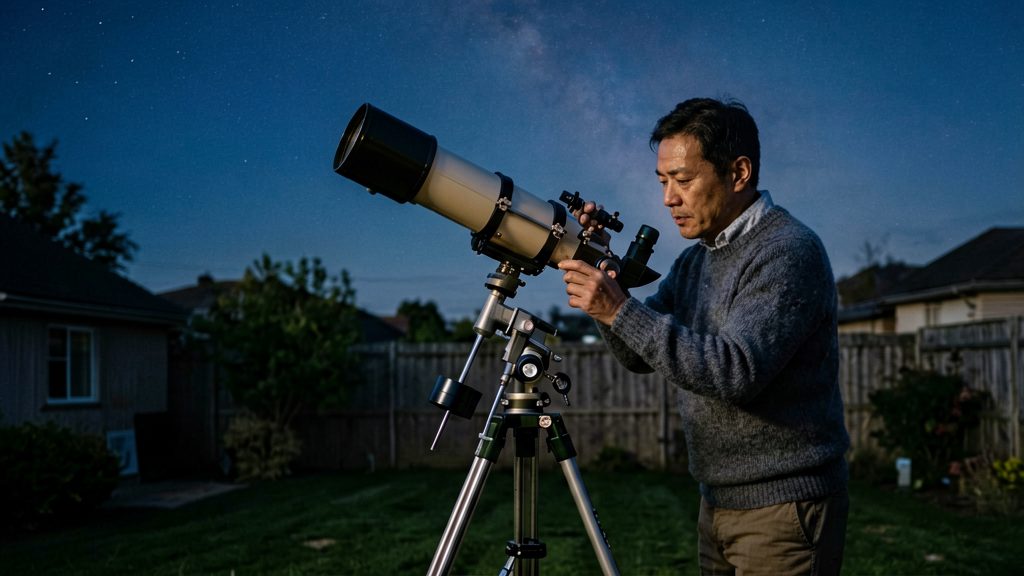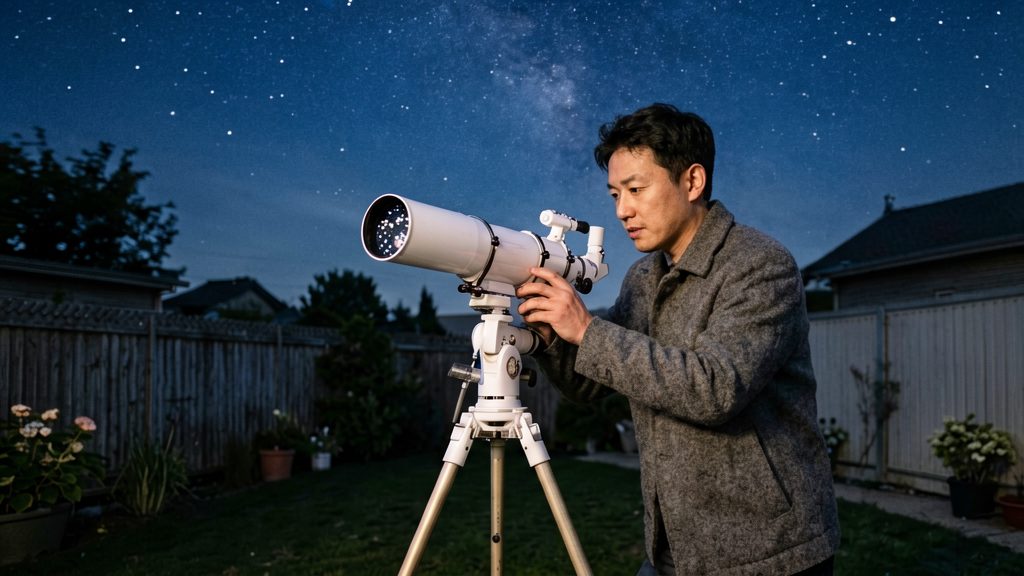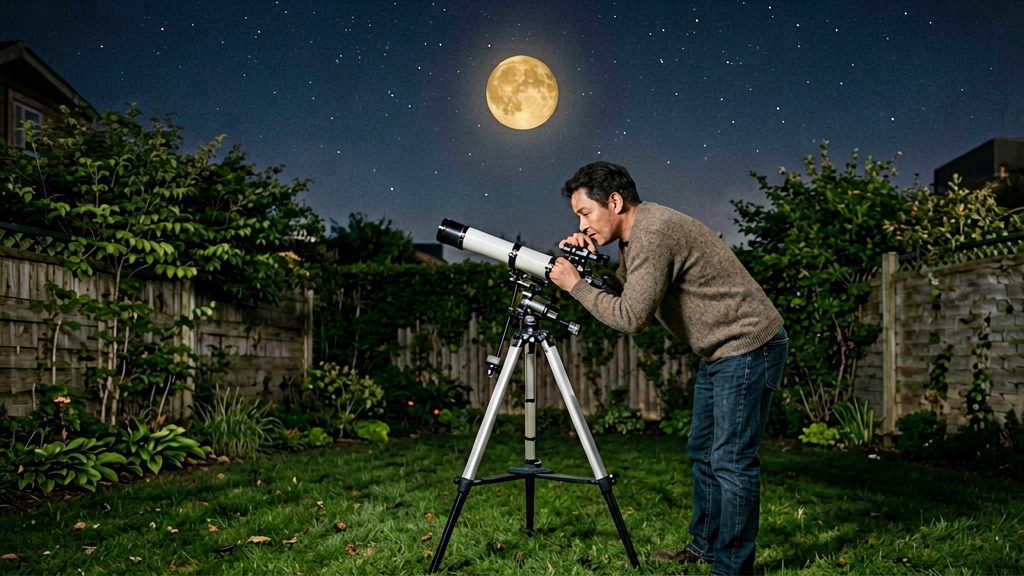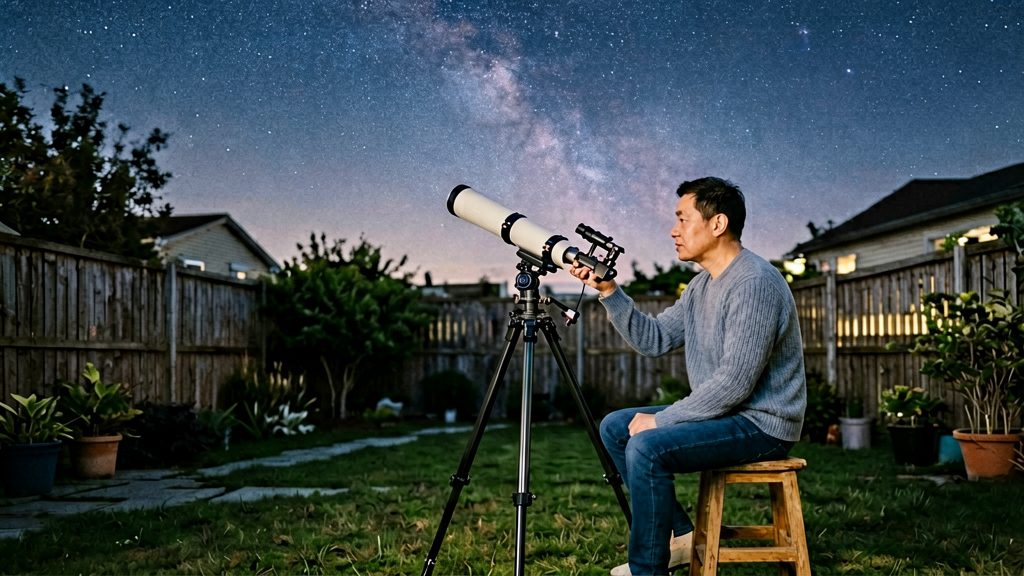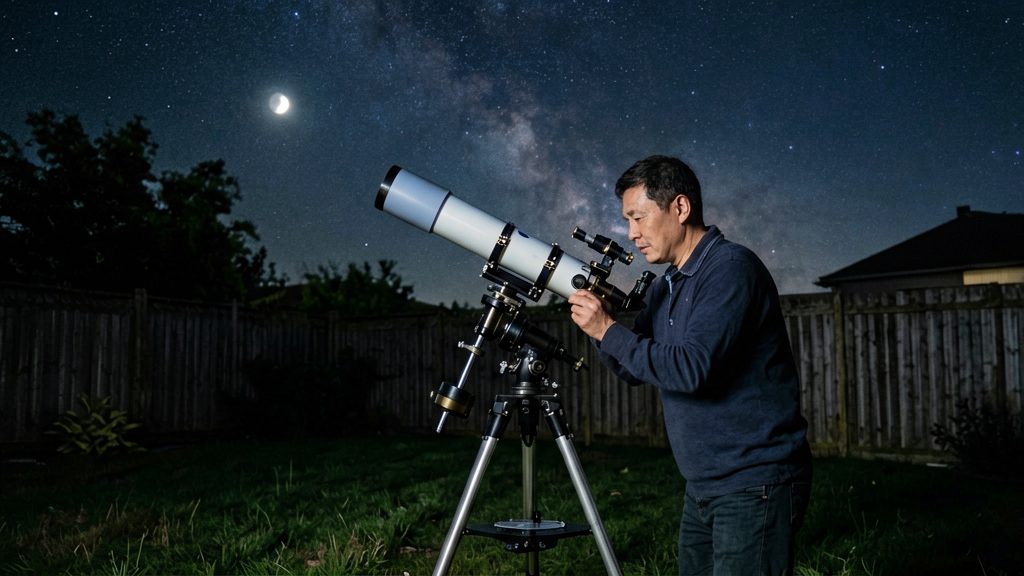
An alt-az mount is the simplest telescope mount type. It moves the telescope around two axes: one tilts the tube up and down, and the other turns it side to side. Because it has little or no counterweight, it is lighter and easier to carry than most equatorial mounts. That makes it a practical choice for visual observers who set up and pack away often, especially for terrestrial viewing and low-power sky scanning.
Alt-az mount: what it is and who it suits
The two axes
| Axis | Movement | Plain-language meaning |
|---|---|---|
| Altitude | Up and down | Sets how high above the horizon the tube points |
| Azimuth | Side to side | Sets the compass direction the tube faces |
Aiming works like a camera on a tripod head: you raise or lower the tube to reach the target’s height, then turn the base to bring it into the same direction. Celestron describes this as the simplest mount design.
Why it is lighter and more portable
Alt-az mounts carry little or no counterweight. Equatorial mounts need counterweights to balance the tube around a tilted polar axis, which adds weight and bulk. Without that counterweight, an alt-az mount is easier to carry to a dark site and set up in a few minutes, according to Celestron.
Who benefits most
- Low-power sky scanners who sweep wide areas at low magnification to explore the sky.
- Visual observers who do not plan deep-sky photography.
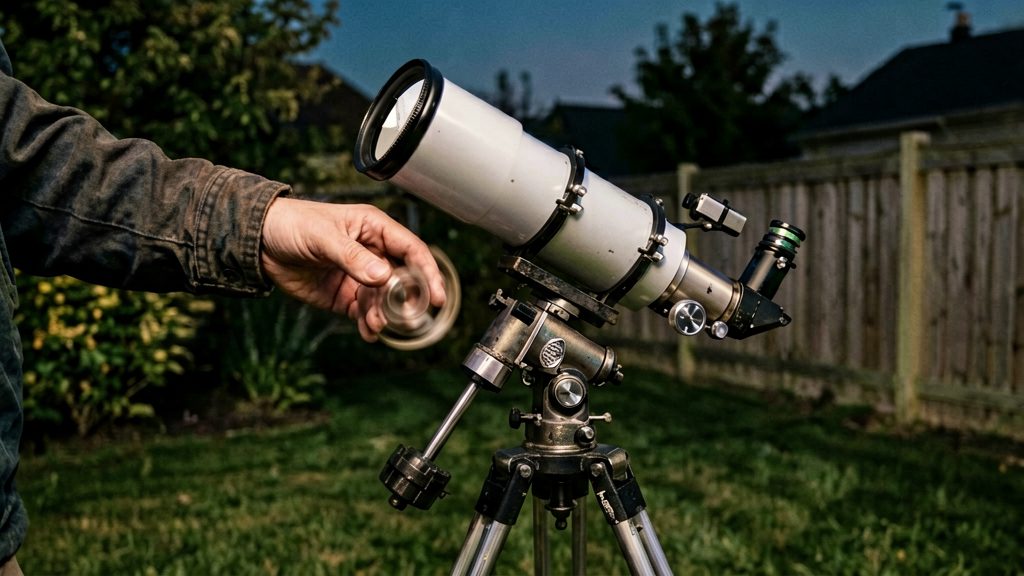
Alt-az or equatorial: which should you choose?
An equatorial mount has two axes, right ascension and declination. The right ascension axis is tilted to match Earth’s rotation axis, so the telescope can follow a star by turning only that axis. Choose by what you plan to observe. Alt-az suits quick, portable sessions. Equatorial suits sessions where the target must stay centred for longer, and it is the traditional choice for deep-sky photography.
Matching the mount to your goals
- Visual observing and low-power scanning: An alt-az mount is the practical default.
- Terrestrial observing: Alt-az mounts suit daytime and terrestrial viewing, where you sweep across landscapes at low magnification.
- Deep-sky photography: Equatorial mounts, with their single right ascension axis, are the traditional choice for this work.
| Goal | Alt-az mount | Equatorial mount |
|---|---|---|
| Low-power scanning and terrestrial viewing | Well suited (Celestron) | Not the main use case in the sources |
Beginner-friendly alt-az designs
TelescopicWatch recommends Dobsonian alt-az telescopes for beginners.
Converting select Celestron alt-az models to an equatorial setup
Some Celestron alt-az models can be set up on an equatorial base by adding a wedge. A wedge tilts the mount’s vertical axis toward the celestial pole. Celestron names the CPC, NexStar Evolution, NexStar 6SE and NexStar 8SE for this conversion.
How much weight can the mount carry?
Every alt-az mount has a rated payload, the maximum weight its manufacturer says it can carry. High Point Scientific advises respecting that figure. The rating only helps if you compare it with the full load on the mount, not the optical tube alone.
Rated payload versus total load
Add up everything attached to the mount before comparing it with the rating:
- The optical tube
- Accessories fixed to the mount head, such as a tray or dew shield
- Eyepieces, diagonal and finder
- Any camera, phone adapter or other attachment
The rating may or may not include accessories. Check the manufacturer’s specification or the label on the mount. If the document does not say, contact the manufacturer before assuming you have margin.
Weight planning for eyepieces, diagonals and finders
Eyepieces, diagonals and finders are light individually, but they add up. Weigh the accessories you actually use and include them in the total. Recalculate each time you add an eyepiece, a camera or a new finder, since these changes accumulate.
Stability margin: why sturdier legs matter under load
High Point Scientific notes that sturdier tripods improve stability. A load within the rated payload can still feel unsteady on light legs, so treat the rating as a ceiling and leave room below it. To check stability, observe at high magnification and tap the tube lightly. If the image takes a long time to settle, the tripod may be too flexible for the load. Compare the total load with the rated payload and consider sturdier legs.
Do you need GoTo tracking?
An alt-az mount without motorized tracking loses objects because Earth’s rotation carries the sky across the field of view. A target centred in the eyepiece drifts out of view quickly, so you must keep correcting by hand. Whether that matters depends mainly on aperture and magnification. According to TelescopicWatch, computerized tracking is not very necessary for smaller-aperture telescopes, while catadioptric telescopes of 8 inches or larger usually need tracking, whether on an alt-az or an equatorial mount.
Manual slow motion versus motorized tracking
- Manual slow motion: Turn the altitude and azimuth slow-motion knobs to recentre the target. This works for brief looks at bright objects, such as the Moon or planets at low power, but it demands constant attention at higher magnification.
- Motorized tracking: The mount drives the telescope against Earth’s rotation so the target stays near the centre. Tracking keeps the object in view but does not correct the rotation of the image, which matters only for long-exposure imaging.
For visual use on small telescopes, many observers manage with manual control. Once you use high-power eyepieces or a heavier tube, motorized tracking saves time and frustration.
GoTo databases and star alignment
A GoTo mount holds an internal object database and slews the telescope to a selected target automatically. Before it works, the mount needs alignment:
- Centre one to three bright stars or planets in the eyepiece and confirm each alignment star in the handset.
- High Point Scientific describes plate solving, which uses the camera image to determine the sky position, as more accurate than star alignment.
- Re-align if you move the tripod or change your observing site, because the alignment no longer matches the mount’s position.
Fork, tripod or Dobsonian base?
The three common alt-az designs differ in how they hold the telescope tube and where the weight sits. The right choice depends on the telescope type. Outboard-design mounts are common in cheap alt-az models.
Manual fork and one-armed fork
Both designs sit on a tripod and move the tube up and down (altitude) and side to side (azimuth) with the same two axes. According to TelescopicWatch, they suit refractors and smaller reflectors and catadioptrics.
- Manual fork: a U-shaped yoke supports the tube on both sides.
- One-armed fork: a single arm supports the tube, which keeps the mount compact.
- Best match: lighter optical tubes that a beginner can aim by hand.
Dobsonian alt-az base
A Dobsonian base is a low, box-like platform that carries a reflector tube on a simple altitude bearing. The design is typically used with Newtonian reflectors. It sits on the ground, so there is no tripod to set up.
Outboard-design alt-az mounts
Outboard designs place the altitude axis away from the tripod centre, and that is where their trade-offs appear. TelescopicWatch notes that cheap alt-az mounts often use this layout, which makes aiming frustrating. As High Point Scientific notes, a sturdier tripod improves stability, so check the rated load against the tripod.
| Design | Typical telescope | Main trade-off |
|---|---|---|
| Manual fork | Refractors, smaller reflectors and catadioptrics | Manual aiming, suits light tubes |
| One-armed fork | Refractors, smaller reflectors and catadioptrics | Compact, one-sided support |
| Dobsonian base | Beginner reflectors | Simple, low setup, visual use |
| Outboard design (cheap alt-az) | Budget alt-az setups | Aiming can feel frustrating |
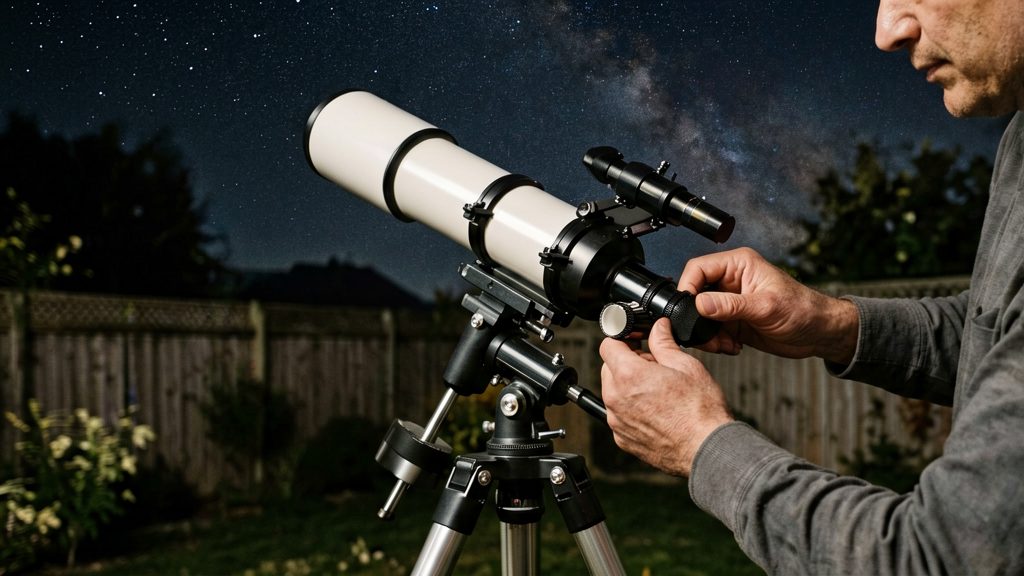
Can you do astrophotography on an alt-az mount?
Long-exposure deep-sky astrophotography does not work well on a standard alt-az mount. Short-exposure imaging of the Moon and bright planets is possible, because the exposure is brief enough that rotation and drift do not blur the image. The limits come from how an alt-az mount moves: it turns around two axes, altitude and azimuth, and the sky does not turn with them.
Field rotation and star trails
On an alt-az mount, the field of view rotates as the telescope tracks an object. Celestron notes that alt-az mounts are not designed for deep-sky photography, and High Point Scientific states that they cause field rotation in long exposures. Tracking keeps the target centred but cannot correct the rotation without a wedge. Over a long exposure, the rotation shows up as blur and trailing that increase with exposure length.
Target orientation drift
An object seen through an alt-az mount appears to turn on its side as the telescope follows it, according to TelescopicWatch. A target that looks upright at the start of a session can be tilted at a noticeable angle an hour later. This affects framing, and it makes stacking several frames of a faint target difficult, because the frames do not line up cleanly.
For deep-sky work, tracking is not enough on its own because it cannot correct field rotation.
Short-exposure planetary and lunar imaging
Planets and the Moon are bright enough to be captured in very short exposures. A short exposure records the target before field rotation and drift accumulate into visible blur. This makes alt-az mounts workable for:
- Lunar imaging: capturing the Moon in short video or burst sequences, then stacking the best frames
- Planetary imaging: recording Jupiter, Saturn or Mars with a phone or camera at the eyepiece, using brief captures
- Visual observing and scanning: the mode in which alt-az mounts are ideal, according to High Point Scientific
| Imaging style | Suitability on alt-az | Main limit |
|---|---|---|
| Visual observing | Ideal | None for this use |
| Low-power sky scanning | Suitable | Not a photography method |
| Long-exposure deep-sky | Poor | Field rotation and target tilt |
| Short-exposure Moon and planets | Possible | Exposure must stay short |
What to check before buying
Before buying, confirm that the specific model’s spec sheet, tripod, tracking and seller terms match how you plan to observe.
| Check | What to verify | Why it matters |
|---|---|---|
| Mount type | The listing states alt-az, and whether it accepts a wedge for equatorial use | Some Celestron alt-az models (CPC, NexStar Evolution, NexStar 6SE and 8SE) can be used on an equatorial setup with a wedge, according to Celestron |
| Tracking | Motorized tracking or GoTo is included, and which alignment method the controller supports | Keeps targets in view during a session |
| Rated payload | The maximum weight printed on the label or spec sheet | Respect the rated payload, which is the maximum weight the mount can carry, according to High Point Scientific |
| Tripod | The stated height range, and leg rigidity | Affects how steady the setup feels at the eyepiece |
| Accessory tray | Whether it is included and attaches to the tripod | Keeps eyepieces and controller within reach at the eyepiece |
| Return window | The return period and conditions, in writing | Limits financial risk if the mount does not suit your setup |
Read the spec sheet and product label
- Find the tracking entry. Check whether the model has motorized tracking, and whether GoTo is included.
- For GoTo, check the alignment method. According to High Point Scientific, GoTo alignment uses 1–3 bright stars or planets, or plate solving, which it calls more accurate.
- Compare the rated payload with the weight of the telescope tube and accessories you intend to mount.
Verify tripod height, leg rigidity and accessory tray
- Compare the stated height range with your eye height. Check the seated and standing positions you will use at the eyepiece.
- Once the mount is tightened, nudge the tube gently. Vibration that persists for a long time points to a flexible tripod.
- Confirm whether the accessory tray comes in the box or is sold separately.
Check the return policy and local dealer support
- Get the return window and conditions in writing before paying. Check whether opened items or accessories are eligible.
- Ask the dealer whether it offers setup help, and whether warranty claims go through the dealer or the manufacturer.
- For rules that depend on your location, contact your provincial consumer protection office or the seller directly, since consumer rules in Canada vary by province.