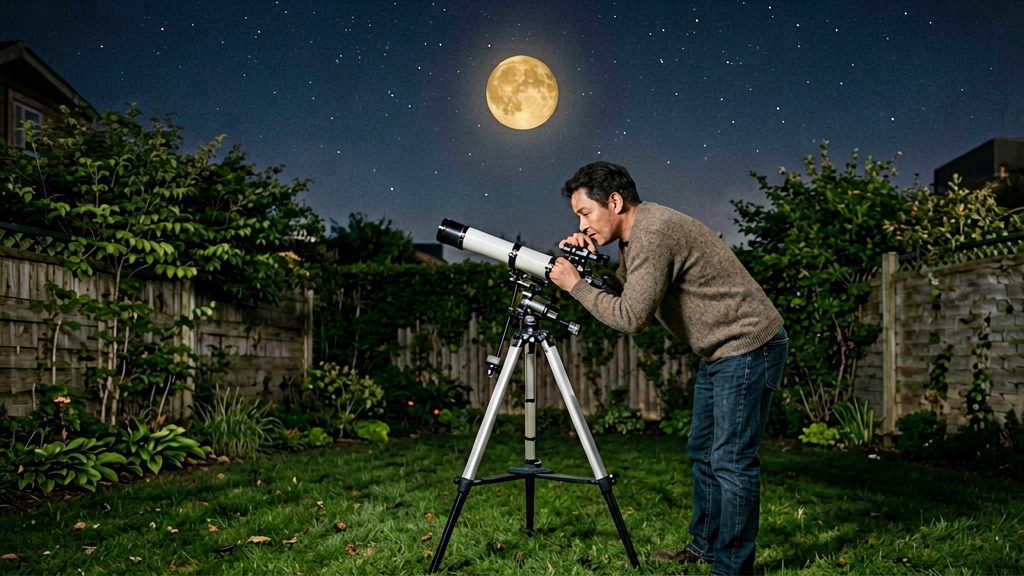
Saturn’s rings are best placed for amateur telescopes around opposition, when the planet is high in the evening sky. For 2026, the reference peak is October 2026, which EarthSky (2026) calls the best month of the year to observe Saturn. Because the planet moves slowly, the useful season covers several weeks, and the best night within it depends on sky conditions more than on the calendar. The 2026 peak has passed, but Saturn should still be visible in the evening sky in late 2026; confirm its position in a planetarium app.
Why October 2026 stands out
October 2026 falls in the reopening phase, so the rings are wider than in 2025, when they were nearly edge-on:
- EarthSky (2026) gives a ring tilt of about -7.5° around the October 2026 opposition, with the southern face visible.
- Astronomy gives about 7°, and the Farmers’ Almanac gives 7.45°. Tilt figures differ slightly between publishers, so cite the one you use.
Choosing observing dates by sky conditions
Calendar dates set the season, but the night you observe depends on the following conditions:
| Condition | What to check | Effect on the rings |
|---|---|---|
| Steadiness of the air | Look at the planet at low power for a few minutes before deciding | Steady air shows fine detail |
| Moon phase | Check a lunar calendar | A bright Moon close to Saturn lowers contrast |
| Twilight | Compare sunset time with Saturn’s position | Observing Saturn low in bright twilight limits detail |
Why opposition matters for Saturn
At opposition, Earth passes between the Sun and Saturn, so the planet sits on the opposite side of the sky from the Sun and rises around sunset. Its disk is then nearly fully lit as seen from Earth, and it is at or near its largest apparent size and brightest for the year. Opposition changes only the viewing geometry. Saturn itself is the same at any time.
Its disk measures about 19.7 arcseconds across at opposition, according to EarthSky (2026). Astronomy magazine gives about 20 arcseconds for the 2026 event, which is the same figure rounded. The table below lists the 2026 values with their sources.
| Measure at the 2026 opposition | Value | Source |
|---|---|---|
| Disk diameter | About 19.7 arcseconds | EarthSky (2026) |
| Apparent magnitude | 0.3, in the constellation Cetus | Astronomy magazine |
| Ring extent, end to end | Nearly 45 arcseconds | Astronomy magazine |
Because the disk is only about 20 arcseconds wide, its visible size depends on your telescope’s magnification and the steadiness of the air, not on the date alone. Saturn is therefore a planet to observe with patience rather than a wide object that fills the eyepiece.
The rings are also brightest in a short window. According to BBC Sky at Night Magazine (2026), they brighten for a few days around opposition. Outside that window, the same rings look dimmer.
The disk size, magnitude and ring tilt for the 2027 opposition are not confirmed here, so check a current ephemeris or an astronomy almanac before planning an observing session.
What time of night is best for Saturn?
Around opposition, Saturn is highest in the south near midnight, which is the best time to observe it. After opposition, as now in November 2026, it crosses the meridian earlier each evening, so check your app for the transit time.
| Time of night | Saturn’s position around opposition |
|---|---|
| Around sunset | Saturn rises in the east |
| Around midnight | Saturn is highest in the south, the best time to observe |
| Through the night | Saturn remains visible from dusk to dawn |
| For Canada | Altitude depends on your latitude and was not verified here; check an app |
Altitude controls image quality. A planet low in the sky looks through more of Earth’s atmosphere, which causes blur and colour fringing. Saturn high in the sky gives noticeably steadier views than a planet near the horizon, so observing near transit is the most practical approach. Its altitude from Canada depends on your latitude, so check an app.
Transit is the moment Saturn crosses your meridian and reaches its highest point. Plan your session around that time, and start observing about an hour before it, once the planet is clear of the rooftops and trees on your horizon.
How open are Saturn’s rings in 2026?
Saturn’s rings are open at a modest angle in 2026 and are still widening. EarthSky (2026) gives a ring tilt of about -7.5° around the October 2026 opposition, with the southern face of the rings turned toward Earth. That angle is what makes the rings look open through a telescope. Other published figures are close but not identical: Astronomy magazine gives about 7°, and the Farmers’ Almanac gives 7.45°. Treat the value as approximately 7 to 7.5°.
The rings open up because of a cycle. Earth crossed the ring plane in March 2025, when the rings were nearly edge-on and almost disappeared from view (Celestron, 2025). Since then the tilt has been increasing, and the rings are opening again. Celestron (2025) states that they reopen toward maximum tilt around 2032. The exact tilt at the 2027 opposition was not verified.
Ring tilt is the key measure here. A larger tilt means wider apparent rings and a more visible gap between the rings and the planet’s disk. The southern face is the side you see during this period, so the rings look brighter and more open than during the 2025 crossing.
What telescope do you need to see Saturn’s rings?
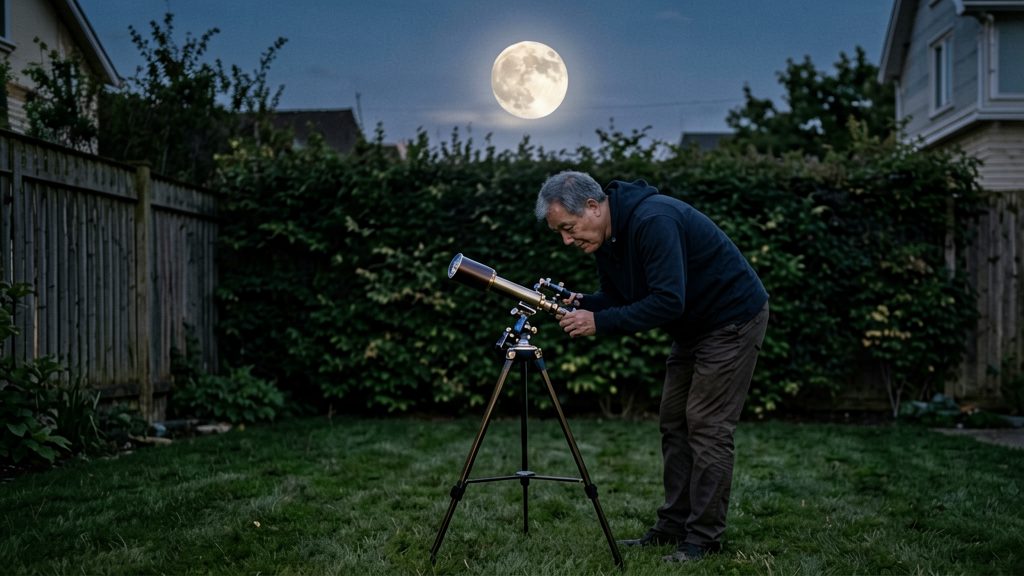
According to Celestron (2025), a telescope of at least 50mm aperture at about 25x shows Saturn’s rings and its moon Titan. Binoculars show Saturn as an oval disk but not the rings. BBC Sky at Night Magazine (2026) recommends a 75mm refractor or larger for good views. At opposition, Saturn’s disk is about 19.7 arcseconds across, and EarthSky (2026) says any small backyard telescope shows the rings.
| Instrument | What you see at Saturn | Source |
|---|---|---|
| Binoculars | Oval disk, no rings | EarthSky (2026) |
| Telescope of at least 50mm aperture, about 25x | Rings and Titan | Celestron (2025) |
| Small backyard telescope | Rings | EarthSky (2026) |
| 75mm refractor or larger | Rings, recommended for good views | BBC Sky at Night Magazine (2026) |
Why binoculars stop at the oval
Binoculars show Saturn as an elongated oval but not the rings, according to EarthSky (2026). The oval appearance is the first clue that the rings are present. A telescope is the instrument that separates the rings from the planet’s disk.
The 50mm threshold
At 50mm aperture, the rings and Titan become visible at about 25x, per Celestron (2025). This is the aperture where the planet stops looking like a featureless oval and the ring outline appears.
Why UK observers are advised to use 75mm
According to BBC Sky at Night Magazine (2026), a 75mm refractor or larger is recommended for UK skies.
Magnification, filters and seeing conditions
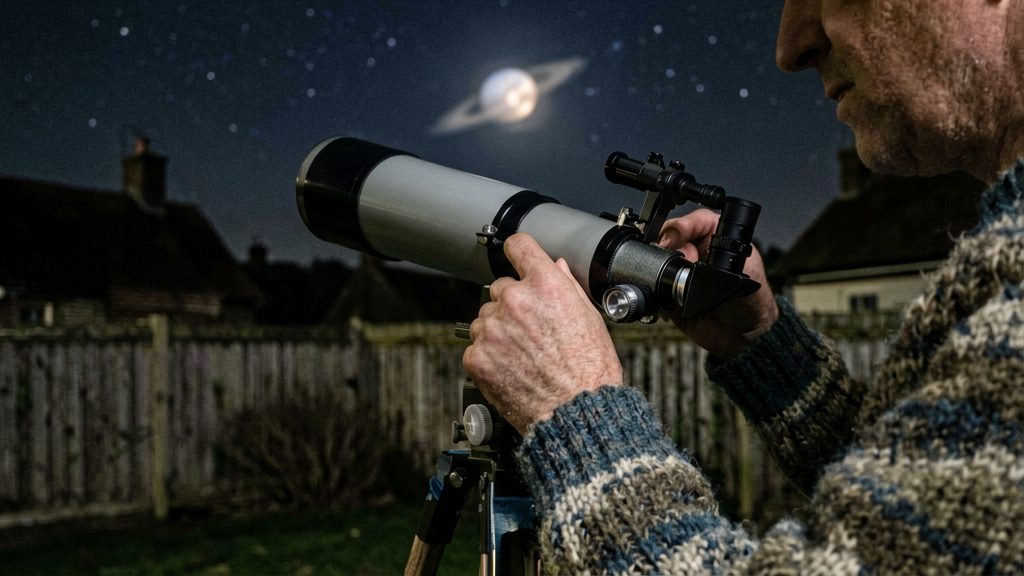
Start Saturn at low magnification, around 25x, and increase power only when the air allows it. At low power the rings are easier to frame and the image is less affected by atmospheric turbulence. The Cassini Division, the dark gap between the bright A and B rings, works as a seeing test once you raise the magnification enough to show it. It is not usually visible at the 25x starting power and depends on your telescope’s aperture. If you can see it clearly and the planet’s edges stay sharp, you can try higher powers. If the gap blurs or disappears, lower the magnification or wait for steadier conditions.
Choosing a starting eyepiece
Magnification equals telescope focal length ÷ eyepiece focal length. To reach about 25x, use this calculation:
- Telescope focal length 1000 mm ÷ 25 = eyepiece focal length 40 mm
- Check the focal length printed on the eyepiece barrel, not the marketing name
- Move to a shorter eyepiece only after the rings and Cassini Division hold steady
Using the Cassini Division as a seeing test
- Centre Saturn in the eyepiece and let the image settle for a minute or two.
- Look for the Cassini Division, the dark gap between the bright A and B rings.
- Note whether the gap stays sharp for several seconds at a time. Brief flashes of clarity suggest the air is changing rapidly.
- Increase magnification in small steps, checking the gap at each step.
The Encke Division
The Encke Division is a fainter gap near the outer edge of the A ring. According to Celestron (2025), it needs an 11-inch or larger telescope under extremely steady conditions. Smaller instruments generally will not show it, so treat it as an advanced target rather than a beginner benchmark.
Colour filters for Saturn
Celestron (2025) lists the following filters for Saturn. Celestron (2025) lists these filters, and their effect varies with the instrument and sky.
| Filter | Colour |
|---|---|
| #12 | Deep yellow |
| #21 | Orange |
| #25 | Red |
| #58 | Green |
| #80A | Blue |
| Variable polarizing | Adjustable tint |
Tips for cold-night observing
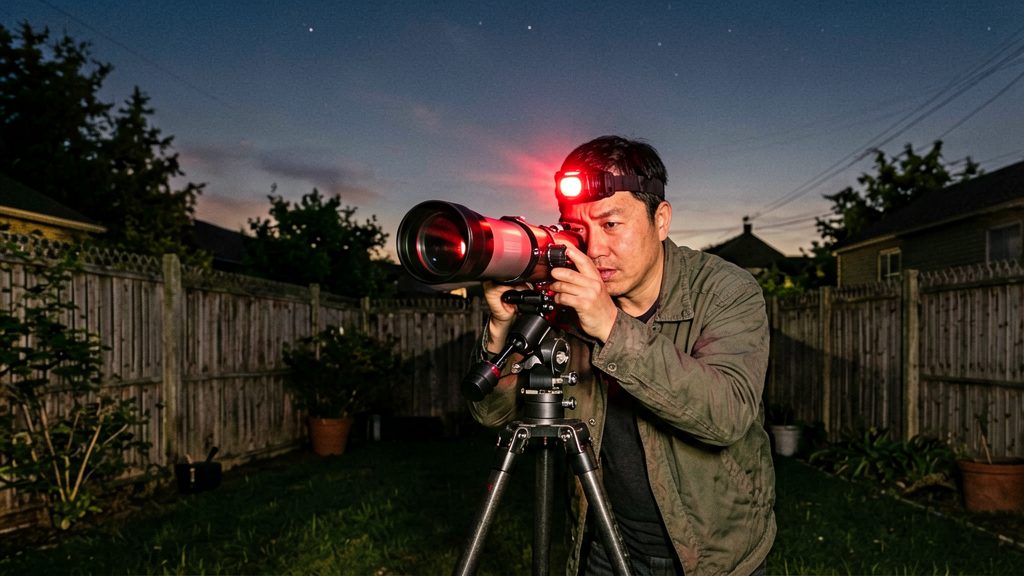
Cold nights change how a telescope performs more than most beginners expect. Optics that are still warm from the house cool unevenly, which blurs the image, and moisture condenses on lenses and the finder scope. Plan the setup, the dew control and the power supply before dark, and Saturn’s rings will stay sharper for the whole session.
Let the optics reach outdoor temperature
- Carry the telescope outside as early as possible, ideally before sunset, so the thermal equilibrium of the tube and mirror or lens can settle.
- Leave the cap off the objective only when you are ready to observe, and keep the tube out of direct light from porch lamps or a heated car.
- The time needed depends on tube size and the temperature difference. Check the manufacturer’s instructions for your model.
Prevent dew on lenses and the finder
- Use a dew heater strip or band on the objective or corrector plate if your model supports one. Many dew heaters have a controller that adjusts power to the ambient humidity.
- Fit a dew shield or lens shade to the main tube and to the finder scope to slow moisture from settling on the glass.
- Keep a lens cloth and a spare, dry eyepiece cap nearby to wipe optics between observations.
Plan batteries and warm breaks
- Cold reduces battery capacity, so carry spare batteries for dew heaters, go-to mounts and cameras, and keep them in an inside pocket until needed.
- Schedule a warm break indoors every hour or so. Warming hands, eyes and batteries lets you return to the eyepiece with better focus and steadier hands.
- Use a red torch to check settings at the telescope so your eyes stay dark-adapted.
| Cold-night issue | Practical response |
|---|---|
| Blurred image from temperature gradients | Allow equilibrium outdoors before observing |
| Fogged or wet optics | Dew heater, dew shield, lens cloth |
| Weak batteries | Spare batteries kept warm |
| Numb hands and fatigue | Scheduled warm breaks indoors |
When is the next Saturn opposition?
The next Saturn opposition falls on October 18, 2027, according to EarthSky (2026). Planning a session starts with this date.
| Opposition | Date | Planning note |
|---|---|---|
| 2026 | October 4, about 12 UTC (EarthSky, 2026) | Already passed. Saturn can still be observed in the evening; check its transit time in an app. |
| 2027 | October 18 (EarthSky, 2026) | The next peak. Schedule sessions on nights around this date. |
Lessons from the October 2026 opposition window
- Opposition timestamps are in UT. The 2026 event happened at about 12 UTC, so the local date and time can differ from the headline date. Convert before you plan.
- Plan more than one night. The favourable period is a stretch of weeks, which gives you room to pick clear nights.
Checking local sunset and transit times in advance
- Pick two or three candidate nights in October 2027, then look up sunset for your town in a planetarium app or a local almanac.
- In the same app, find the time Saturn crosses the meridian (transit) at your location.
- Schedule the session to begin after full darkness and to cover transit, when the planet is highest.
- Check the app’s time zone and daylight-saving settings before trusting any printed time.