No, a Moon filter is not essential for a typical beginner telescope. According to BBC Sky at Night Magazine, a Moon filter is a dark grey neutral-density filter that dims the light passing through it. This makes a bright Moon more comfortable to view. Because it is useful but not essential, most beginners can start without one and add it only if the bright Moon proves uncomfortable.
Do I need a moon filter for a telescope?
Who benefits most
- Observers who spend long sessions on the Moon and find its glare tiring to the eyes.
- Observers who switch between the Moon and deep-sky targets in the same night.
- Observers who want more comfortable views of the bright lunar surface without changing their observing plan.
Practical test: observe with and without first
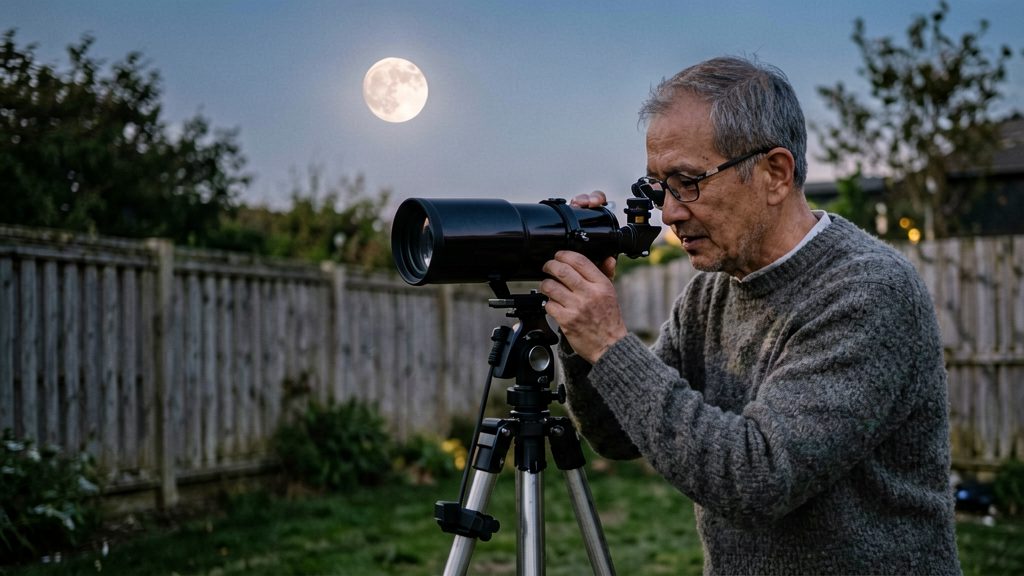
- Point the telescope at the Moon using a low-power eyepiece and no filter. Note the glare and how comfortable the view is.
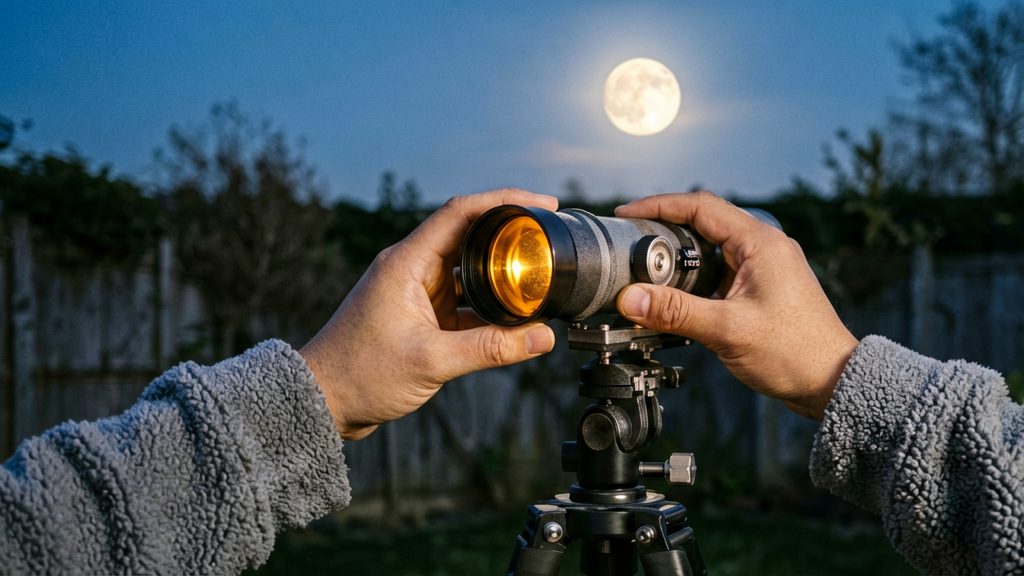
- Screw the filter into the eyepiece barrel. Moon filters are threaded for this, so no extra adapter is needed for standard models.
- Compare the same area of the Moon. Check whether surface detail is easier to see or whether the view becomes too dim to follow.
- Switch the telescope to a faint deep-sky target and note how well your eyes cope after the filtered Moon view. Compare this with an unfiltered session on another night.
If the filtered view is more comfortable and the detail remains clear, the filter is worth keeping. If the unfiltered view is comfortable, you do not need one.
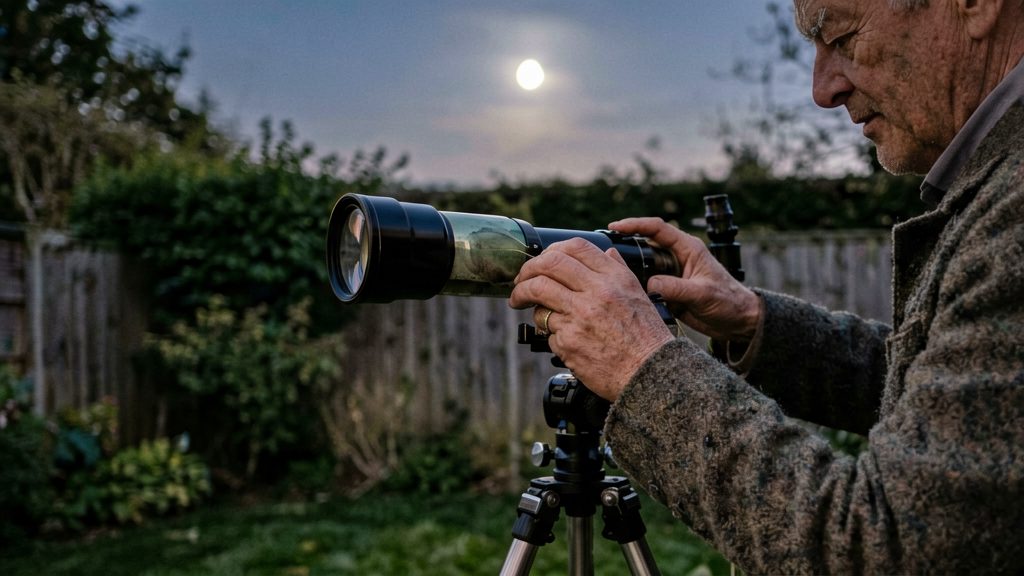
What does a moon filter actually do?
A Moon filter is a dark grey neutral-density filter that dims the light passing through it. It reduces overall brightness without changing colour, so the Moon looks the same but less intense. According to BBC Sky at Night Magazine, this makes viewing a bright Moon more comfortable.
Reduced glare on a bright Moon
- The full Moon is one of the brightest objects in the night sky, and at the eyepiece its light can feel harsh.
- A dimmed image lets you keep your eye at the eyepiece for longer with less squinting.
- The filter lowers the brightness of the whole field, including the bright limb and the darker maria, so surface detail stays visible at a more comfortable level.
Dark adaptation after observing
- Dark adaptation is the increased sensitivity your eyes develop in dim surroundings. Looking at a bright lunar view reduces that sensitivity.
- Using a filter limits how much the Moon’s light readjusts your eyes, so you are less likely to lose night vision when you switch to fainter targets such as deep-sky objects.
When is the Moon too bright without a filter?
Astronomy magazine advises extra dimming once the Moon is more than half full, though how bright it feels varies from observer to observer. Astronomy magazine recommends a Moon filter, a polarizer or a No. 47 filter at that stage. Between New Moon and about First Quarter, and again from Third Quarter to the end of the waning Moon, the same source says lighter filters work best. The phase therefore determines how much light you need to cut, not only whether you need a filter.
Filter guidance by Moon phase
| Moon phase | Filter guidance |
|---|---|
| New Moon to about First Quarter | Lighter filters work best |
| About First Quarter to about Third Quarter (more than half full) | Astronomy magazine recommends a Moon filter, a polarizer or a No. 47 filter |
| Third Quarter to end of waning Moon | Lighter filters work best |
Why the near-full Moon needs heavier filtering
Sky at Night notes that filter densities differ to suit different Moon phases. For the brightest, near-full Moon, a denser filter is the appropriate choice, since the light reaching the eyepiece is at its highest.
Neutral density or polarizing: which type?
Two filter designs cover most Moon viewing: a fixed neutral-density filter and an adjustable polarizing pair. According to Astronomy magazine, a typical No. 96 neutral-density Moon filter has a density of 0.90 and transmits about 13% of the light. An adjustable two-filter polarizing system passes roughly 3 to 50% of the Moon’s light. The difference is control: the fixed filter always dims by the same amount, while the polarizing pair covers a much wider brightness range.
| Feature | Fixed neutral-density (No. 96, density 0.90) | Adjustable polarizing pair |
|---|---|---|
| Light transmitted | About 13% | Roughly 3 to 50% |
| Brightness control | None; one fixed level | Rotate one filter against the other |
| Refocusing after installation | Not stated by the source | Usually needed |
Choosing between them comes down to handling:
- Fixed neutral-density: There are no settings to adjust, so the view is the same each time you use it.
- Adjustable polarizing pair: Install both filters, rotate the pair until the Moon is at a comfortable brightness, then refocus, since the filter usually shifts the focus point.
Do coloured filters improve lunar detail?
Colored contrast filters can enhance lunar detail, according to Astronomy magazine (2026), which names four of them: contrast filters Nos. 8, 11, 12 and 15. Their effect is to change how the Moon’s surface tones separate visually, not to add light or brightness. Most colored contrast filters are a separate tool from the neutral-density Moon filter and from polarizing systems, which dim the Moon rather than shift its contrast. The violet No. 47 is the exception, since it mainly dims the Moon.
Which colors help and why
Astronomy magazine (2026) notes that Nos. 8, 11 and 12 can reduce chromatic fringing in low-quality refractors. Chromatic fringing is the colored halo that appears around bright edges, caused by a lens focusing different wavelengths at slightly different points. Filtering part of the spectrum reduces that color bleed, so the lunar limb and crater rims look cleaner.
The violet No. 47 is a different case. It passes about 3% of light, according to Astronomy magazine (2026). That low transmission makes it a strong dimmer, and the same source recommends it for a Moon more than half full, alongside a Moon filter or a polarizer.
| Filter | Reported effect | Source |
|---|---|---|
| Nos. 8, 11, 12, 15 | Can enhance lunar detail | Astronomy magazine (2026) |
| Nos. 8, 11, 12 | Can reduce chromatic fringing in low-quality refractors | Astronomy magazine (2026) |
| No. 47 (violet) | Passes about 3% of light | Astronomy magazine (2026) |
How to test a colored filter
- Observe the Moon at the eyepiece with no filter and note any color halo on bright limbs.
- Screw in one colored filter, keeping the same eyepiece and focus.
- Compare crater edges and the terminator (the shadow line) for clearer separation of grey tones.
- Check the filter’s transmission and whether it suits your telescope.
What size filter fits my eyepieces?
Moon filters are made in two standard barrel sizes: 1.25-inch and 2-inch. The filter has to match the diameter of the eyepiece you use. Because the size is set by the eyepiece, check the barrel diameter in the manufacturer’s specifications before buying, and do not rely on the size of the eyepiece’s outer housing or the eyepiece’s focal length.
According to BBC Sky at Night Magazine (2026), Moon filters come in 1.25-inch and 2-inch sizes. A filter for a 1.25-inch eyepiece will not fit a 2-inch barrel, and the reverse is also true.
How to match the filter to the barrel
- Read the barrel diameter from the eyepiece’s specifications, or from the marking printed on the barrel.
- Choose a filter of the same nominal size, 1.25-inch or 2-inch.
- Thread the filter onto the barrel by hand, without forcing it, and confirm it sits flush before observing.
Can I use a moon filter for the Sun?
No. A Moon filter is a dark grey neutral-density filter, and Astronomy magazine states that photographic neutral-density filters must never be used to view the Sun. A filter that only dims light does not protect your eyes from the Sun, so it cannot substitute for a solar filter. Sunlight requires a dedicated solar filter.
- Never substitute: Do not use a Moon filter, a photographic neutral-density filter, or any colored or dimming filter in place of a solar filter.
- Use a solar filter: Astronomy magazine states that a proper solar filter is required for solar viewing.
- Read the labeling: Check the manufacturer labeling before any solar observation. Confirm that the product is explicitly rated for solar use. If the label does not state this, do not point the telescope at the Sun with it.
- Follow the instructions: Install and use the solar filter exactly as the manufacturer directs, and check the filter for damage before each session.
Are there alternatives to a filter?
Two no-cost methods are available for a Moon that feels too bright, but only one of them actually reduces brightness. The other changes the view without dimming it.
Aperture masks are the practical workaround. Cut a disc of opaque card (black or dark matte paper works) so it covers the outer part of the objective and leaves a smaller open centre. Secure it to the front of the tube with tape or a cardboard ring, taking care that nothing can fall onto the optics. Because less glass receives light, the image gets dimmer. The trade-off is that the same reduction in aperture also cuts resolution, so fine lunar detail such as crater rims and small rilles becomes softer. A mask suits a moderately bright Moon for casual viewing. It is a poor choice when you want sharp detail.
Lower-power eyepieces do not dim the Moon. Swapping to a longer-focal-length eyepiece lowers magnification and widens the field, but the Moon’s surface stays just as bright. A longer-focal-length eyepiece lowers magnification and widens the field. It is not a reliable way to cut glare, so use it for a wider view of the whole disc.
| Option | Reduces brightness? | Main trade-off |
|---|---|---|
| Aperture mask (opaque card) | Yes | Lower resolution |
| Lower-power eyepiece | No | Changes magnification and field only |
| Moon filter (1.25-inch or 2-inch) | Yes | Purchase required |