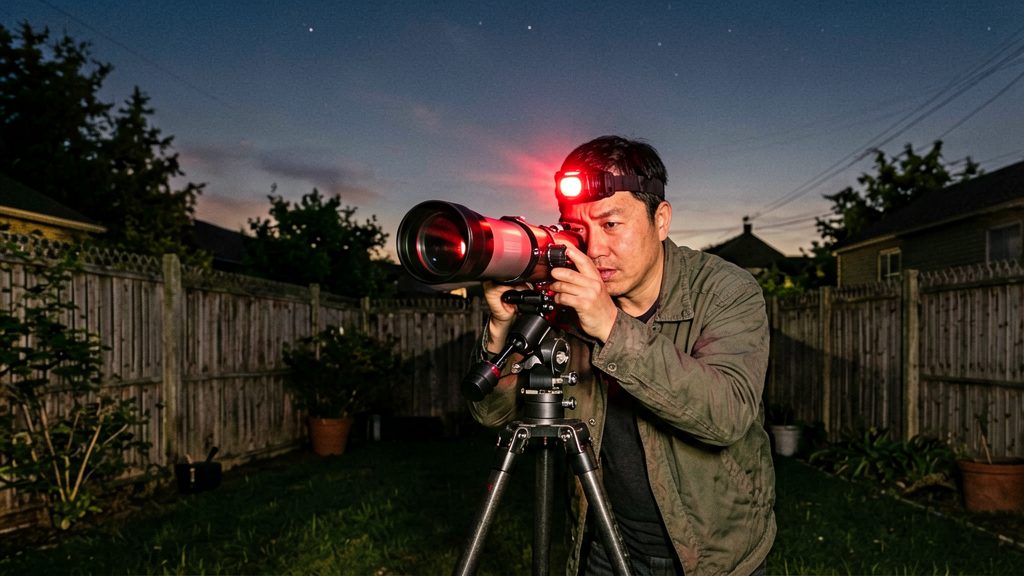
Mars is hard to see in detail because it looks small in the eyepiece and its surface markings are faint against its own pale disc. Even at opposition, when it is closest to Earth, Mars appears as a small pinkish disc in most amateur telescopes. Surface features have low contrast, so they show up only when the planet is well placed and the optics are working at a suitable magnification.
Why is Mars so hard to see in a telescope?
Mars’s apparent size is one of the two main limits, alongside low contrast. Because the planet is far smaller than the Moon or Jupiter, it never fills much of the field of view, and its surface detail is packed into a tiny disc.
How distance changes Mars’s apparent size
- Mars is best observed at opposition, which occurs roughly every two years, according to High Point Scientific, a telescope retailer (undated page).
- Away from opposition, Mars is farther away and looks smaller.
- About four months before or after opposition, Mars looks gibbous, so only part of its lit face is turned toward Earth.
Why surface detail has low contrast
Mars’s markings are only slightly darker than the orange-pink disc around them, so the eye needs to separate contrast that is subtle rather than bold. High Point Scientific reports that at about 35x Mars appears as a pale disc, faint gray markings appear at 60–70x, and at about 100x the planet looks pinkish with darker regions such as Syrtis Major becoming easier to see.
When is the best time to observe Mars?
Mars is best observed around opposition, the moment when Earth passes between the Sun and Mars and the planet sits opposite the Sun in the sky. According to High Point Scientific, opposition occurs roughly every two years, and the planet is at its brightest and largest in the telescope at that time. About four months before or after opposition, Mars looks gibbous, so its disc is only partly lit and less detail is visible. The 2020 opposition is covered in the RASC Vancouver Centre (2020) guide. For the next opposition, which should fall around early 2027, check a current ephemeris such as the RASC Observer’s Handbook, because the exact date was not confirmed here.
Once you know the opposition window, the practical question is how high Mars climbs. Observe when the planet is highest in the sky, because Astronomy magazine advises that low altitude means more atmosphere between you and Mars, which degrades the seeing. Use a planetarium app or the RASC Observer’s Handbook to find the time of culmination (the moment Mars crosses your local meridian) for your location and date.
- Opposition: the best window for apparent size and brightness.
- Culmination: the highest point of the night, where seeing is usually steadiest.
- Rise times: use the rise time only as a reference; plan the session around culmination.
What telescope size and magnification do you need?
Aperture sets how much detail a telescope can gather, and the magnification ceiling sets how far you can push power before the image degrades. According to RASC Vancouver Centre (2020), even small telescopes of 60 to 100 mm show the major features of Mars. The useful magnification range then follows from the aperture, not from the eyepieces you own.
Minimum aperture for major features
- 60 to 100 mm: the range RASC Vancouver Centre (2020) gives for seeing Mars’s major features.
- Other guides set higher minimums, some saying 4 inches or more. Check the source you use before buying, and treat the 60 to 100 mm figure as the RASC position.
The 1 to 2 times aperture rule
RASC Vancouver Centre (2020) gives a rule of thumb: on nights of good seeing, use a magnification of 1 to 2 times the aperture in millimetres. For a 100 mm scope, that is 100x to 200x. The same source notes that magnifications above 400x may not be realistic whatever the telescope size.
Inch-based ceiling of 20 to 25 times aperture
Astronomy magazine recommends working up to about 20 to 25 times the aperture in inches, which is roughly 160x for an 8-inch scope. Stop increasing power when more magnification shows no additional detail.
| Aperture | 1 to 2 times rule (mm) | 20 to 25 times inch ceiling |
|---|---|---|
| 60 mm (about 2.4 in) | 60x to 120x | about 47x to 59x |
| 100 mm (about 3.9 in) | 100x to 200x | about 79x to 98x |
| 8 in (203 mm) | about 203x to 406x (above 400x may not be realistic) | about 160x to 200x |
Which filters bring out Mars surface details?
Colour filters raise contrast on Mars by darkening or brightening different parts of the disc. Orange and red filters suit the dark surface markings and deserts, while green and blue filters suit the polar caps and atmospheric haze. Choosing a filter means deciding which of these features you want to see.
| Filter | Reported effect on Mars | Source |
|---|---|---|
| Orange, Wratten #21 and #23A | Darkens the dark surface markings and brightens the deserts | Astronomy magazine (2003) |
| Red, Wratten #25 and #29 | Darkens the dark surface markings and brightens the deserts | Astronomy magazine (2003) |
| Green or blue | Emphasizes the polar caps; brings out haze and clouds | Astronomy magazine (2003) |
| Yellow or orange | Enhances the markings | High Point Scientific (retailer) |
Orange and red for surface markings
Orange and red filters are the families to use when you want the dark markings and bright deserts to stand out against each other. Wratten #21 and #23A are the orange options, and #25 and #29 are the red options. Some guides list yellow instead of red, and the retailer High Point Scientific names yellow or orange for enhancing markings.
Green and blue for caps and haze
Green and blue filters are the choice for the polar caps and for haze and clouds. They do not change the dark markings in the same way as the orange and red families, so they are complementary rather than interchangeable with them.
Choosing a site and beating poor seeing in Canada
Seeing, the steadiness of the air between Mars and your telescope, often limits detail more than aperture does. Two factors you control decide much of it: the ground around your setup and whether the optics have reached outdoor temperature.
Ground surface
Set up on open grass or near water. Avoid concrete and asphalt, which release stored heat at night and degrade the seeing, according to Astronomy magazine.
| Ground | Recommendation |
|---|---|
| Open grass | Recommended |
| Near water | Recommended |
| Concrete | Avoid: releases stored heat at night |
| Asphalt | Avoid: releases stored heat at night |
Telescope cool-down
Let the telescope reach outdoor temperature before observing. The RASC Vancouver Centre (2020) gives cool-down times as follows:
| Telescope | Cool-down before observing |
|---|---|
| Standard scope | 30 to 60 minutes |
| Large or closed-tube scope | Longer than 30 to 60 minutes |
Judging steady air from twinkling
According to the RASC Vancouver Centre (2020), details are easier to spot when the stars are not twinkling much, so the twinkle is a useful check on conditions. Centre a bright star in the eyepiece and watch it for a few seconds. A small, calm point suggests steady air. Strong shimmer suggests that surface detail on Mars will be hard to see that night. Repeat the check later in the session, because conditions change through the night.
For site recommendations near you, contact your local RASC centre.
What Mars features can you expect to see?
At about 35x, Mars appears as a pale disc. Faint gray markings start to show at 60 to 70x, and at about 100x the named dark areas, including Syrtis Major, become easier to pick out. These magnifications come from High Point Scientific, a telescope retailer, so treat them as approximate and confirm them with your own eyepieces and conditions.
| Magnification | What you can expect to see |
|---|---|
| About 35x | A pale disc |
| 60 to 70x | Faint gray markings |
| Below 100x | Polar caps can be spotted |
| About 100x | A pinkish tint, with Syrtis Major and Mare Tyrrhenum easier to see |
Faint gray markings at 60 to 70x
The gray markings are the first surface detail to appear as you raise the power. They are faint, so they are easiest to spot when the image is steady. If the image shakes, step back to a lower power until it settles.
Named dark features: Syrtis Major and Mare Tyrrhenum
Syrtis Major and Mare Tyrrhenum are the named dark features that High Point Scientific says become easier to see at about 100x. Use them as reference points: once you can find one on the disc, you can check that your focus and eyepiece are doing their job.
Binoculars do not show surface detail
Binoculars are not powerful enough to show Mars’s surface detail, according to High Point Scientific. Use a telescope if you want to see the markings described above.
How can you track Mars through a night?
Mars completes one rotation in 24 h 39 min 35 s, according to the RASC Vancouver Centre (2020). Because the planet turns slightly more slowly than a 24-hour day, the same surface features rise, cross the central meridian and set roughly 40 minutes later each night. Tracking Mars therefore means checking the same feature at several times on one night, then again on successive nights, to separate real surface detail from passing atmospheric effects.
Logging features during one night
Rotation shifts the view within a single session. A feature visible near the eastern limb at the start of the session moves toward the centre of the disc as the planet rotates. Note the time and the feature’s position relative to the disc edge or a nearby landmark, then repeat the note every 30 to 60 minutes while seeing remains steady.
- Sketch the disc at each interval, marking the terminator and any dark or bright areas.
- Record the time in local clock time and the eyepiece and filter used.
- Compare the sketches afterwards to see which markings moved and which stayed fixed.
Comparing features across successive nights
Repeat the same timed observation on consecutive nights. Because the rotation period is longer than 24 hours, the same surface marking reaches the same position about 40 minutes later each evening. Observing at the same clock time on several nights therefore presents the disc at a different rotational phase each time, which is how you confirm that a feature is on the planet’s surface.